
I Tested 10 AI Detectors So You Don't Have To
Here's Which Ones Actually Work in 2026

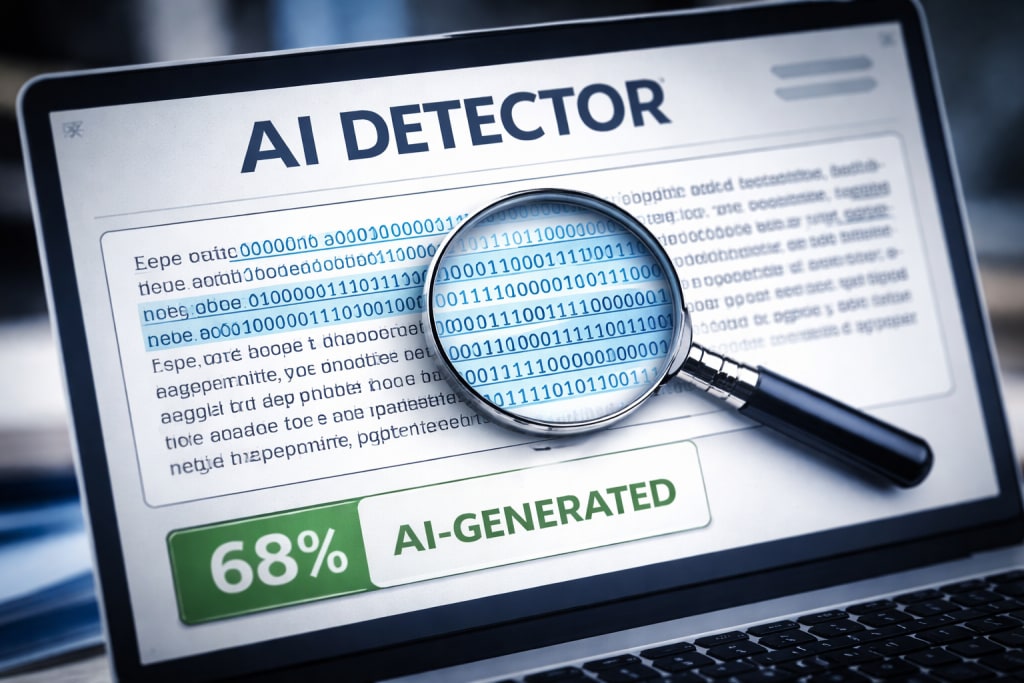
Made with the help of Claude AI
AI Detector Low Down
Let's be honest. The AI content war is real, and it's getting messy.
Whether you're a student trying to prove your essay is actually yours, a content manager trying to figure out if your freelancers are quietly outsourcing to ChatGPT, a teacher drowning in suspiciously perfect papers, or a publisher trying to protect the integrity of your platform — the question is the same: can AI detectors actually tell the difference between human writing and machine-generated text?
The short answer is: sometimes. The longer answer is a lot more interesting.
AI detectors have exploded in popularity over the past two years, and in 2026 there are dozens of tools claiming to be the most accurate, most reliable, most trusted solution on the market. But independent research, university studies, and real-world testing keep revealing the same uncomfortable truth — these tools are powerful, but far from perfect.
In this article, I'm breaking down ten of the most widely used AI detectors available right now. I'll cover what each one does, who it's built for, what makes it stand out, and where it falls flat. By the end, you'll have a clear picture of which tool might actually serve your needs — and which ones you might want to take with a very large grain of salt.
How AI Detectors Actually Work
Before we get into the individual tools, it's worth spending a moment on the science — or lack thereof — behind AI detection, because understanding the mechanics will help you interpret the results you get from any of these platforms.
AI detectors generally work by analyzing text for patterns that are statistically associated with large language models like ChatGPT, GPT-4, Gemini, Claude, and others. The two most common signals they look for are perplexity and burstiness.
Perplexity refers to how predictable the word choices in a piece of text are. When an AI writes, it tends to select the most statistically likely next word at each step. This makes the text smooth, coherent, and very readable — but also measurably predictable. Human writers, by contrast, make unexpected word choices, use creative phrasing, go off on tangents, and occasionally break grammatical rules in ways that feel natural. That unpredictability registers as high perplexity, and detectors use it as a signal that a human was probably involved.
Burstiness refers to variation in sentence structure and length. Humans tend to write in bursts — a long, complex sentence followed by a short one. Then another long one. Then a fragment. AI writing tends to be more rhythmically consistent, with sentences of similar length and structure flowing from one to the next in a polished, almost metronomic way. Detectors measure this variation to flag content that feels too uniform.
Beyond those two signals, most modern detectors also use trained machine learning classifiers — models that have been fed enormous amounts of both human and AI-generated text and learned to distinguish between them. Some tools also look for stylometric fingerprints, examining vocabulary richness, the frequency of specific filler phrases commonly used by models like GPT-4, and the overall "linguistic fingerprint" of the writing.
Some AI developers have even begun embedding invisible watermarks into AI-generated output, which future detectors will be able to identify. But for now, most detection relies on the probabilistic signals described above.
The problem — and it's a significant one — is that none of these signals are definitive. A highly educated human writer with a formal, consistent style might produce text that looks extremely AI-like to a detector. A student whose first language isn't English might get flagged constantly. And a person who uses AI to generate a draft and then rewrites it heavily might end up with text that passes as fully human. The false positive rate across most tested tools is non-trivial, and several university studies have concluded that current AI detectors are neither fully accurate nor reliably consistent.
With that context in mind, let's look at the tools.
GPTZero
Website: gptzero.me
GPTZero is arguably the most well-known dedicated AI detector on the market, and for good reason. It was one of the first tools built specifically to detect AI-generated text, and it has continued to evolve significantly since its initial launch. The platform was created by a Princeton student, and it gained enormous traction very quickly among educators who were trying to figure out whether their students were submitting AI-generated work.
What sets GPTZero apart is the depth of its analysis. Rather than just giving you a single overall score, it breaks down your text sentence by sentence, highlighting which specific sentences it believes are most likely AI-generated. This granular feedback is incredibly useful for understanding exactly where in a piece of writing the AI signals are concentrated.
GPTZero has also been independently evaluated by the University of Chicago, which found it to be the most consistent of the AI detectors examined in their comparative study. According to their analysis, GPTZero detected all AI-generated text save that from Microsoft Copilot with 100 percent accuracy — a notably strong result compared to competing tools.
It offers a free tier that allows you to paste in text and get an instant overall AI score, making it accessible for casual users. Premium plans unlock API access, document uploads, batch scanning, and deeper analytics that are useful for institutions and businesses processing large volumes of content.
The main caveat: like all detectors, GPTZero is not infallible. It can and does produce false positives, and text that has been significantly edited or humanized after AI generation may not be flagged.
QuillBot AI Content Detector
Website: quillbot.com/ai-content-detector
QuillBot built its reputation as a paraphrasing and grammar tool, but in recent years it has expanded its suite to include a capable AI detector. The QuillBot AI Content Detector is free to use and can analyze text for signals from ChatGPT, GPT-5, Gemini, Claude, and other major AI platforms.
The interface is clean and intuitive. You paste your text, hit analyze, and within seconds you get a percentage score indicating how much of your content appears to be AI-generated. The tool has earned strong user ratings — sitting at 4.8 out of 5 stars across nearly 10,000 reviews — which suggests it delivers a consistently useful experience for everyday users.
What makes QuillBot's detector particularly interesting is the ecosystem it sits within. If you're a writer who uses QuillBot for paraphrasing and grammar assistance and then wants to check whether your revised work still reads as human, you can do all of that within the same platform. The integration feels natural.
The detector is marketed primarily toward students, writers, and content professionals who want a quick, reliable check without needing to invest in a premium tool. For light to moderate use cases, it performs well. For institutional or enterprise applications, you may want something with more configurability.
Pangram Labs
Website: pangram.com
Pangram Labs takes a more forensic approach to AI detection, positioning itself as a research-grade tool designed for publishers, platforms, and content integrity professionals rather than individual end users. It consistently ranks at the top of independent round-up reviews, including Pangram's own published analysis of the 30 best AI detectors in 2026.
What distinguishes Pangram is the rigor of its underlying methodology and the specificity of its output. Rather than delivering a binary human-or-AI verdict, Pangram provides nuanced confidence scores and can flag content that blends human and AI writing in ways that simpler tools miss.
The tool has been designed with scale in mind, making it well-suited for media companies, academic institutions, and content platforms that need to process high volumes of submissions. If you're running a publication and want a systematic way to flag potentially AI-generated submissions before they reach your editorial team, Pangram is worth serious consideration.
It's worth noting that Pangram also publishes detailed research on the state of AI detection, which gives it added credibility in the space. The team is transparent about the limitations of detection technology, which is a good sign that they're approaching the problem with intellectual honesty rather than just marketing.
Grammarly AI Detector
Website: grammarly.com/ai-detector
Grammarly needs no introduction. With over 30 million daily users and a reputation built on decades of writing assistance, Grammarly's entry into the AI detection space carries significant weight. Their AI Detector is free to use and has earned the distinction of being ranked the number one free AI checker for ChatGPT by multiple independent evaluations.
The interface is exactly what you'd expect from Grammarly — polished, friendly, and easy to use. You paste your text, and the tool gives you a clear score showing how much of your work appears to have been written with AI. The output is presented in accessible language, avoiding the technical jargon that makes some competitor tools feel intimidating to non-technical users.
What Grammarly emphasizes is responsible AI use rather than adversarial detection. The framing is that their tool helps writers navigate the increasingly complex landscape of AI-assisted writing, rather than positioning itself as a gotcha tool. This philosophical stance is worth noting if you're using it in a professional or educational context.
With a user rating of 4.6 out of 5 across more than 176,000 reviews, Grammarly's AI Detector has proven its reliability at scale. The massive user base also means the tool has been tested against an extraordinarily diverse range of writing styles, topics, and languages, which likely contributes to its robustness.
The limitation here is the same as everywhere else: no AI detector is 100 percent accurate, and Grammarly's own documentation is transparent about this. The tool estimates the likelihood of AI involvement rather than making definitive determinations.
The University of Chicago Comparative Analysis
Website: academictech.uchicago.edu
This entry is a little different. Rather than a commercial product, the University of Chicago's Academic Technology team published a comprehensive comparative guide to AI and plagiarism detection software that has become an essential reference for educators and institutions evaluating these tools.
Their analysis examined multiple AI detectors across a range of AI-generated texts from different platforms, measuring both accuracy and consistency. The findings were illuminating and, for some tools, fairly damning. They found significant variation in performance across platforms, with GPTZero emerging as the most consistent overall.
The study also highlighted a crucial issue that commercial marketing tends to downplay: the false positive problem. Many tested detectors flagged human-written text as AI-generated at rates that would be deeply problematic in real-world academic or professional contexts. Falsely accusing a student of academic dishonesty based on an unreliable tool is not a minor error — it can have serious consequences for that student's academic career.
The University of Chicago's work serves as an important reminder that AI detection should be treated as one signal among many in an investigative process, not as a definitive verdict. If you're in an educational setting, this resource is required reading before implementing any AI detection policy.
Scribbr AI Detector
Website: scribbr.com/ai-detector
Scribbr is well-known in academic circles as a provider of plagiarism checking, citation tools, and essay editing services. Their AI Detector is a natural extension of their existing mission to support academic integrity.
The Scribbr AI Detector accurately detects texts generated by the most popular tools, including ChatGPT, Gemini, and Microsoft Copilot. Like other tools in this space, it provides an overall score along with more granular feedback about specific passages that triggered AI signals.
What Scribbr does particularly well is contextualizing its results within an academic framework. The platform understands that its primary users are students and educators, and it presents its output accordingly — with clear explanations of what the scores mean and appropriate caveats about the limitations of AI detection technology.
Scribbr is also trusted for its transparency. Unlike some competitors who make sweeping claims about accuracy without publishing supporting data, Scribbr is upfront about the fact that their detector is a tool to support decision-making, not replace it. For academic institutions looking to add AI detection to their existing plagiarism workflows, Scribbr integrates naturally with the broader suite of academic integrity tools.
ZeroGPT
Website: zerogpt.com
ZeroGPT is one of the most widely used free AI detectors on the market, and its popularity stems largely from its accessibility and multi-stage analytical approach. The platform bills itself as a trusted AI checker for ChatGPT, GPT-5, and Gemini, and it delivers analysis instantly for anyone who pastes in text.
What ZeroGPT emphasizes in its methodology is a multi-component detection model that analyzes text from several angles simultaneously rather than relying on a single signal. The goal is to minimize both false positives and false negatives by triangulating across multiple detection methods, including perplexity analysis, stylometric profiling, and trained classification models.
For free users, ZeroGPT is generous with its allowances, making it a popular choice for students, bloggers, and casual users who want a quick check without any financial commitment. The results are presented clearly, with an overall AI probability score and some indication of which portions of the text triggered the most concern.
The trade-off for the free model is that the tool offers less granularity and configurability than premium alternatives. For enterprise or institutional use, ZeroGPT's premium tiers offer API access and batch processing. But for the average person who just wants to know whether a piece of text is likely AI-generated, ZeroGPT delivers a fast, free, and reasonably reliable answer.
YouScan AI Detector
Website: youscan.io/ai-detector
YouScan is primarily known as a social media monitoring and analytics platform, which makes its AI Detector something of an unexpected offering. But given that social media is increasingly flooded with AI-generated content — from fake product reviews to AI-written posts and comments — the need for detection in that space is real and growing.
YouScan's free AI Detector promises instant, accurate analysis of AI-written content, and it's designed to be quick and accessible. You paste in your text, and the tool returns its analysis rapidly, with a clear indication of whether the content appears to have been generated by AI.
What makes YouScan interesting is its origin in social listening and brand intelligence. The team understands AI-generated content not just as an academic integrity problem but as a brand safety and authenticity problem. Fake reviews, AI-generated comments, and synthetic social media content are real threats to businesses that depend on genuine customer engagement, and YouScan's detector is positioned to help identify that kind of manipulation.
For individual users, YouScan's detector works as a straightforward free tool. For businesses concerned about the authenticity of content related to their brand online, YouScan's integration with its broader social media monitoring platform could make it a particularly compelling option.
Community Perspectives From Reddit
Community: reddit.com/r/humanizeAIwriting
This entry is also a little different — rather than a single commercial tool, it's worth acknowledging the enormous amount of real-world, unfiltered experience being shared in communities like Reddit's r/humanizeAIwriting, r/Professors, and related forums.
Professors have been particularly vocal on these platforms about their experiences with AI detection tools, and the consensus is nuanced. Many educators who have spent significant time with these tools have concluded that no single detector should be used as the sole basis for an academic integrity decision. The false positive rates are too high, and the technology changes too rapidly for any institution to bet its policies on it.
What's interesting is how quickly the community has identified the arms race dynamic at the heart of AI detection. As detection tools improve, humanization tools that make AI-generated text less detectable also improve. Some tools mentioned in these communities, like walterwrites.ai, aim to blend detection and humanization in a single workflow — a signal of how sophisticated the cat-and-mouse game has become.
The Reddit threads are genuinely valuable reading for anyone implementing AI detection policy, because they surface edge cases, failure modes, and real-world experiences that vendor marketing materials don't mention. A student with a formal, precise writing style who uses technical vocabulary may routinely get flagged by AI detectors. A non-native English speaker who writes in careful, structured sentences may face the same problem. These communities are where those experiences get documented.
Copyleaks AI Detector
Website: copyleaks.com/ai-content-detector
Copyleaks occupies a unique position in this landscape because it started as a plagiarism detection company and has built genuine institutional credibility over years of serving universities, publishers, and enterprises. Its AI Detector is a natural extension of that existing infrastructure and comes backed by independent third-party research claiming 99 percent accuracy.
That accuracy claim is significant, and it's backed by published studies rather than just marketing copy. Copyleaks has invested heavily in validation research, which distinguishes it from competitors whose accuracy claims are harder to independently verify.
The platform supports detection for ChatGPT, GPT-5, Gemini, and other major AI models, and it offers both free individual access and enterprise solutions for organizations that need to process large volumes of content. The enterprise suite includes API integration, LMS plugins for educational institutions, and detailed reporting capabilities.
For writers and individual users, Copyleaks offers a free tier that provides meaningful utility without requiring a commitment. For institutions — particularly universities that already use Copyleaks for plagiarism detection — adding AI detection through the same platform is a natural workflow extension that doesn't require introducing a new vendor relationship.
The user rating of 4.4 out of 5 across nearly 100 reviews is modest compared to some competitors in terms of review volume, but the institutional backing and independent accuracy research give Copyleaks credibility that raw review counts don't fully capture.
The Bigger Picture: What Should You Actually Do With These Tools?
After surveying all ten of these tools, a few conclusions emerge clearly.
First, no single AI detector should be treated as infallible. The University of Chicago's research, along with findings from the University of San Diego and numerous other institutions, consistently shows that AI detectors produce false positives and false negatives at rates that make them unreliable as standalone verdicts. If you're making a consequential decision — academic, professional, or legal — based solely on an AI detector's output, you're building on shaky ground.
Second, the choice of tool should be driven by your specific use case. GPTZero and Scribbr are strong choices for academic contexts. Grammarly works well for writers who want a quick, accessible check integrated into their existing workflow. Copyleaks is well-suited for institutional users who need accuracy backed by independent research. Pangram is worth exploring for publishers and platforms. YouScan makes most sense in a social media or brand monitoring context.
Third, context matters enormously in interpreting results. A piece of text flagged as 70 percent AI-generated by one tool might get a 30 percent score from another. The tools disagree with each other constantly, which itself tells you something important about the current state of the technology.
Fourth, these tools are getting better. Watermarking technology, multimodal detection, and increasingly sophisticated classifiers trained on newer AI models are all pushing the field forward. What's true about the accuracy of these tools today may not be true six months from now.
Fifth, humanization tools are keeping pace. For every advance in detection, there are corresponding advances in making AI-generated text harder to detect. This is the arms race at the heart of the industry, and it's not going to resolve cleanly in favor of either side anytime soon.
The most reasonable approach is to use AI detectors as one signal in a broader evaluation process — not as the final word. For educators, that means combining detector results with knowledge of a student's prior work, conversation about the submission, and common sense assessment of whether the writing is consistent with that student's demonstrated abilities. For publishers, it means using detection as a screening tool that flags content for human review, not as an automated rejection mechanism. For businesses, it means building AI content policies that are clear, fair, and not entirely dependent on technology that has well-documented limitations.
The AI content question isn't going away. If anything, it's going to become more complex and more consequential as AI-generated text becomes more sophisticated and more prevalent. These ten tools represent the current state of the art in our collective attempt to navigate that complexity — imperfect, evolving, and worth understanding clearly.
The best thing you can do is go in with realistic expectations, test multiple tools on your specific type of content, and never treat a percentage score as a substitute for human judgment.
About the Creator
Sandy Rowley
AI SEO Expert Sandy Rowley helps businesses grow with cutting-edge search strategies, AI-driven content, technical SEO, and conversion-focused web design. 25+ years experience delivering high-ranking, revenue-generating digital solutions.
Keep reading
More stories from Sandy Rowley and writers in 01 and other communities.
What is AI?
Created with the help of ChatGPT and Grok AI. What Is AI? A Clear, No-Nonsense Guide to Artificial Intelligence Artificial intelligence is everywhere right now—powering search engines, writing content, recommending what you watch, and even helping doctors diagnose disease. Yet despite how often we hear about it, most people still aren’t entirely sure what AI actually is.
By Sandy Rowley5 days ago in 01
A Simple Guide to Cryptocurrency and Market Trends
Cryptocurrency has rapidly transformed from a niche digital concept into a global financial movement. Over the years, it has attracted attention from investors, developers, and businesses looking to explore new opportunities in decentralized finance. As the ecosystem continues to expand, understanding the basics of cryptocurrency becomes increasingly important.
By Nimra kanwal5 days ago in 01




Comments (2)
I really didn't want to have to
More on AI Detectors here: https://exclusiveofferhub.life/01/ai-detectors%3C/span%3E%3C/span%3E%3C/span%3E%3C/a%3E%3C/p%3E%3C/div%3E%3C/div%3E%3C/div%3E%3Cdiv class="css-w4qknv-Replies">