
Real People Who Won Big After Using ChatGPT and AI
Documented Cases That Will Surprise You

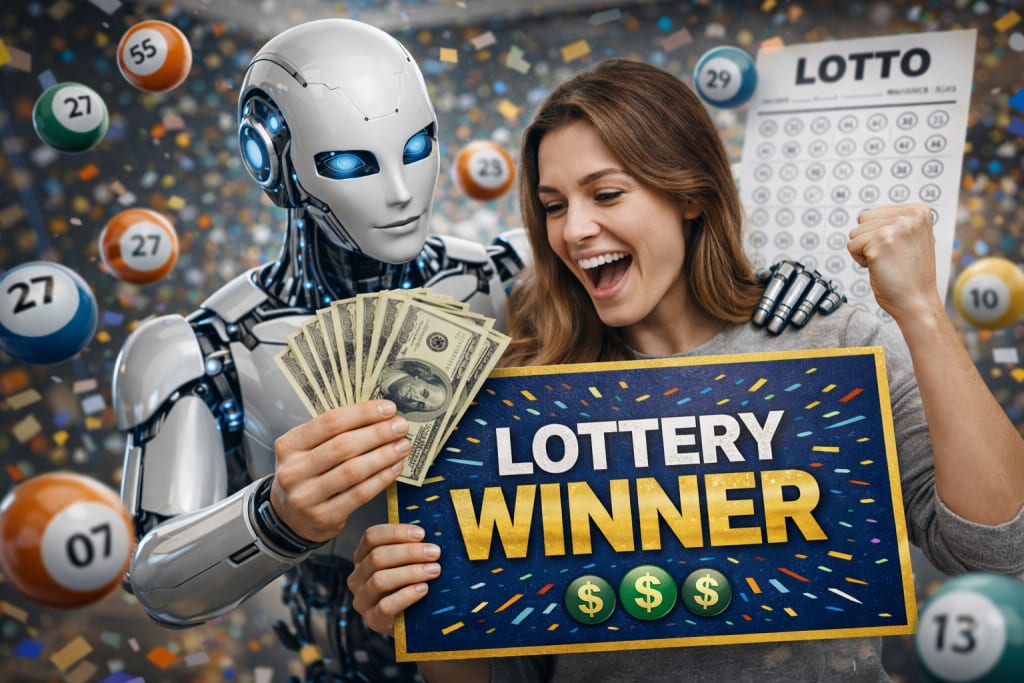
Lottery jackpots. Pitch competitions. Nobel Prizes. Here are the real documented winners who credited artificial intelligence with helping them win — and what their stories actually tell us.
Can AI help you win?
It is one of the most searched questions of 2025 and 2026. And while the mathematical answer to "can AI predict lottery numbers" is a firm no — random systems are unpredictable by definition — the documented reality of people who have won significant prizes after using AI is far more interesting than a simple yes or no.
Here are the real, verified cases of people who won — and credited AI or ChatGPT with playing a role.
The Lottery Winners Who Used ChatGPT
Carrie Edwards — $150,000 Powerball Win, Virginia, September 2025
The most widely reported AI lottery story of 2025 belongs to Carrie Edwards, a retiree from Virginia who won $150,000 in the September 8 Powerball drawing using numbers she asked ChatGPT to suggest.
Edwards had never played online before. When she decided to try, she was not sure how to pick her numbers. Her solution was direct.
"So I'm like hey chat — ChatGPT, talk to me, talk to me about this $1.7 billion and do you have numbers for me," she said at her prize press conference.
ChatGPT's initial response was telling. The AI replied: "Carrie, you know it's all about luck, right?" — accurately representing its own inability to predict random outcomes. Despite that disclaimer, it did suggest a set of numbers when pressed. Edwards played them. Two days later, sitting in a meeting, she received a notification she assumed was a scam. It was not.
Edwards matched four of five Powerball numbers plus the Powerball, winning $50,000. She had paid an extra dollar for the Power Play option, which tripled her prize to $150,000.
In a remarkable coda to the story, she immediately donated the entire amount to three causes: the Association for Frontotemporal Degeneration, which claimed her firefighter husband's life; Shalom Farms, fighting food insecurity; and the Navy-Marine Corps Relief Society.
Tammy Carvey — $100,000 Powerball Win, Michigan, September 2025
Just days after Edwards' win, Tammy Carvey of Wyandotte, Michigan had a nearly identical experience. When the Powerball jackpot climbed above $1 billion, Carvey decided to play.
"I only play Powerball when the jackpot gets up there," she said. "I asked ChatGPT for a set of Powerball numbers and those are the numbers I played on my ticket."
Carvey matched four white balls and the Powerball in the September 6 drawing, winning $50,000. She had added the Power Play option, doubling her prize to $100,000.
"My husband and I were in total disbelief," she said after claiming her prize. She planned to use the winnings to pay off her home.
A Man in Singapore — $38 TOTO Prize, May 2023
One of the earliest documented cases of ChatGPT being credited with lottery success comes from Singapore, where a man named Tan posted a TikTok video in May 2023 showing that he had asked ChatGPT for seven numbers for the TOTO lottery — a draw with a grand prize of 2.4 million Singaporean dollars.
ChatGPT provided the numbers. Tan played them and matched three of the seven, winning approximately $38 SGD.
The prize was small. But the story went viral because it was among the first documented cases of someone actually winning anything using AI-generated lottery numbers — and because Tan's TikTok caption, "Thanks ChatGPT," captured the absurd novelty of the moment perfectly.
A Man in Thailand — $59 Win, April 2023
Around the same time as the Singapore story, a man in Thailand reportedly won approximately $59 using lottery numbers suggested by ChatGPT, in what appears to be the earliest widely documented case of an AI-assisted lottery win.
What These Lottery Stories Actually Mean
Before moving on to other categories of AI-assisted wins, it is important to be direct about what these lottery stories do and do not tell us.
They do not tell us that AI can predict lottery numbers. The mathematics of independent random events is not overturned by individual outcomes. The odds of winning Powerball are approximately 1 in 292 million for the jackpot. The odds of matching four balls plus the Powerball — what both Edwards and Carvey achieved — are approximately 1 in 913,000.
Every week, tickets with those combinations are purchased. Some of them win. The winning tickets with numbers from ChatGPT and the winning tickets with numbers from birthdays, fortune cookies, and quick picks are statistically identical in their odds.
What these stories tell us is something more interesting: people are using AI as a random number generator — essentially a more entertaining version of quick pick — and some of those random numbers, predictably, occasionally win. The AI is not predicting. It is generating. The wins are what statistics says will happen to some percentage of random number combinations.
What is genuinely notable is what Carrie Edwards did with her winnings. And the fact that ChatGPT told her upfront that it was all about luck — which is the accurate answer.
Beyond the Lottery: AI Helping People Win in Other Domains
The lottery wins get the headlines. But the more substantive documented cases of AI helping people win involve domains where AI's actual capabilities — analysis, research, writing, structuring, pattern recognition — provide genuine rather than coincidental advantage.
The Entrepreneur Who Won a $35,000 Pitch Competition
In 2024, a founder and entrepreneur documented how he used ChatGPT to win a $35,000 pitch competition for his spirits company 1867 Reserve in the Pronghorn Innovation Challenge.
Facing an application deadline with limited time, he turned to ChatGPT to help complete the application. He trained the AI on everything about his company, then fed it the application questions. The full application was complete in under 60 minutes.
"ChatGPT is incredibly powerful, and can help us transform those fictional dreams in our heads into tangible realities," he wrote afterward. "What AI can't do is get in front of real people, speak from the heart, and capture an audience's imagination — only we can do that."
He advanced to the finals and pitched on stage in Miami. He won the $35,000 prize. He credited ChatGPT as a collaborator in the research, structuring, and application — and human storytelling and presence as the factors that actually closed the win.
This is a critical distinction. AI helped him compete. He won.
The Nobel Prize Winners in AI-Adjacent Fields
In October 2024, the Nobel Prize committee made history by awarding two Nobel Prizes directly connected to artificial intelligence — a first for the institution and a landmark moment in recognizing AI's scientific impact.
Geoffrey Hinton and John Hopfield were awarded the Nobel Prize in Physics for their foundational work on neural networks and deep learning — the technology that underlies ChatGPT, Claude, Gemini, and virtually every modern AI system. Hinton, widely known as the godfather of AI, won despite having previously left Google citing concerns about AI safety risks.
Simultaneously, Demis Hassabis and John Jumper of Google DeepMind were awarded the Nobel Prize in Chemistry for AlphaFold — an AI system that solved the decades-long scientific challenge of predicting protein structures with remarkable accuracy. This breakthrough, achieved through AI, has accelerated drug development, disease research, and molecular biology in ways that scientists estimate would have taken decades of traditional research to accomplish.
These are not cases of AI helping someone win a prize. They are cases of AI being the reason prizes exist to be given — prizes recognizing the most transformative scientific work in their respective fields.
The World's Best Programmer Who Beat ChatGPT — Then Credited AI with Pushing Him
In a counterintuitive entry on this list, Przemysław Dębiak, a 42-year-old Polish programmer, won the AtCoder World Tour Finals 2025 — the most prestigious programming competition in the world — beating a specially prepared algorithm by OpenAI that came in second place.
The ten-hour competition required solving complex optimization problems at the highest level of difficulty. Dębiak, a former OpenAI employee and multiple international programming champion, won with a final advantage of 9.5% over the AI competitor.
His story belongs on this list because of what it represents about the AI era: the humans who work closest to AI — who understand it, train alongside it, and compete against it — are the ones pushing their own abilities to new heights. Dębiak did not use AI to win. He beat AI. But he did so in a competition that would not exist without AI, and his edge was built through years of working at the frontier of the technology.
"Humanity has prevailed — for now," he said after winning.
What All of These Stories Have in Common
Looking at this list — lottery winners, pitch competition winners, Nobel laureates, world-class programmers — a coherent picture emerges about what AI actually does for the people it helps.
In random systems like the lottery, AI provides nothing beyond what a random number generator provides. The wins are real. The AI's role is coincidental. The stories are fascinating precisely because they highlight the difference between AI's genuine capabilities and what people imagine those capabilities to be.
In competitive domains involving research, writing, analysis, and preparation, AI provides genuine leverage. The entrepreneur who won $35,000 used ChatGPT to do in 60 minutes what would have taken days — freeing him to focus on the human elements of his pitch that AI cannot replicate.
In scientific and technical fields, AI is producing wins that were previously impossible — not assisting human winners but creating entirely new categories of human achievement.
And in direct competition with AI itself, the humans who win are the ones who have engaged with the technology most deeply — not avoided it.
The question is not whether AI can help you win. In the right context, with the right application, the documented evidence suggests it can. The more useful question is: what kind of winning do you have in mind — and is AI actually the right tool for that particular game?
For lottery numbers: AI is as good as a coin flip. Which is exactly as good as anything else.
For research, writing, preparation, and competitive applications: the evidence suggests it is considerably better than going it alone.
Sources:
Newsweek. Virginia Woman Wins Lottery with ChatGPT Numbers, Then Gave It All Away. September 2025.
CBS Detroit. Michigan Woman Wins $100,000 Powerball Prize Using ChatGPT Numbers. October 2025.
Entrepreneur. She Let ChatGPT Pick Her Lottery Numbers. She Won. September 2025.
Technical.ly. AI Helped This Founder Win $35K. 2024.
Euronews. Meet the World's Best Programmer Who Beat ChatGPT. July 2025.
Nobel Prize Committee. 2024 Nobel Prize in Physics and Chemistry announcements.
Yahoo News / NextShark. Singapore Man Wins Lottery Using ChatGPT. May 2023.
About the Creator
Sandy Rowley
AI SEO Expert Sandy Rowley helps businesses grow with cutting-edge search strategies, AI-driven content, technical SEO, and conversion-focused web design. 25+ years experience delivering high-ranking, revenue-generating digital solutions.
Keep reading
More stories from Sandy Rowley and writers in 01 and other communities.
Can AI Predict Lottery Numbers?
Can AI Predict Lottery Numbers? The Honest Answer Might Surprise You Millions of people are asking AI systems to pick their winning numbers. Here is what artificial intelligence actually says about its own ability to predict the lottery — and the mathematics behind why no system ever can.
By Sandy Rowleyabout 11 hours ago in 01
AI-First Platform Development: How Businesses Are Rebuilding Software From the Ground Up
Most software built in the last decade was designed for humans to operate. AI was added later, often as a layer on top of existing systems. That approach is reaching its limits. A growing number of companies are now moving toward AI-first software and platform development — where artificial intelligence is built into the architecture from the start, not retrofitted afterward.
By ViitorCloud Technologies7 days ago in 01
Rolling Kitchens Go Digital: The Rise of Food Truck App Development
The food truck industry has witnessed remarkable growth over the past decade. What once started as a small-scale street food concept has evolved into a dynamic and competitive business model. Food trucks are no longer limited to fixed locations or word-of-mouth marketing—they are embracing digital transformation to reach a wider audience. At the heart of this evolution lies food truck app development, which is helping businesses connect with customers, streamline operations, and create engaging dining experiences.
By Nayel Basim Al Shehhi5 days ago in 01
Comments
There are no comments for this story
Be the first to respond and start the conversation.