
The Cigarette Pack Has Always Been More Than Just a Box
From 10-count tins to the modern 20-cigarette flip-top, the story of how cigarettes are packaged reveals more about culture, regulation, and branding than you might expect.

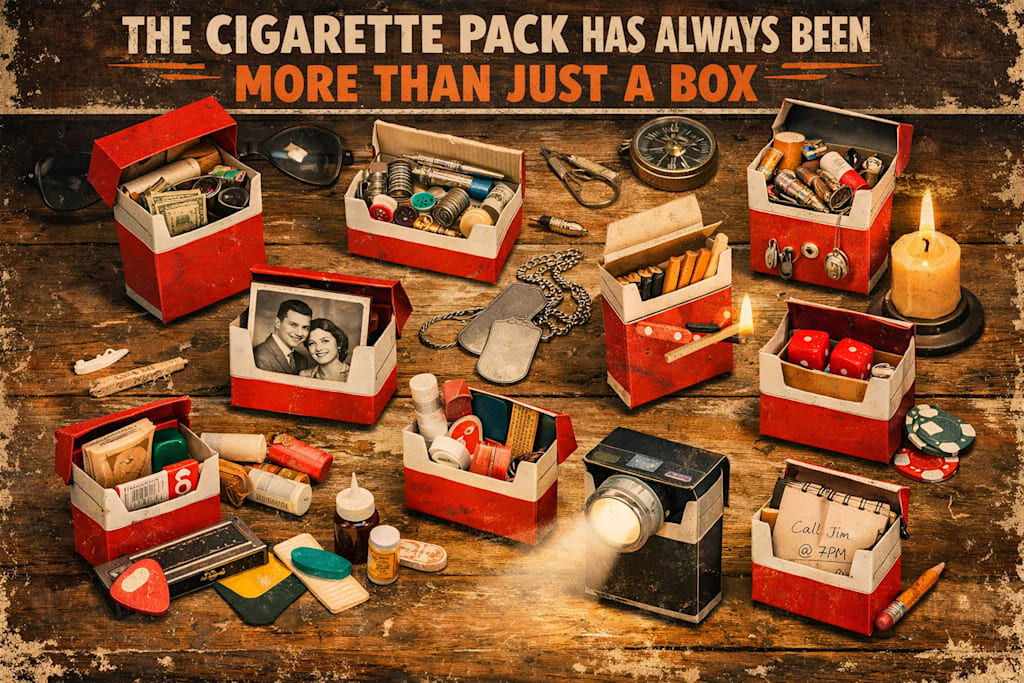
From 10-count tins to the modern 20-cigarette flip-top, the story of how cigarettes are packaged reveals more about culture, regulation, and branding than most people ever stop to consider.
Walk into any gas station in America and you already know what you are getting: a rectangular cardboard box, roughly 3.5 inches tall, containing 20 cigarettes. The experience is so consistent, so rehearsed, that most people never pause to wonder why a cigarette pack holds exactly 20. Not 15. Not 25. Not 30. Twenty.
The answer to that question turns out to be more interesting than the question itself and it touches on manufacturing history, wartime supply chains, federal tax policy, and the psychology of consumer habit. The cigarette pack, in other words, has never been a neutral container. It has always been a product in its own right.
"The pack is the first thing you sell. The cigarette is what keeps them coming back."
How Did 20 Cigarettes Become the Standard?
It was not always 20. Early 20th-century cigarette packaging was wildly inconsistent tobacco companies sold cigarettes in tins and sliding cardboard boxes holding anywhere from 10 to 20, with 10-count and 12-count packs common for certain premium and import brands. The 20-cigarette count as an industry default only solidified in the United States in the years following World War II.
Two forces drove the standardization. The first was mechanized production. Automated cigarette-packing machinery developed in the 1940s and 1950s was optimized around a 20-count configuration — it was the size that balanced tray dimensions, feed speeds, and wrapping efficiency most cleanly. Switching to a different count meant retooling the entire line.
The second force was federal excise tax structure. The U.S. tobacco excise tax is calculated per 1,000 cigarettes, and the 20-count pack divides into that tax unit cleanly 50 packs per thousand. That mathematical neatness made accounting, stamping, and distribution significantly simpler for manufacturers and the government alike. Once the tax structure was built around 20-count packs, deviating from it created a compliance headache that nobody wanted.
The 20-count standard is not universal. Canada and Australia regularly sell 25-count packs alongside 20-count versions. Japan has historically sold 10-count premium packs. The U.S. standard is a product of its specific regulatory and manufacturing history not a global norm.
The Flip-Top Box: An Accidental Icon
If the 20-cigarette count is one of the most overlooked details in consumer product history, the flip-top hard-pack box might be the most overlooked design icon of the 20th century.
Before the 1950s, most cigarettes in the United States were sold in soft packs simple rectangular cardboard sleeves with a foil interior. They were cheap to produce and perfectly functional, but they had a flaw: the top tore off, and once it was gone, there was nothing protecting the cigarettes from being crushed in a pocket or bag.
Philip Morris changed everything in 1955 when it introduced the Marlboro hard flip-top box a rigid cardboard case with a hinged lid that snapped shut. The design was intended to solve the protection problem, but it had an unintended consequence: the audible click of the lid opening and closing became a sensory signature of the product. The weight of the box in the hand, the resistance of the lid these tactile details reinforced perceived quality in a way that a soft pack simply could not.
By the 1980s, the hard flip-top pack had displaced the soft pack as the dominant cigarette format in the United States. The soft pack still exists — it is slightly cheaper to produce and still preferred by some smokers — but the flip-top is what most Americans picture when they think of a cigarette pack.
The audible click of a flip-top lid became as much a part of the brand experience as the cigarette itself.
From Pack to Carton: The Arithmetic of the Habit
Beyond the individual pack sits the carton 10 packs, 200 cigarettes, wrapped in cellophane with a single tax stamp. The carton is one of those retail formats that perfectly reflects the math of a sustained consumer habit: if you smoke a pack a day, a carton lasts exactly 10 days.
Cartons have always carried a price advantage typically 10 to 15 percent cheaper per cigarette than buying individual packs. For regular smokers, it is one of the more obvious optimization opportunities available to them. And for the tobacco companies, carton sales represent guaranteed committed volume: a customer who buys a carton is less likely to switch brands mid-carton than one who buys a single pack at a time.
The full breakdown of pack types, carton sizes, and exactly how the cigarette count varies across different formats is worth understanding if you are either a regular smoker managing your budget or a business owner navigating the tobacco supply chain. There is a detailed breakdown of cigarette pack sizes in the U.S. that covers everything from standard 20-count packs to bulk wholesale quantities, international variations, and what to know about food-safe packaging compliance — worth reading if you want the complete picture.
Why Cigarette Packaging Still Matters in 2026
In an era when tobacco advertising is prohibited in most U.S. media channels, cigarette packaging has become one of the last remaining brand communication surfaces available to tobacco companies. The pack itself is the advertisement.
This is why the tobacco industry fought so hard and for so long against plain packaging legislation. Australia introduced mandatory plain packaging in 2012, requiring all cigarettes to be sold in olive-drab boxes with no brand colors or logos, only the brand name in a standardized font. Studies consistently showed that plain packaging reduced the perceived premium quality of cigarettes and made the health warnings more salient to smokers. Several other countries have followed.
The United States has not gone to plain packaging and the tobacco industry has made clear it will defend brand packaging rights aggressively. As a result, the cigarette pack remains an active design space. Premium brands invest heavily in printing quality, coating feel, inside-lid graphics, and even the resistance of the flip-top lid mechanism, because these details affect how the product is perceived and experienced.
The regulatory constraint as a design challenge
FDA regulations require that health warnings occupy at least 30 percent of the front and rear panels of every cigarette pack sold in the United States. For packaging designers, this is a constraint that has to be built into the design from the beginning not added at the end. The remaining 70 percent of those panels, plus the side panels, the inside lid, and the inner tray, remain fully available for brand design.
For businesses exploring private-label or specialty tobacco products, understanding how cigarette counts and pack formats work is the first step. The second is understanding what the packaging itself can and cannot do under current federal requirements and how to maximize brand impact within those boundaries.
The Pack as a Cultural Artifact
It is easy to treat a cigarette pack as an afterthought just a container for the product inside. But the standard 20-count flip-top box that most Americans recognize today is actually the result of decades of manufacturing optimization, tax policy decisions, design competition, regulatory battles, and shifting consumer psychology. Every element of it — the count, the format, the size, the flip-top lid was shaped by forces well beyond a simple desire to hold cigarettes.
Whether you smoke, have quit, or have never smoked at all, the humble cigarette pack is one of the more interesting design and policy stories in American consumer product history. The fact that it has remained essentially unchanged for 70 years while almost everything else around it has been transformed says something interesting about the power of a standard, once established, to outlast almost any alternative.
About the Creator
Larry Clark
I am a dedicated and skilled professional specializing in custom packaging solutions. With a deep understanding of packaging design, I focus on creating high-quality, tailored boxes for cakes, food, and cosmetics.
Keep reading
More stories from Larry Clark and writers in 01 and other communities.
British Bakery Sales in UK: Growth, and Opportunities
The British bakery sector plays a pivotal role in the UK's food industry, blending time-honoured techniques with contemporary innovation to cater to evolving consumer needs. From the delightful scent of freshly baked goods filling local streets to the ease of online orders, the market has seen notable growth in recent years. This article explores the current state of bakery sales in the UK, highlights key trends shaping the sector, and identifies opportunities for businesses to thrive in this competitive arena.
By Larry Clark2 months ago in 01
Exploring the Dynamics of Digital Currency Markets
The world of digital currencies has grown at an extraordinary pace, capturing the attention of investors, technologists, and everyday users. What was once considered an experimental concept has now become a global financial phenomenon. With new projects launching frequently and communities forming around them, the ecosystem continues to evolve in unpredictable yet fascinating ways.
By Nimra kanwalabout 4 hours ago in 01
Real World Asset Tokenization: From Concept to Deployment A Complete Enterprise Guide for 2026
Real world asset tokenization has moved from early-stage discussions into practical business use across multiple industries. Enterprises are no longer asking whether tokenization has value, but how to implement it in a way that aligns with compliance, investment goals, and operational realities. In 2026, organizations dealing with real estate, commodities, debt instruments, and even intellectual property are studying tokenization as a method to digitize ownership and widen participation.
By Ethan hunt2 days ago in 01




Comments
There are no comments for this story
Be the first to respond and start the conversation.