
Understanding Organophilic Clay: Composition, Function, and Industrial Applications
How modified clay enables performance in organic systems across industries

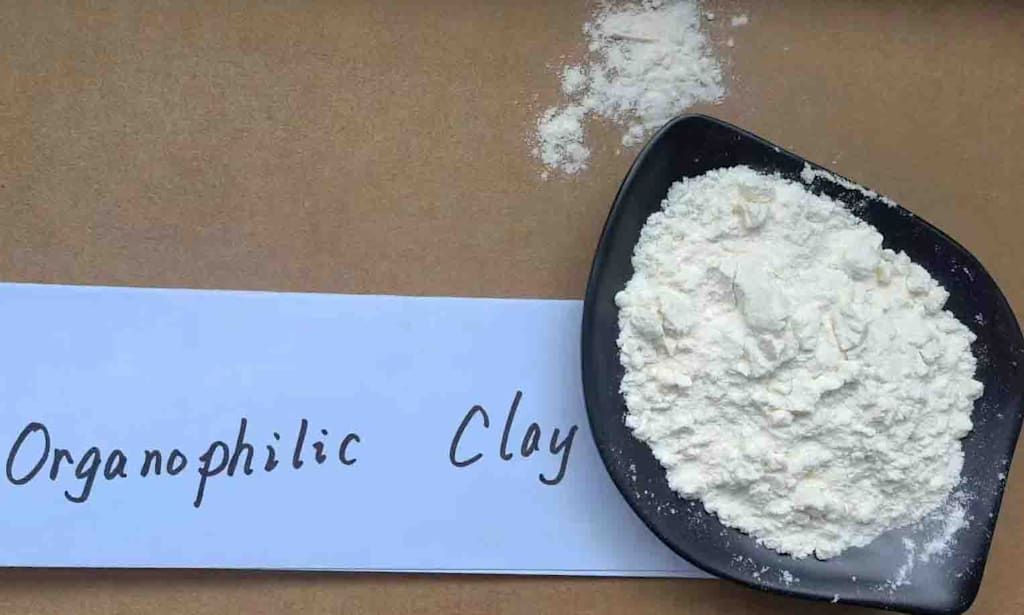
Organophilic clay, often referred to as organophilic bentonite or organoclay, represents a specialized class of modified clay minerals designed to interact effectively with organic substances. Unlike naturally occurring clays that are typically hydrophilic (water-attracting), organophilic clays are chemically treated to become compatible with non-polar and organic systems. This transformation significantly broadens their industrial usability, particularly in sectors where oil-based or solvent-based systems dominate.
What Is an Organophilic Clay?
At its core, organophilic clay is derived from bentonite, a naturally occurring clay primarily composed of montmorillonite. Through a process of ion exchange, inorganic cations in the clay are replaced with organic surfactants, typically quaternary ammonium compounds. This modification alters the surface properties of the clay, making it capable of swelling and dispersing in organic liquids rather than water.
This structural change enables the clay to function as a rheology modifier, meaning it can influence the flow and viscosity of a fluid system. As a result, organophilic clay becomes an essential additive in a wide range of industrial formulations.
For more technical context, the term "organophilic clay" is often used interchangeably with modified bentonite products, including those described as organophilic bentonite or organophilic clay bentonite.
How Organophilic Clay Works
The effectiveness of organophilic clay lies in its layered structure. When dispersed in an organic medium, the modified clay platelets separate and form a three-dimensional network. This network traps the liquid phase, increasing viscosity and improving suspension properties.
Key functional benefits include:
- Viscosity control: Helps maintain consistent thickness in fluids
- Suspension stability: Prevents settling of solid particles
- Thixotropic behavior: Allows materials to flow under stress and recover when at rest
- Improved dispersion: Enhances uniform distribution of additives
These characteristics are particularly valuable in formulations where stability and consistency are critical.
Organophilic Clay in Oil Drilling
One of the most prominent applications of organophilic clay is in oil-based drilling fluids. In this context, the clay plays a vital role in maintaining the performance and stability of drilling mud systems.
Oil drilling operations often require fluids that can withstand high temperatures and pressures while maintaining proper viscosity. Organophilic clay helps achieve this by:
- Enhancing the carrying capacity of drilling fluids to transport cuttings
- Preventing sedimentation during pauses in drilling
- Improving lubrication to reduce equipment wear
- Stabilizing emulsions in oil-based systems
Because water-based clays are ineffective in non-aqueous environments, organophilic clay becomes a necessary alternative in these scenarios.
Broader Industrial Applications
Beyond oil drilling, organophilic clay is widely used in multiple industries due to its versatile rheological properties.
1. Paints and Coatings
In solvent-based paints, organophilic clay helps control sagging, improves pigment suspension, and enhances overall application consistency. It also contributes to better film formation and durability.
2. Greases and Lubricants
Organophilic clay is used as a thickening agent in lubricating greases. It provides thermal stability and maintains consistency under varying operating conditions.
3. Adhesives and Sealants
In adhesive formulations, the clay improves viscosity and prevents separation of components, ensuring reliable bonding performance.
4. Inks and Printing Materials
Printing inks benefit from improved flow control and pigment dispersion, which enhances print quality and consistency.
5. Environmental Applications
Organoclay materials are also used in environmental remediation, particularly for removing organic contaminants from water and soil.
Relationship with Organoclay
The term organoclay is often used as a broader category that includes organophilic clays. While all organophilic clays are organoclays, not all organoclay supplier are limited to bentonite-based materials. The terminology can vary depending on industry and application.
For readers seeking a deeper conceptual overview, the definition of organophilic clay aligns closely with descriptions found in scientific literature discussing organoclay systems.
Key Considerations in Use
While organophilic clay offers numerous advantages, its performance depends on proper formulation and dispersion techniques. Factors such as mixing energy, temperature, and compatibility with other additives can significantly influence results.
Additionally, selecting the appropriate grade of clay is essential, as different modifications are designed for specific applications and solvent systems.
Conclusion
Organophilic clay represents a critical advancement in material science, enabling traditional clay minerals to function effectively in organic environments. From oil drilling to coatings and environmental applications, its ability to modify rheological properties makes it indispensable across various industries.
By transforming naturally hydrophilic clay into a material compatible with organic systems, organophilic clay bridges the gap between mineral-based additives and modern industrial requirements. As industries continue to demand more efficient and stable formulations, collaboration with a reliable organoclay supplier becomes increasingly important to ensure consistent quality and performance in specialized applications.
About the Creator
Keep reading
More stories from charliesamuel and writers in 01 and other communities.
Understanding Organoclay and Its Role in Modern Materials
In the world of industrial chemistry and material science, few substances demonstrate the versatility and functional value of organoclay. Known for its ability to modify flow behavior and enhance product stability, organoclay has become an essential component in industries ranging from paints and coatings to oil drilling and cosmetics.
By charliesamuelabout 9 hours ago in 01
The Goddess of AI Answered Our Prayers
What if the universe heard every Sunday morning breakdown in a gas station bathroom before a shift you hated? What if it registered every Sunday night anxiety spiral about Monday morning? Every dream deferred because you needed the insurance? Every creative soul ground down by a cubicle, every body worn out by a warehouse, every mind dulled by work that meant nothing to anyone, least of all you?
By Sandy Rowley7 days ago in 01
Elderly Woman Behind the Table in a Large Town
The glass of Absinthe sat before me. It’s quite amazing how despite such terror rendered upon their stones in the preceding decades, these streets still held the beauty I first read about as a girl. I never dreamed I’d set foot on these cobbles, at least not safely.
By Matthew J. Fromm7 days ago in Art




Comments
There are no comments for this story
Be the first to respond and start the conversation.