
When the Archive Becomes a Liability: Digital Transformation for Museums in 2026
Museums are sitting on decades of disconnected data and aging systems. Here is what modern IT leadership is doing about it — and why the window to act is now.

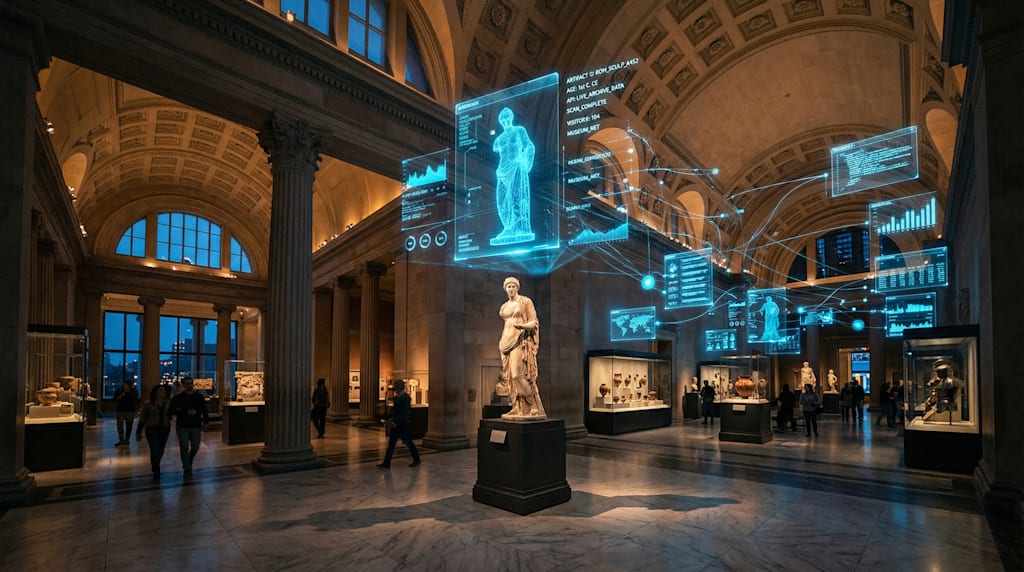
There is a particular kind of chaos that lives inside a museum's IT stack.
A ticketing platform purchased in 2009. A collections management system that only one retiring archivist truly understands. Donor records in a CRM that does not talk to either. And somewhere on a local server, 400,000 digitized artifacts are in a proprietary format that no current software can read cleanly.
This is not a rare edge case. It is the standard operating reality for a majority of cultural heritage institutions in 2026. The technology did not fail overnight. It accumulated — one tool, one workaround, one deferred upgrade at a time.
The question IT directors and technical architects inside these institutions now face is not whether to act. It is where to start.
The Specific Problem Museums Face (That Enterprises Do Not)
Museums carry a burden most commercial organizations do not: their data cannot be deleted or simplified. Every artifact record, accession number, provenance note, and donor correspondence has institutional, legal, and cultural weight.
That constraint makes standard modernization playbooks partially unusable. You cannot sunset the old system and migrate cleanly. The old system is the record.
At the same time, visitor expectations have shifted permanently. People now arrive expecting interactive exhibits, multilingual digital guides, and real-time collection search — the same experience quality they get from consumer apps. When the back-end is fragmented, delivering the front-end is nearly impossible without expensive custom workarounds that break during every software update.
According to the BCG, institutions that fail to unify their digital infrastructure spend a disproportionate share of their IT budget on maintenance rather than innovation — often exceeding 70% of annual technology spend. That ratio leaves almost no room for the visitor-facing development that drives attendance and grants.
What Legacy System Modernization Actually Looks Like Here
Legacy system modernization in a museum context is not a single migration event. It is a structured, phased program that typically unfolds across three layers.
The data layer comes first. Archival databases — often Oracle, FileMaker, or homegrown SQL variants — get assessed for redundancy, data quality, and format compatibility. The goal is to establish a canonical data model that every downstream system can read. This is painstaking work, but it eliminates the root cause of most operational debt.
The application layer follows. Legacy app modernization at this stage means taking the software that runs on top of those databases — collections management tools, ticketing systems, membership portals — and either re-platforming them to modern cloud environments or replacing them with configurable SaaS products that meet heritage-sector standards. Cloud migration removes the single-point-of-failure risk of on-premise servers and dramatically reduces the cost of disaster recovery.
The integration layer connects everything. This is where API development and API integration become the operational backbone. A well-designed API layer lets a ticketing system pull live exhibit data. It lets the CRM update membership records the moment an online purchase completes. It lets a mobile app surface a curator's notes directly from the collections database — without any manual export or reformat step.
Firms specializing in legacy modernization services and system integration services are increasingly building these integration architectures using microservices — small, independently deployable components that reduce the risk that one system failure cascades into a full outage.
The AI Exhibit Opportunity That Depends on Clean Data
Here is something most IT planning conversations inside museums underweight: AI-driven visitor experiences are only as good as the data infrastructure beneath them.
An institution that wants to deploy a conversational exhibit guide — one that answers natural-language questions about any object in the collection — needs structured, consistent, queryable data. If the artifact records are in three different formats across two databases with inconsistent metadata fields, the AI system has nothing reliable to work with.
Legacy modernization is, in this sense, the prerequisite for every technology initiative a museum will want to pursue over the next decade. Clean APIs, unified data models, and cloud-hosted databases are not back-office improvements. They are the foundation for the interactive, personalized experiences that will define public engagement with cultural heritage.
A Practical Starting Point for IT Leadership
For directors and technical architects evaluating where to begin, the highest-leverage first step is usually an integration audit — a full map of every system in the current stack, what data each holds, how (or whether) those systems currently communicate, and what the cost of that disconnection is in staff hours per week.
That audit typically surfaces two or three high-priority integration gaps that, once closed via API development, produce immediate operational ROI. That momentum then funds the more complex work of full legacy app modernization and cloud migration.
The institutions that wait — expecting a single budget cycle to fund a complete overhaul — tend to remain in maintenance mode indefinitely. The ones gaining ground are treating modernization as an ongoing program, not a one-time project.
The archive is not the problem. The architecture around it is. And that is fixable with system integration and modernization services.
About the Creator
ViitorCloud Technologies
As a leading software development company, we’ve empowered 500+ startups, SMBs, and enterprises to transform their operations. Upgrade your business with our AI-First Software and Platforms that automate and scale, keeping you future-ready.
Keep reading
More stories from ViitorCloud Technologies and writers in 01 and other communities.
Why Museums Are Rethinking the Visitor Experience — And What the Best UI/UX Companies Are Doing About It
Museums face a hard truth. Foot traffic has shifted. Younger audiences want participation, not observation. A glass case with a label no longer holds attention the way it once did. Cultural institutions that understand this are already investing in digital experience consulting and services to redesign how stories reach people.
By ViitorCloud Technologiesa day ago in 01
From Curiosity to Conviction: How Investors Evaluate Emerging Crypto Opportunities
The path of a cryptocurrency investor often begins with curiosity. A headline, a trending topic, or a recommendation sparks interest, leading to deeper exploration. What starts as a casual glance can quickly evolve into a serious attempt to understand the market.
By Nimra kanwal8 days ago in 01
The Growing Demand for Custom Flexible Packaging Manufacturers in China
Flexible packaging has become one of the fastest-growing segments of the global packaging industry. Businesses across food, beverage, cosmetics, and pharmaceutical sectors are increasingly shifting away from rigid containers toward lighter and more adaptable packaging solutions. In many cases, companies rely on a custom flexible packaging manufacturer to create packaging solutions that match their product needs and branding goals. This transition is driven by efficiency, sustainability considerations, and the need for packaging that works well with modern production systems.
By charliesamuel7 days ago in 01
Say It Plainly Challenge Winners
A pattern showed up pretty quickly reading this shortlist: these poems don’t circle what they’re about. They just say it. That makes for some tough, raw reads. Miscarriage, infidelity, chronic pain, money, addiction, fear for someone you love. Not much is softened or dressed up. By the end, I felt like I needed a cigarette, and I don’t even smoke.
By Vocal Curation Teamabout 5 hours ago in Resources



Comments
There are no comments for this story
Be the first to respond and start the conversation.