
Who Really Benefits from the AI Energy Panic?
AI Data Center Protests

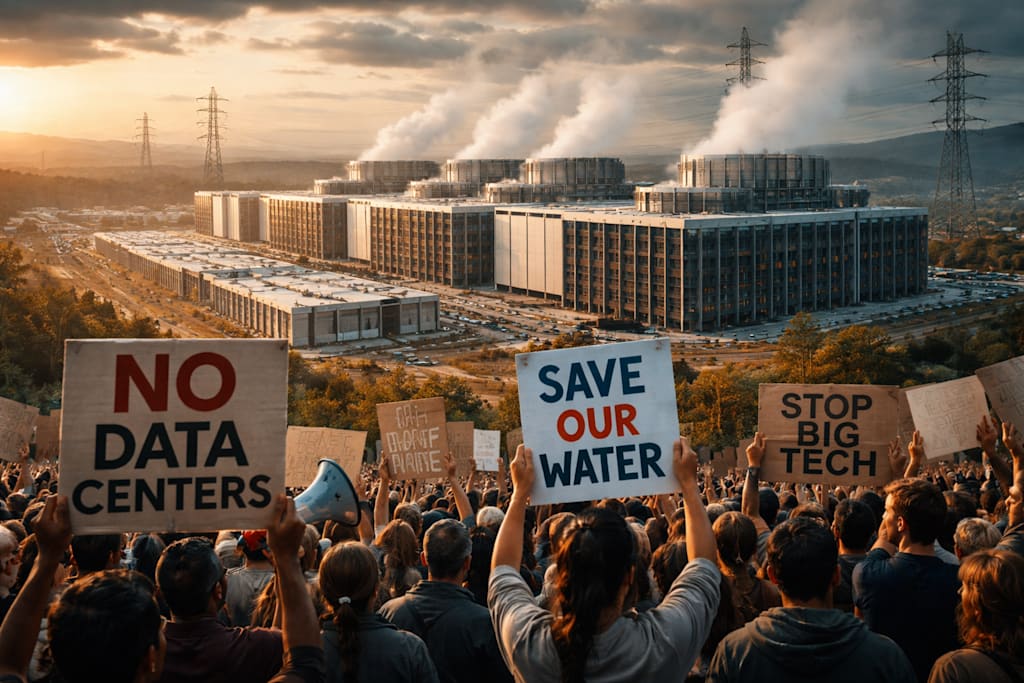
There's a new story taking over the headlines: AI is eating the planet alive.
You’ve probably seen the warnings — data centers sucking up more electricity than entire countries, towns fighting back against new facilities, and politicians scrambling to respond. There’s a growing sense of urgency that’s starting to feel a lot like fear. Energy. Water. Infrastructure. Everything suddenly feels like it’s on the brink.
But if you step back and look closer, a bigger question emerges:
Who actually benefits from all this panic?
Because this isn’t really just about electricity and cooling water. It’s about power — economic power, political power, and who gets to control the future of AI.
The scale of what’s happening is undeniably huge. Data centers are being built at breakneck speed, some demanding gigawatts of power — enough to run small cities. In the U.S., data centers already eat up about 4–5% of all electricity, and that could climb to 9–17% by 2030. The growth is real. The pressure on infrastructure is real.
But here’s where the story starts to break down:
Using a lot of energy isn’t the same as causing an energy crisis.
One of the most important points that rarely gets mentioned is this: the indirect economic growth sparked by AI could drive 10–20 times more energy demand than the AI systems themselves.
In other words, AI isn’t just consuming energy — it’s creating new industries, new manufacturing, new services, and new economic activity that all need energy too. It’s an economic multiplier, not just a power hog.
Think about it: every major technological leap in history — railroads, electricity, the internet — ended up increasing total energy use because they made the economy bigger and more productive. AI looks like it’s doing the same thing. We’re not heading into scarcity. We’re heading into a new era of expansion.
The same pattern shows up with water. Headlines love to say a big data center can use hundreds of thousands of gallons a day. What they usually leave out is that most of that water isn’t “destroyed” — it evaporates through cooling systems, goes into the air, forms clouds, and eventually comes back down as rain somewhere else. It’s borrowed, not gone.
Yes, local water stress can be a real issue in certain places. But the broader narrative often ignores how data centers are already shifting toward recycled water and more efficient cooling tech that can cut usage dramatically.
The real bottleneck right now isn’t a lack of energy or money — it’s infrastructure access. Grid connections, transformers, and permitting are all painfully slow. That scarcity turns energy access into a competitive advantage. The companies that lock in power deals early get a massive head start. Everyone else struggles or gets locked out.
This is where things get interesting — and a bit cynical.
When infrastructure is hard to build, the big players win. Delays, regulations, community pushback, and environmental reviews all make it harder for new competitors to enter. The incumbents quietly benefit from the slowdown. They secure long-term energy contracts, invest in their own power plants, and strengthen their moat while smaller players or newcomers get squeezed.
Fear also makes it easier to justify huge rate hikes from utilities (often passed on to regular customers), subsidies, fast-tracked permits, and public funding — even when the biggest winners are already trillion-dollar companies.
There’s a psychological side too. If people come to see AI as dangerous, greedy, and environmentally destructive, it slows down public support and makes tighter regulation feel necessary. That suits both big tech incumbents (less competition) and governments (more control).
We’ve seen this movie before — with railroads, electricity, automobiles, and the early internet. New technology arrives, fear spreads, regulations tighten, and the biggest players end up even stronger.
Of course, not all concerns are manufactured. Grid reliability, local impacts, and the risk of a few companies controlling too much compute and energy are legitimate issues worth serious discussion.
But the dominant narrative right now frames AI as a crisis of consumption. The fuller picture is that we’re living through the early stages of a profound economic and technological shift — one that will demand massive infrastructure but also deliver huge gains in productivity, innovation, and human capability.
So who actually benefits from the AI energy panic?
- Early AI infrastructure leaders who face less competition
- Energy companies enjoying surging demand
- Regulators and governments gaining more influence
- Large tech companies that can shape both policy and public perception
- Media outlets thriving on alarming headlines
The AI energy story isn’t fake — but it’s dangerously incomplete.
Yes, AI uses a lot of power and water. Yes, it’s straining systems. But it’s also unlocking new economic growth and reshaping what’s possible.
In the end, this isn’t really about how much electricity AI consumes.
It’s about who controls the energy — and therefore, who gets to build the future, and who gets left behind.
About the Creator
Sandy Rowley
AI SEO Expert Sandy Rowley helps businesses grow with cutting-edge search strategies, AI-driven content, technical SEO, and conversion-focused web design. 25+ years experience delivering high-ranking, revenue-generating digital solutions.
Keep reading
More stories from Sandy Rowley and writers in 01 and other communities.
How to Recover Lost Cryptocurrencies—Or at Least, Try To
Those people who had the foresight to jump in when digital currency was cheap have made some pretty impressive money investing in cryptocurrency. They started buying and trading and selling, making transactions the same way any person would do with cash or a card in hand. Unfortunately, people discovered a shocking problem with digital currencies that they didn't foresee coming: Sometimes crypto gets lost.
By Gerand Cruise5 days ago in 01




Comments
There are no comments for this story
Be the first to respond and start the conversation.