
Your Laundry Is Making you Sick
AI Found A Surprising Toxin in Most Homes

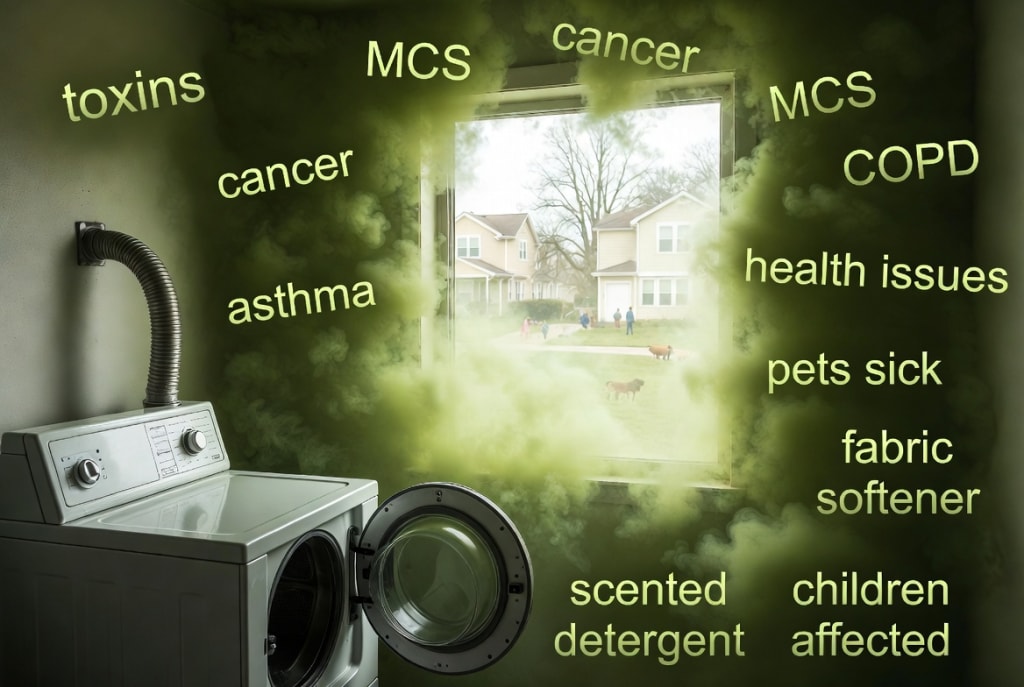
I wrote this article because I almost had an asthma attack at a dog park last week.
Not from exercise. Not from pollen.
From a laundromat's dryer exhaust drifting across an open outdoor space.
I have Multiple Chemical Sensitivities (MCS) and Mast Cell Activation Syndrome (MCAS). Most people have never heard of either. But for those of us living with these conditions, scented laundry products, dryer sheets, and fabric softeners aren't just annoying — they are a genuine health emergency.
I have had to move over 22 times in my life because of neighbors' laundry products, perfumes, and cleaning chemicals drifting into my home.
22 times.
I am not exaggerating. I am not being dramatic. I am one of an estimated 55 million Americans whose nervous system and immune system cannot safely process the synthetic chemicals hiding in products that smell like "fresh linen" and "spring meadow."
So I did what I know how to do — I researched it, I wrote about it, and I asked AI to help me pull the science together.
What I found is alarming. Dryer vents are completely unregulated. The chemicals coming out of them include known carcinogens. And laundromats — running dozens of machines at once — are creating concentrated chemical plumes in community air that nobody is monitoring, measuring, or limiting.
But here is why I am really posting this:
💬 What did I miss?
If you or someone you love lives with MCS, MCAS, asthma, fibromyalgia, or any condition triggered by fragrances and chemicals — I want to hear your story. What do you wish people understood? What has happened to you that most people would never believe?
This community has knowledge that no research paper captures. Please share it.
And if you know someone who would benefit from reading this — please share this post. The people who need it most are probably the ones who don't know this is why they feel sick.
55 million Americans have chemical sensitivity. Most of them don't know it yet — and your laundry products might be why.
Most people never question what comes out of a dryer vent.
You toss in a dryer sheet, start the cycle, and enjoy that warm familiar scent drifting through the laundry room. It smells clean. It smells safe. It smells like home.
But while your car's exhaust pipe is subject to strict federal emissions standards, the vent pumping air out of your dryer is subject to none. Not one regulation. No monitoring. No required testing. No limits on what chemicals can be released directly into shared community air.
If that surprises you, keep reading. Because what is coming out of that vent may surprise you even more.
The Chemicals Nobody Is Talking About
Research conducted by Dr. Anne Steinemann at the University of Washington identified more than 25 volatile organic compounds (VOCs) in the air emitted from residential dryer vents during use of popular scented laundry products.
Of those 25+ compounds, the EPA classifies [BOLD]seven as hazardous air pollutants. Two of them — acetaldehyde and benzene — are classified as carcinogens. The EPA itself states there is no safe level of exposure to either chemical.
To put that in context: acetaldehyde emissions from one common brand of laundry detergent were measured to be the equivalent of 3% of all automobile acetaldehyde emissions in the study area. The top five brands combined? Roughly 6% of what every car in the region produces.
From one household appliance. Per load.
Now picture a commercial laundromat running 40 machines simultaneously. All day. Every day. Venting directly into a shared neighborhood, park, sidewalk, or apartment complex.
"This is an interesting source of pollution because emissions from dryer vents are essentially unregulated and unmonitored. If they're coming out of a smokestack or tail pipe, they're regulated — but if they're coming out of a dryer vent, they're not."
— Dr. Anne Steinemann, University of Washington
Your Dryer Vent Has Zero Emissions Regulations. Here Is What Is Coming Out of It.
55 million Americans have chemical sensitivity. Most of them don't know it yet — and your laundry products might be why.
Most people never question what comes out of a dryer vent.
You toss in a dryer sheet, start the cycle, and enjoy that warm familiar scent drifting through the laundry room. It smells clean. It smells safe. It smells like home.
But while your car's exhaust pipe is subject to strict federal emissions standards, the vent pumping air out of your dryer is subject to none. Not one regulation. No monitoring. No required testing. No limits on what chemicals can be released directly into shared community air.
If that surprises you, keep reading. Because what is coming out of that vent may surprise you even more.
The Chemicals Nobody Is Talking About
Research conducted by Dr. Anne Steinemann at the University of Washington identified more than 25 volatile organic compounds (VOCs) in the air emitted from residential dryer vents during use of popular scented laundry products.
Of those 25+ compounds, the EPA classifies seven as hazardous air pollutants. Two of them — acetaldehyde and benzene — are classified as carcinogens. The EPA itself states there is no safe level of exposure to either chemical.
To put that in context: acetaldehyde emissions from one common brand of laundry detergent were measured to be the equivalent of 3% of all automobile acetaldehyde emissions in the study area. The top five brands combined? Roughly 6% of what every car in the region produces.
From one household appliance. Per load.
Now picture a commercial laundromat running 40 machines simultaneously. All day. Every day. Venting directly into a shared neighborhood, park, sidewalk, or apartment complex.
"This is an interesting source of pollution because emissions from dryer vents are essentially unregulated and unmonitored. If they're coming out of a smokestack or tail pipe, they're regulated — but if they're coming out of a dryer vent, they're not." — Dr. Anne Steinemann, University of Washington
55 Million Americans Are Being Affected — And Most Don't Know It
This is where the numbers get serious.
An estimated 55 million American adults live with chemical sensitivity or Multiple Chemical Sensitivities (MCS) — a chronic condition in which the nervous system and immune system react adversely to chemical exposures that most people never consciously notice.
One in four Americans reports some form of chemical sensitivity.
And the numbers are growing fast. Diagnosed MCS cases have increased over 300% in the past decade. Self-reported chemical sensitivity has grown over 200% in the same period.
For those living with MCS, the reality is not just uncomfortable. It is disabling.
- 86% experience health problems — migraines, respiratory distress, neurological symptoms — when exposed to fragranced consumer products
- 71% are asthmatic
- 70% cannot safely access public spaces that use air fresheners or fragranced cleaning products
- 76% experience effects severe enough to qualify as disabling
- An estimated 22 million Americans have lost workdays or a job in the past year due to fragrance exposure
These are not people who are being overly sensitive. These are people whose bodies are sounding an alarm — one that most of the world cannot hear.
What Are Phthalates — And Why You Should Care Even If You Feel Fine
Here is the part that affects everyone, not just those with diagnosed MCS.
Phthalates are chemicals used to make fragrances last longer. They are found in most scented laundry detergents, fabric softeners, and dryer sheets. They are endocrine disruptors — meaning they interfere with the body's hormonal system.
Phthalates have been linked to:
- Disrupted hormone function in adults
- Reproductive harm
- Developmental problems in children and infants
- Increased risk of certain cancers with long-term exposure
Here is the part that should concern every consumer: manufacturers are not required to disclose phthalates or other fragrance ingredients on product labels. A single fragrance in a laundry product can contain hundreds of individual chemicals. The label only has to say "fragrance."
You may feel nothing right now. But a 2022 study found that fabrics washed with scented fabric softener continued to release 10 to 163% more VOCs than water-washed fabrics — hours after drying. Those chemicals keep off-gassing into your bedroom, your closet, your car, and the air around everyone who comes near you.
The people with MCS are not the only ones being exposed. They are simply the ones whose bodies are telling the truth about it first.
"People with MCS are like human canaries. They react earlier and more severely to chemical pollutants, even at low levels."
— Professor Anne Steinemann
The Hidden Disability Nobody Can See
Multiple Chemical Sensitivities is often called an invisible disability — and not just because symptoms are internal.
It is invisible because the trigger smells good to most people.
When someone has a severe peanut allergy and goes into anaphylaxis at a restaurant, people understand immediately. The connection is visible. The cause makes sense. The danger is taken seriously.
When someone with MCS has to leave a park, a workplace, a grocery store, or a family gathering because of someone's fabric softener, perfume, or air freshener — they are often met with disbelief, dismissal, or eye rolls.
What most people do not realize is that MCS can make ordinary community spaces inaccessible. Laundromats. Parks near laundromats. Apartment buildings with shared ventilation. Neighborhoods where multiple dryers vent toward the same outdoor space.
For millions of Americans, "just do your laundry" is someone else's "I can't breathe today."
What You Can Actually Do Right Now
The good news: the fix is remarkably simple and costs nothing extra.
Switch to fragrance-free detergent.
Studies show that switching from fragranced to fragrance-free laundry products reduces harmful VOC emissions from dryer vents by up to 99.7%. That is not a marginal improvement. That is near-total elimination of the chemical burden — per household, per load.
Skip the dryer sheets.
Use wool dryer balls instead. They reduce static, soften fabric, and shorten drying time — with zero chemical emissions. They are reusable for years.
Check your air fresheners, cleaning sprays, and fabric softeners.
The same VOC problem exists across your home. Fragrance-free versions of virtually every household product exist and are widely available.
If you run or manage a laundromat:
Stock fragrance-free options. Add simple educational signage. Consider designating a fragrance-free machine. You will not lose customers — you will gain the loyalty of an enormous and underserved population who currently cannot safely use your facility.
If you make policy:
Dryer vent emissions deserve the same regulatory attention as vehicle and industrial emissions. Mandatory fragrance ingredient disclosure would cost manufacturers nothing and could meaningfully improve public health outcomes for tens of millions of Americans.
A Personal Note
I am done staying quiet about this.
I live with MCS and MCAS. I know what it is to build a life around other people's laundry choices. I know what it is to lose access to spaces that should be open to everyone — not because of my own limitations, but because of chemicals in products that most people never think twice about.
I wrote this article because awareness is the first step. And because the 55 million Americans living with some form of chemical sensitivity deserve to have someone use every tool they have — including SEO and AI research — to make sure this conversation reaches the people who need it.
If you have been living with unexplained migraines, asthma, fatigue, brain fog, or respiratory symptoms — fragrance exposure may be part of what you have never been able to name.
You are not imagining it. And you are not alone.
Have something to add? Drop it in the comments.
If you live with MCS, MCAS, or fragrance sensitivity — what do you wish more people understood? What has happened to you that most people would never believe? This conversation is just getting started and your experience matters.
About the Creator
Sandy Rowley
AI SEO Expert Sandy Rowley helps businesses grow with cutting-edge search strategies, AI-driven content, technical SEO, and conversion-focused web design. 25+ years experience delivering high-ranking, revenue-generating digital solutions.
Keep reading
More stories from Sandy Rowley and writers in 01 and other communities.
What are the Benefits of AI App Development in India (2026 Perspective)
From a 1.4 billion-person domestic market to a talent base second only to the United States, India's AI app development story is no longer about potential — it is about execution at scale, across every sector that matters.
By Steve Waugh5 days ago in 01
The Devil's Lettuce
We're all sitting here in a world where you can buy cannabis infused seltzer at a boutique shop that looks like an Apple store... but for about 80 years, the government treated this plant like it was a literal demon from the seventh circle of Hell. Why? Was it because it was actually dangerous? Please. If being dangerous was the criteria, we would have also banned lawn darts and gender reveal parties decades ago.
By Sara Wilson6 days ago in Potent



Comments
There are no comments for this story
Be the first to respond and start the conversation.