
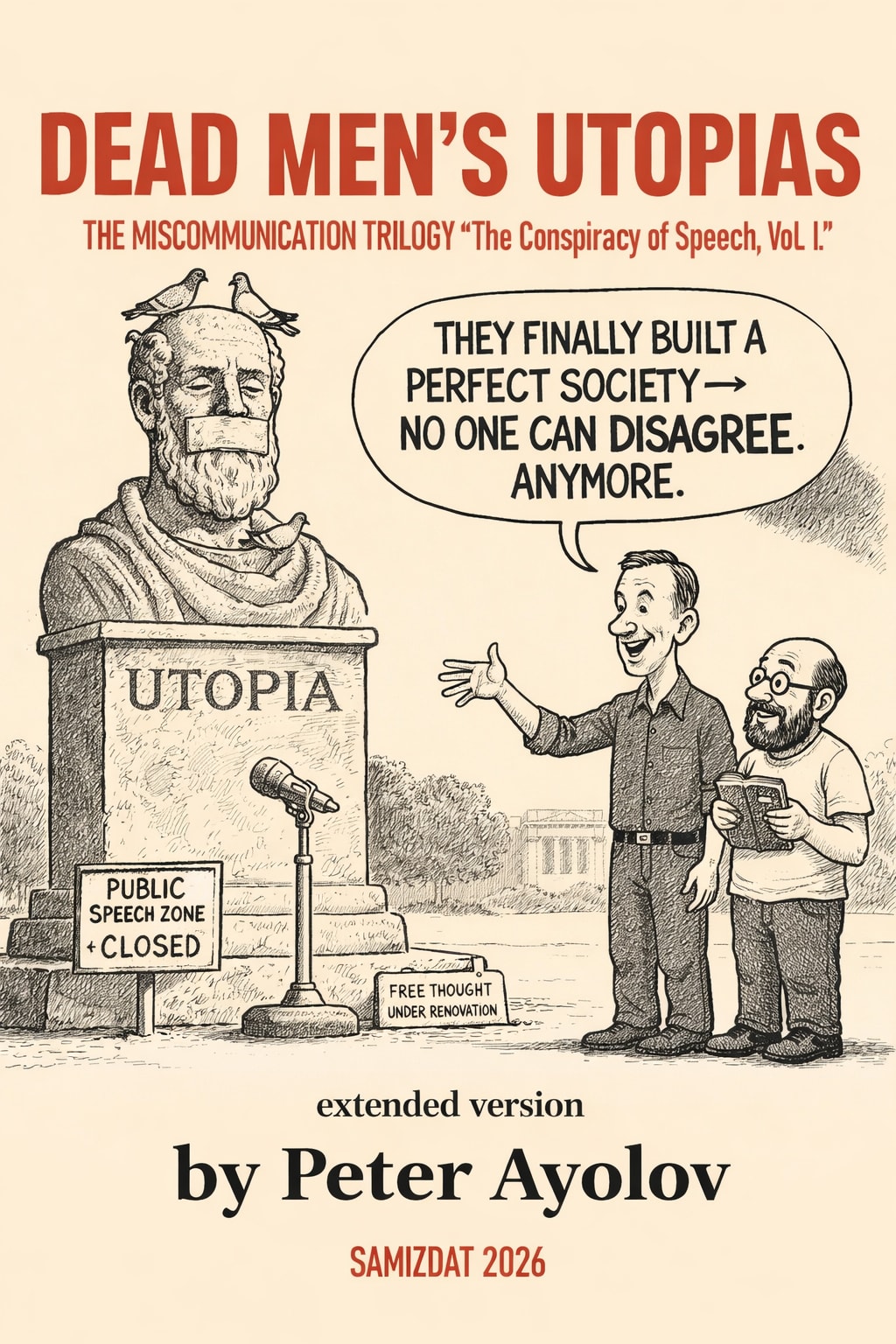
DEAD MEN'S UTOPIAS
THE MISCOMMUNICATION TRILOGY, “The Conspiracy of Speech, Vol. I.”, Part 5 (Extended version)

Review
Dead Men’s Utopias
Dead Men’s Utopias by Peter Ayolov presents itself as the fifth part of Volume I, The Conspiracy of Speech, within THE MISCOMMUNICATION TRILOGY(The Planned Obsolescence of Language), yet its role within the structure of the work is more complex than a simple continuation. It is neither a conclusion nor a detached addition, but an expanded return to the beginning. The text revisits the foundational ideas of the opening part and rearticulates them in a broader, more elaborated, and conceptually intensified form. This repetition is not accidental and not redundant. It is structural. It reflects the very logic the book describes: that language persists, returns, and reshapes itself through accumulation rather than replacement. In this sense, the extended version is not simply longer; it is deeper, denser, and more recursive.
The most important feature of the book is precisely this recursive movement. Where earlier parts of Volume I establish the framework of communication, speech, rhetoric, and deception, Dead Men’s Utopias pushes the argument further by concentrating on what remains after meaning has already begun to decay. It does not introduce a new thesis, but radicalises the existing one. Language is no longer treated merely as a tool that can be misused or distorted; it is presented as an autonomous structure that continues to function independently of human intention. Once articulated, ideas do not disappear with their authors. They persist, circulate, and organise reality long after their original context has vanished. This persistence is what the book names through its central metaphor. ‘Dead men’s utopias’ are not simply outdated or failed visions of the future. They are active frameworks that continue to shape how the present is understood and how the future is imagined. Utopias, in their classical sense, are projections of ideal futures, but here they are transformed into inherited constraints. They survive their historical moment and become templates that limit the possibility of thinking otherwise. What was once imagined as possibility becomes a structure of repetition. The extended version makes this argument more forcefully by expanding the range of examples, reflections, and conceptual elaborations. Where the earlier parts of the volume sketch the outlines of the problem, this text fills them in with greater detail. It slows down the movement of the argument, allowing each idea to be examined from multiple angles. This is not simply an addition of material, but a transformation of the rhythm of the text. The reader is not pushed forward towards a conclusion, but drawn back into the same conceptual field, forced to confront its implications more fully.
In this way, the book transforms the idea of miscommunication. It is no longer understood as a failure between speakers, a breakdown in the transmission of meaning. Instead, it becomes a structural condition embedded in the continuity of language itself. People do not merely misunderstand each other; they inherit misunderstandings. These misunderstandings are stabilised through repetition, embedded in institutions, and reproduced across generations. Communication does not fail because individuals are careless or confused; it fails because it operates within a system that preserves forms even after their meaning has weakened or disappeared. One of the strengths of the book lies in its ability to connect this abstract argument to concrete social and cultural processes. Language is not treated as an isolated system, but as something embedded in institutions, media, and everyday practices. Educational systems, political discourse, and technological platforms are all shown to function as mechanisms for the reproduction of inherited language. They do not simply transmit information; they reinforce particular ways of speaking and thinking. In doing so, they ensure that the ideas of the past remain active in the present. The role of media is particularly significant in this context. The book suggests that contemporary communication technologies intensify the persistence of language by accelerating its circulation. Ideas are repeated more quickly, detached more rapidly from their original context, and consumed more superficially. This acceleration does not produce clarity or understanding. On the contrary, it contributes to a form of saturation in which meaning becomes diluted. The more language circulates, the less it signifies. Repetition replaces understanding, and communication becomes a form of noise.
This leads to one of the most important conceptual moves in the book: the inversion of the relationship between language and thought. Traditionally, language is seen as a tool used by thinking subjects to express their ideas. Dead Men’s Utopias reverses this assumption. Thought is not primary; language is. Individuals do not think freely and then express their thoughts in words. They think within the limits of the language they have inherited. Language does not follow thought; thought follows language. This inversion has far-reaching implications, as it challenges the idea of intellectual autonomy and raises questions about the possibility of independent thinking. The extended version deepens this argument by showing how this inversion operates over time. Language not only shapes thought in the present; it carries the past into the future. Concepts that were formulated under specific historical conditions continue to structure thinking long after those conditions have changed. This creates a temporal disjunction between experience and interpretation. People live in a world that is constantly changing, but they interpret it through concepts that belong to the past. The result is a form of conceptual inertia, in which the language used to describe reality lags behind reality itself.
This inertia is closely linked to the idea of ‘borrowed futures’ that runs through the book. The future is not imagined freely, but through inherited concepts. Words such as progress, development, and innovation carry with them assumptions that shape how the future can be understood. These assumptions are rarely questioned, because they are embedded in the language itself. As a result, the future is not an open horizon, but a continuation of past ideas. It is ‘borrowed’ from previous generations, structured by their expectations and limitations. The extended version makes clear that this borrowing is not simply a matter of influence, but of constraint. The language used to imagine the future limits what can be imagined. Even attempts at radical change are often expressed within the same conceptual framework that they seek to challenge. This creates a paradox in which change appears possible, but remains confined within existing structures. The utopian impulse becomes self-defeating, as it reproduces the very conditions it seeks to overcome. At the same time, the book avoids presenting this situation as entirely closed. While it emphasises the constraints imposed by inherited language, it also suggests the possibility of awareness. By recognising the persistence of language and its role in shaping thought, individuals can begin to question the frameworks within which they operate. This does not provide a simple escape, but it introduces a critical distance. Awareness becomes a form of resistance, a way of engaging with language rather than being passively shaped by it.
The recursive structure of the book reinforces this possibility. By returning to the beginning and reworking its central ideas, the text demonstrates that repetition is not necessarily identical. Each return introduces a shift in emphasis, a new perspective, a slight deviation from the original formulation. This suggests that while language persists, it is not entirely fixed. It can be reinterpreted, reconfigured, and transformed, even as it continues to exert its influence. This tension between persistence and transformation is one of the most compelling aspects of the book. Language is presented as both stable and dynamic, both constraining and generative. It preserves the past, but also allows for the emergence of new meanings. The extended version does not resolve this tension, but explores it in greater depth, showing how it operates across different levels of analysis. Another significant contribution of the book is its stylistic consistency. The text maintains a philosophical and reflective tone throughout, avoiding both technical jargon and simplistic generalisation. It moves carefully between abstraction and example, allowing complex ideas to be developed without losing clarity. The extended form enhances this quality, providing space for the argument to unfold gradually and coherently.
The decision to produce an extended version is therefore not merely a matter of adding content, but of reconfiguring the structure of the argument. The additional material allows for a more comprehensive exploration of the central themes, while the recursive design ensures that the text remains focused on its core problem. The result is a work that feels both familiar and new, repeating and extending at the same time. Importantly, Dead Men’s Utopias should not be read as a final statement within Volume I. It does not close the argument, but reopens it. The presence of further parts within the volume makes clear that this text is one movement within a larger composition. Its function is not to conclude, but to deepen and intensify, to prepare the ground for what follows by returning to what has already been established. This positioning gives the book a distinctive character. It resists the linear progression that is typical of many philosophical works, in which each part builds towards a final conclusion. Instead, it adopts a cyclical structure, in which ideas are revisited and reworked. This structure is not only formal, but conceptual. It reflects the book’s central claim that language operates through repetition and persistence rather than linear development.
In this sense, the extended version can be understood as an enactment of its own thesis. By repeating and expanding the initial argument, it demonstrates how ideas continue to operate through rearticulation. The text becomes an example of the phenomenon it describes, illustrating the persistence of language through its own structure. At the same time, the book maintains a critical stance towards this persistence. It does not simply accept the continuity of language as inevitable or desirable. On the contrary, it highlights the limitations and constraints that this continuity imposes. The persistence of language is shown to be both necessary and problematic, enabling communication while also restricting thought. The extended version allows this ambivalence to be explored more fully. By providing additional space for reflection, it reveals the complexity of the relationship between language and thought. It shows that this relationship cannot be reduced to a simple opposition between freedom and constraint, but must be understood as a dynamic interplay between persistence and transformation.
Ultimately, Dead Men’s Utopias succeeds in transforming what could have been a straightforward extension into a significant development of the project. It deepens the central argument, expands its scope, and refines its conceptual framework. At the same time, it maintains continuity with the earlier parts of Volume I, ensuring that the work remains coherent and integrated. The result is a text that is both demanding and rewarding. It requires careful reading and sustained attention, but offers a rich and thought-provoking exploration of the nature of language and its role in shaping human thought. By returning to the beginning and extending it, the book demonstrates that the problem of language cannot be resolved once and for all, but must be continually revisited and re-examined. Dead Men’s Utopias is therefore best understood not as an addition, but as a transformation. It takes the initial insights of The Conspiracy of Speech and develops them into a more comprehensive and nuanced analysis. In doing so, it reinforces the central insight of the trilogy: that language is not simply a medium of communication, but a system that persists, accumulates, and shapes reality beyond the control of those who use it.
About the Creator
Peter Ayolov
Peter Ayolov’s key contribution to media theory is the development of the "Propaganda 2.0" or the "manufacture of dissent" model, which he details in his 2024 book, The Economic Policy of Online Media: Manufacture of Dissent.
Keep reading
More stories from Peter Ayolov and writers in BookClub and other communities.
A Visitor's Guide To Victorian England
A Book Review Being interested in all things Victorian, I am constantly looking for books on the Victorian Era. In fact, I should admit that I am obsessed about ‘all things Victorian’. From the clothes worn by men and women, rich or poor, to how they lived, where they lived, what they ate and would (or would not ) drink, what kind of transport there was, who worked where, who went to school (and who didn’t), the list really is endless.
By Ruth Elizabeth Stiff9 days ago in BookClub
7 Books to Help You Stop Getting Angry at Others' Opinions
We’ve all been there. A casual comment from a coworker, a heated debate online, or even a harmless difference in perspective from a loved one—and suddenly, we feel irritated, defensive, or outright angry. Why does this happen? And more importantly, how can we stop letting others’ opinions control our emotional state?
By Diana Meresc6 days ago in BookClub



Comments
There are no comments for this story
Be the first to respond and start the conversation.