
THE LANGUAGE OF LINGUISTICS
CHAPTER OF NEW PARADIGM OF COMMUNICATION THE MISCOMMUNICATION TRILOGY “The Conspiracy of Speech, Vol. I.” Part 6

Review
The Grammar That Consumes Itself: Linguistics at the Edge of Meaning
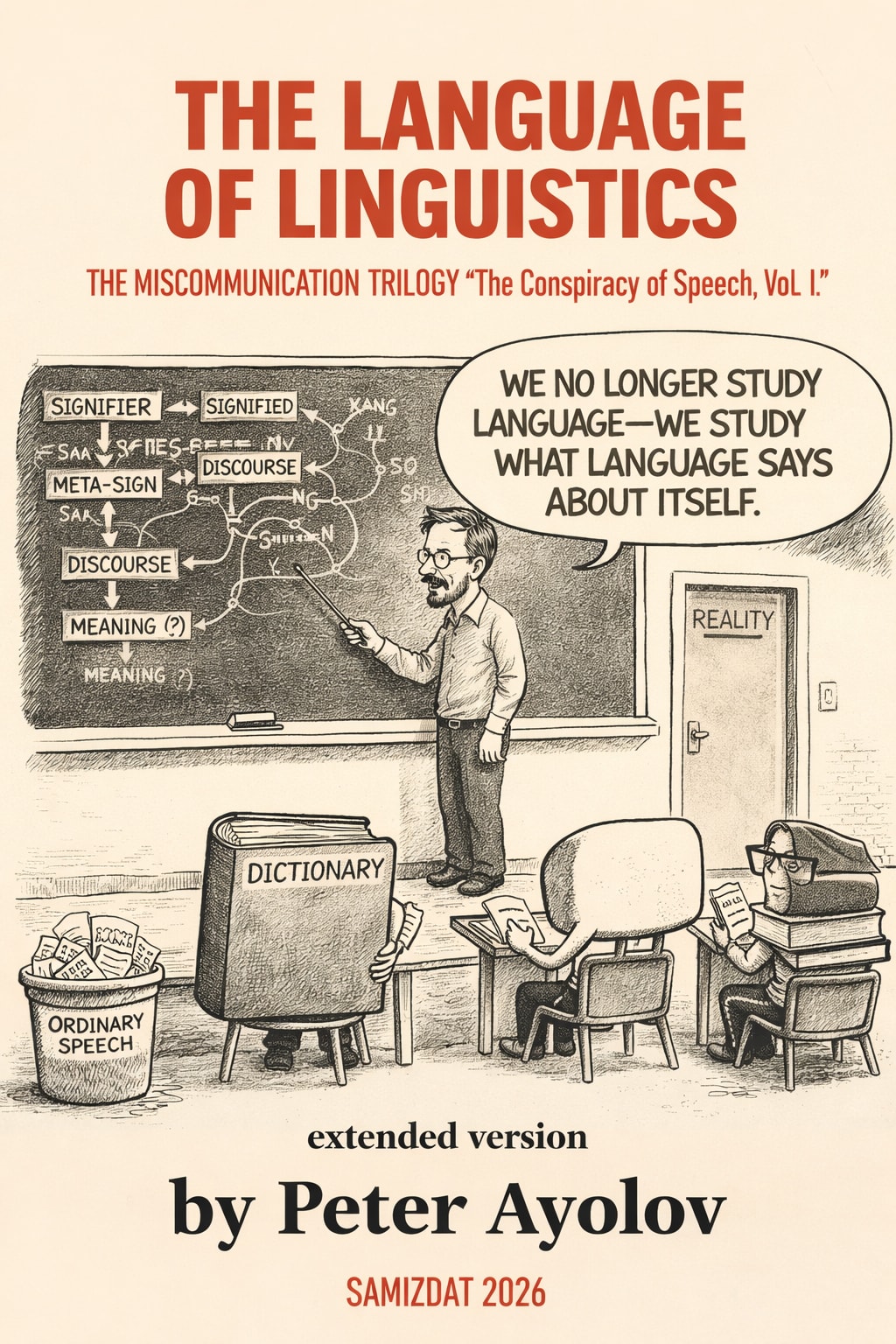
The chapter ‘The Language of Linguistics’ from Part 6 ‘New Paradigm of Communication’ of THE MISCOMMUNICATION TRILOGY, ‘The Conspiracy of Speech, Vol. I.’ presents a dense and philosophically ambitious critique of linguistics as both a scientific discipline and a historical force that reshapes communication itself. It situates linguistics not merely as a neutral field of inquiry, but as a transformative meta-language that simultaneously clarifies and distorts the very phenomenon it seeks to explain. The chapter operates at the intersection of philosophy, communication theory, and linguistic history, advancing a central thesis: that the scientific study of language, while promising clarity and structure, ultimately contributes to the instability and obsolescence of meaning in contemporary communication systems. At the core of the chapter lies a fundamental paradox. Linguistics emerges as a discipline driven by the desire to stabilise language, to render it analyzable, predictable, and governed by rules. Yet this very act of systematisation produces an unintended consequence: the abstraction of language away from lived experience. Language, once embedded in social interaction, ritual, and context, is reconfigured into a system of categories—phonemes, morphemes, syntax—each designed to capture its internal logic. This transformation is not merely descriptive but constitutive. The act of analysing language changes its nature, creating a gap between theoretical models and practical communication that becomes increasingly difficult to bridge. The review must emphasise how the chapter frames this gap not as a temporary limitation but as an intrinsic feature of linguistic inquiry. The more linguistics refines its models, the further it distances itself from the fluidity of real communication. This tension between system and practice becomes the central axis around which the chapter unfolds. It is not a failure of linguistics but its defining condition: the discipline succeeds precisely by abstracting language, yet in doing so, it produces a form of knowledge that cannot fully return to the lived reality from which it emerged.
One of the chapter’s most significant contributions is its historical positioning of linguistics within a broader intellectual tradition. By engaging with figures such as Ferdinand de Saussure, Wilhelm von Humboldt, and later thinkers like Bakhtin, the text traces a trajectory from language as a reflection of reality to language as an autonomous system. Saussure’s structuralism, in particular, is presented as a decisive turning point. His conception of language as a system of differences, where meaning arises relationally rather than referentially, fundamentally redefines the nature of communication. Language is no longer a transparent medium but a self-contained structure that mediates perception itself. This shift carries profound implications. If meaning is generated within a system, then communication becomes less about transmitting ideas and more about navigating structures. Miscommunication, in this framework, is not an error but a structural inevitability. The chapter effectively highlights this insight, demonstrating how the linguistic turn transforms not only the study of language but the very possibility of understanding. The reviewer must note that this argument resonates with broader philosophical traditions, particularly those associated with Wittgenstein and structuralism, though the chapter reframes these ideas within a contemporary critique of communication systems. Equally important is the chapter’s engagement with the social and political dimensions of language. Drawing on Humboldt’s theory of language as a world-making activity, the text emphasises that language is both a product and producer of culture. It shapes thought while being shaped by it, creating a reciprocal relationship that defines the limits of human understanding. This perspective reinforces the chapter’s central argument: language is not merely a tool but an environment within which thought unfolds.
The review should also highlight the chapter’s treatment of linguistics as an institutionalised form of knowledge. By formalising language into specialised categories, linguistics creates a meta-language that operates at a remove from everyday speech. This meta-language becomes a source of authority, establishing hierarchies between those who possess linguistic knowledge and those who do not. In this sense, linguistics participates in broader processes of standardisation and control, shaping what counts as legitimate language while marginalising alternative forms of expression. This critique is particularly compelling when the chapter connects linguistics to technological developments. The integration of linguistic models into computational systems—natural language processing, artificial intelligence—extends the reach of linguistic abstraction into the digital realm. Language is no longer merely analysed; it is automated, embedded in systems that generate and interpret meaning according to predefined rules. This transformation marks a new stage in the evolution of communication, where human and machine language become increasingly intertwined. However, the chapter does not celebrate this development uncritically. Instead, it presents it as an intensification of the paradox inherent in linguistics. As language becomes more formalised and efficient, it also becomes more detached from context, more susceptible to distortion, and more prone to the proliferation of signs without stable reference. This condition is described as part of the broader phenomenon of the planned obsolescence of language, where meaning is continuously produced and consumed without achieving lasting coherence.
From a critical perspective, one of the chapter’s strengths lies in its refusal to offer simplistic solutions. Rather than proposing a return to pre-scientific forms of language or rejecting linguistics altogether, it calls for a reorientation of the discipline. Linguistics must acknowledge its own limits, recognising that it is one discourse among many rather than a final authority. This shift involves moving away from totalising explanations toward a more reflexive and provisional approach, one that embraces the complexity and variability of language. The review should emphasise how this reorientation aligns with broader trends in contemporary thought, particularly the move toward process-oriented and context-sensitive approaches. Language is no longer viewed as a static system but as a dynamic process shaped by social interaction, cultural context, and historical change. This perspective challenges traditional dichotomies—structure versus use, competence versus performance—and opens the possibility of a more integrated understanding of communication. Another notable aspect of the chapter is its emphasis on reflexivity. The study of language is itself an act of language, and this self-referential condition introduces a fundamental limitation. Linguistics cannot fully step outside its object of study; it is always implicated in the processes it seeks to analyse. This insight leads to a broader philosophical conclusion: that language cannot be fully stabilised or controlled. Any attempt to do so encounters the limits of language itself, revealing the provisional nature of all linguistic knowledge.
The chapter’s engagement with Bakhtin further reinforces this point. By emphasising the dialogic nature of language, Bakhtin’s theory challenges the idea of language as a closed system. Meaning emerges through interaction, through the encounter of multiple voices, rather than being contained within fixed structures. This perspective complements the chapter’s critique of linguistic abstraction, highlighting the importance of context, dialogue, and social interaction in the production of meaning. From an evaluative standpoint, the chapter succeeds in integrating diverse theoretical perspectives into a coherent argument. Its strength lies in its ability to connect historical developments in linguistics with contemporary issues in communication and technology. By situating linguistics within a broader critique of modern communication systems, it expands the scope of linguistic inquiry beyond its traditional boundaries. However, the review must also acknowledge certain limitations. The chapter’s philosophical density may pose challenges for readers unfamiliar with linguistic theory or continental philosophy. Its emphasis on abstraction and meta-theoretical reflection, while intellectually rigorous, sometimes comes at the expense of concrete examples or empirical grounding. This can create a sense of distance between the argument and the practical realities of communication.
Yet this limitation is also part of the chapter’s method. By operating at a high level of abstraction, it mirrors the very process it critiques, demonstrating how linguistic theory both illuminates and obscures its object. The absence of concrete examples is not merely an oversight but a reflection of the chapter’s focus on the structural conditions of communication rather than its specific instances. Ultimately, the chapter’s most significant contribution lies in its articulation of a new paradigm of communication. This paradigm does not seek to eliminate ambiguity or achieve perfect clarity. Instead, it recognises ambiguity as a fundamental condition of language, shifting the focus from control to understanding. Communication becomes a process of negotiating meaning rather than transmitting it, a dynamic interaction shaped by context, interpretation, and the limits of language itself. In this framework, the role of linguistics is redefined. It is no longer a tool for mastering language but a means of reflecting on its complexity. It provides insights into the structures that shape communication while acknowledging their limitations. This dual role—both analytical and critical—positions linguistics as a discipline that must continually question its own assumptions and methods.
The chapter concludes with a profound philosophical insight: that language is both a tool and a trap. It enables communication but also constrains it, produces meaning but also generates ambiguity. This duality cannot be resolved; it must be understood as the defining condition of language itself. As a whole, the chapter represents a significant contribution to contemporary discussions of language and communication. It challenges the assumptions underlying linguistic theory, exposes the limits of scientific approaches to language, and offers a nuanced framework for understanding the complexities of communication in a technologically mediated world. Its central argument—that the language of linguistics participates in the planned obsolescence of language—provides a compelling lens through which to examine the evolving relationship between language, knowledge, and power. In evaluating this work, one must recognise its ambition. It does not merely analyse linguistics; it repositions it within a broader philosophical and historical context, revealing its role in shaping modern conceptions of communication. It invites readers to reconsider not only what language is, but how it is studied, how it is used, and how it transforms the conditions of understanding itself.
About the Creator
Peter Ayolov
Peter Ayolov’s key contribution to media theory is the development of the "Propaganda 2.0" or the "manufacture of dissent" model, which he details in his 2024 book, The Economic Policy of Online Media: Manufacture of Dissent.
Keep reading
More stories from Peter Ayolov and writers in BookClub and other communities.
SPEAKING CONSPIRACY
Review The Closed Circuit of Meaning: A Review of Speaking Conspiracy The chapter ‘Speaking Conspiracy’ from Part 6 ‘New Paradigm of Communication’ (extended version) of THE MISCOMMUNICATION TRILOGY, ‘The Conspiracy of Speech, Vol. I.’ reconfigures language as a self-organising system whose patterns of repetition, alignment, and circulation generate a conspiratorial structure without the need for intentional conspirators. It stands as one of the most conceptually dense and theoretically ambitious segments within the broader architecture of the work, offering a sustained interrogation of language not as a neutral medium but as a self-organising system that increasingly operates beyond the intentions of its users. What distinguishes this chapter from more conventional critiques of discourse is its refusal to locate manipulation solely in institutions, elites, or ideological apparatuses. Instead, it advances a more unsettling thesis: that language itself, under contemporary conditions, behaves conspiratorially—not through hidden coordination, but through visible, repeated, and normalised processes of alignment, circulation, and self-reinforcement.
By Peter Ayolovabout 7 hours ago in BookClub
A Visitor's Guide To Victorian England
A Book Review Being interested in all things Victorian, I am constantly looking for books on the Victorian Era. In fact, I should admit that I am obsessed about ‘all things Victorian’. From the clothes worn by men and women, rich or poor, to how they lived, where they lived, what they ate and would (or would not ) drink, what kind of transport there was, who worked where, who went to school (and who didn’t), the list really is endless.
By Ruth Elizabeth Stiff12 days ago in BookClub
7 Books That Make You Feel Hopeful for the Future
Hope isn’t naïve—it’s necessary. In a world saturated with headlines about crisis, uncertainty, and rapid change, we all need reminders that progress, resilience, and human ingenuity are still alive and well. Books have a unique power: they don’t just inform us—they reframe how we see the future. They give us language for optimism, evidence for progress, and stories that rekindle belief in what’s possible.
By Diana Meresc3 days ago in BookClub




Comments
There are no comments for this story
Be the first to respond and start the conversation.