
Legacy Of Sacrifice In The Flames
Ali Larijani Will Live On
Ali Larijani Will Live On
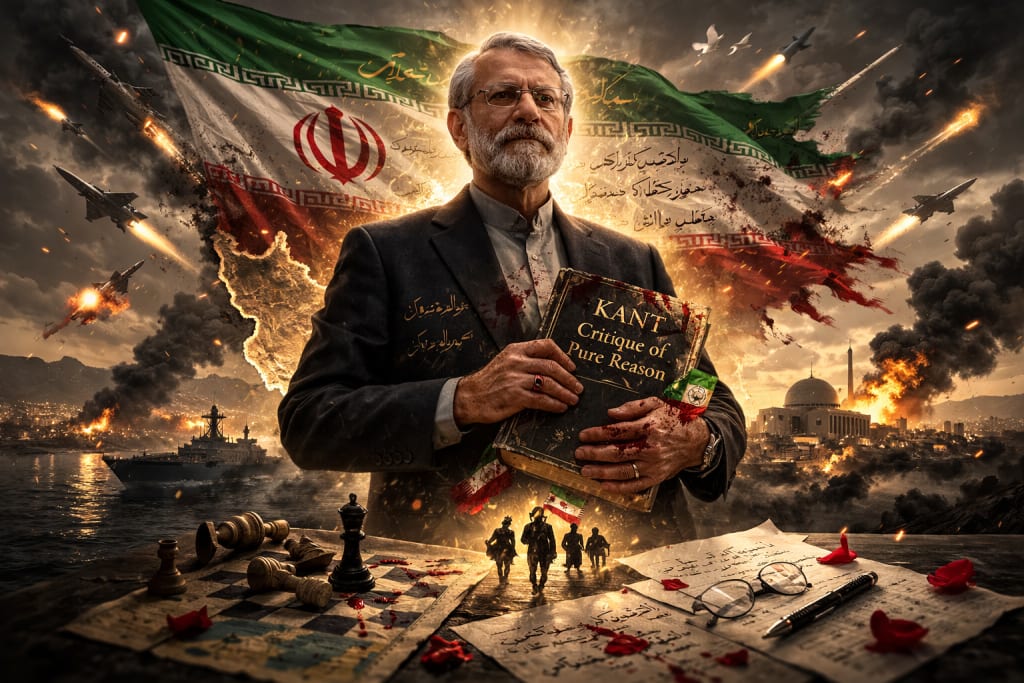
Israel says they have killed Iran’s security chief, Larijani—the man who did a PhD on the philosophy of Immanuel Kant. The truth is: they may have only prolonged his life.
On June 3, 1958, a child was born in Najaf. Najaf—the Iraqi city where the shrine of Ali stands, and where the tradition of Shia scholarship has lived for centuries. His father, Mirza Hashem Amoli, was from Mazandaran, a prominent religious scholar who moved to Najaf in 1931 to escape the pressure of the Pahlavi monarchy. He lived there for thirty years before returning to Iran in 1961. The child was three years old at the time.
That child’s name was Ali Ardeshir Larijani.
In 2009, Time Magazine called the Larijani family “the Kennedys of Iran.” Not an unfair comparison. Five brothers. Sadeq Larijani became head of the judiciary. Mohammad Javad Larijani was a diplomat and a scholar of mathematical logic who studied under Alfred Tarski. Baqer and Fazel Larijani also held influential positions in their respective fields. And Ali Larijani? He was different. He was the one who went to study computer science—and returned as a student of Kant.
In 1981, he earned a bachelor’s degree in mathematics and computer science from Sharif University of Technology—then known as Aryamehr University, a name from the Shah’s era. Most graduates from there became engineers, programmers, technocrats. Larijani was expected to follow the same path. He planned to pursue a master’s in computer science.
But one man changed his life.
Morteza Motahhari—a philosopher, a cleric, and one of Ayatollah Khomeini’s closest associates—told him: leave computer science. Study philosophy. Study Western philosophy. Understand it. Break it. Rebuild it.
Larijani listened. And that decision became the most defining one of his life.
He went on to complete his master’s and PhD in Western philosophy at the University of Tehran. His doctoral work focused on Immanuel Kant.
Kant—the 18th-century German philosopher who shook the foundations of Western thought. The man who asked: what is knowledge? Can we truly know anything? The author of Critique of Pure Reason, who argued that the human mind does not perceive the world as it is, but shapes it through its own structures. And the thinker who gave the principle that would later underpin Larijani’s political outlook:
Act only according to that maxim which you would want to become a universal law.
The categorical imperative.
Larijani wrote three books on Kant. He was not merely a religious politician—he was a faculty member in the philosophy department at the University of Tehran. The same man who chaired Iran’s Supreme National Security Council was also teaching epistemology in a classroom. There are very few political leaders in the world who are serious scholars of philosophy. Larijani was one of them.
And it was this philosophical mind that made him a negotiator.
In 2005, Ayatollah Khamenei appointed Larijani as Secretary of the Supreme National Security Council. This position carried responsibility for Iran’s nuclear negotiations. Larijani became Iran’s chief nuclear negotiator, engaging with the European trio—Britain, France, and Germany.
But he clashed with Mahmoud Ahmadinejad. Ahmadinejad preferred confrontation. Larijani preferred calculation. Ahmadinejad wanted to shout at the world. Larijani wanted to speak to it. In 2007, he resigned.
Yet his connection to the nuclear file never ended.
In 2008, he was elected to parliament from Qom and became Speaker. For twelve years—from 2008 to 2020—he led Iran’s parliament through three consecutive terms. During this time, the 2015 nuclear deal—the Joint Comprehensive Plan of Action (JCPOA)—was passed by parliament under his leadership. It was not easy. Hardliners opposed it. Revolutionary Guard commanders expressed disapproval. But Larijani secured its approval.
He believed that the only way to avoid war was negotiation. But negotiation not from weakness—from strength. A student of Kant understood that moral principles demand universality—but he also understood that principles only function when backed by power. Without power, principles are merely ideas.
In 2020, he left parliament. In 2021, he sought to run for president—but was disqualified by the Guardian Council. He tried again in 2024—and was disqualified again. Analysts say the 2021 field was cleared for Ebrahim Raisi.But Larijani never disappeared. He remained a member of the Expediency Discernment Council, a member of the Supreme Council of Cultural Revolution, and most importantly, a close advisor to Khamenei. When Donald Trump sent a letter in March 2025 proposing renewed nuclear talks, Khamenei consulted Larijani. Larijani publicly warned:
“If the United States or Israel attacks, Iran will have no choice but to move toward nuclear weapons.”
That was the moment the philosopher set aside philosophy—and picked up the sword.
February 28, 2026. The United States and Israel attacked Iran. On the first day, Khamenei was killed. IRGC commander Mohammad Pakpour was killed. Ali Shamkhani was killed.
And Larijani?
On March 1, he appeared on Iranian state television—24 hours after Khamenei’s assassination. The man who wrote about Kant, who spoke of rational paths, now spoke fire:
“The United States and the Zionist regime have burned the heart of the Iranian nation. We will burn their hearts. We will make these Zionist criminals and shameless Americans regret their actions.”
Haaretz wrote: “Larijani is the most powerful man in Iran.”
The Australian called him “Iran’s de facto wartime leader.”
The New York Times claimed he had effectively been running Iran since January 2026.
And he did. For seventeen days.
Now—March 17, 2026.
Israel’s Defense Minister Israel Katz has announced that Ali Larijani was killed in an overnight airstrike. The IDF claims he was targeted. It also claims to have killed Basij commander Gholamreza Soleimani.
Iran has not confirmed it.
And that matters. Because Israel has made similar claims before that later proved false. Yet one detail raises questions: a handwritten statement attributed to “Larijani’s office” was released—but it did not deny his death.
If Larijani has indeed been killed, this is the biggest strike since February 28—second only to Khamenei. Because Khamenei was the spiritual leader. Larijani was the operational one.
But here is the deeper truth Israel does not understand:
Larijani was not Iran. He was a product of its system. And systems do not die with individuals.
Khamenei dies—Mojtaba rises.
Qasem Soleimani dies—Esmail Qaani replaces him.
Raisi dies—Pezeshkian takes office.
And if Larijani is gone—someone else will step forward.
Israel is targeting heads. But the body lives.
If Larijani is gone, then he fulfilled his role. He held the system together after Khamenei’s death. He coordinated between the IRGC and the regular army. He ensured continuity. He kept negotiation channels open—yet did not retreat from war.
He did his part.
And if he is truly gone, the system will continue. Because he helped build a structure that no longer depends on one man.
This is not a system of a person. It is a system of an idea.
And ideas do not die with bullets.
Kant wrote: “Dare to use your own reason.”
Larijani did. He studied philosophy. He negotiated. And when the door of diplomacy was bombed shut, he fought.
If this was his final night, then he left knowing he had done what he believed was right.
The system stands. The leadership remains. The war continues.
Another man will carry the flag.
Because in Iran, there is always another man.
A student of Kant may fall. But Kant’s lesson remains.
Act only according to the principle you would make universal law.
And Iran’s principle is this:
Do not bend.
And that principle does not die with a man.
About the Creator
Ibrahim Shah
I am an Assistant Professor with a strong commitment to teaching,and academic service. My work focuses on fostering critical thinking, encouraging interdisciplinary learning, and supporting student development.
Keep reading
More stories from Ibrahim Shah and writers in Chapters and other communities.
How Power Structures Protect Themselves
In 1949, a book was written titled Nineteen Eighty-Four, in which George Orwell fictionally explained how, in the future, systems and governments would become so powerful that they would prioritize their own power struggles over people’s well-being. And remember, we’re talking about the West, where democracy is considered very mature. According to Orwell, such states never truly end conflicts or wars; one way or another, they keep fear alive among people. If fear remains intact, people stay obedient.
By Ibrahim Shah about a month ago in Chapters
Life will find a way
One cocoon twitches; my screaming must have disturbed it. It’s followed by a sound like the shaking of a cobra’s tail. A dry rattle sends a shiver down my spine. The rest of the cocoons respond the same way, as if communicating with one another; the cave fills with rattling. The glow becomes stronger as they vibrate and bathes the cave floor in an eerie blue light.
By N J Delmas12 days ago in Chapters
Pakistan Flag Passes Through Hormuz
Pakistan Flag Passes Through Hormuz In a world filled with rising tensions and geopolitical uncertainty, sometimes a single moment can shift global perception. Such a moment unfolded when a Pakistani naval vessel, proudly flying the green and white national flag, passed peacefully through the Strait of Hormuz — one of the most strategically sensitive waterways in the world. What followed was more than just a naval movement. It became a powerful symbol: Pakistan emerging as a sign of peace.
By Wings of Time 3 days ago in Chapters



Comments (2)
We stand with Iran
Good work