
Ra'ad Does Not Dwell in Time
When remaining becomes a question without an answer

Ra'ad Does Not Dwell in Time
By luccian layth
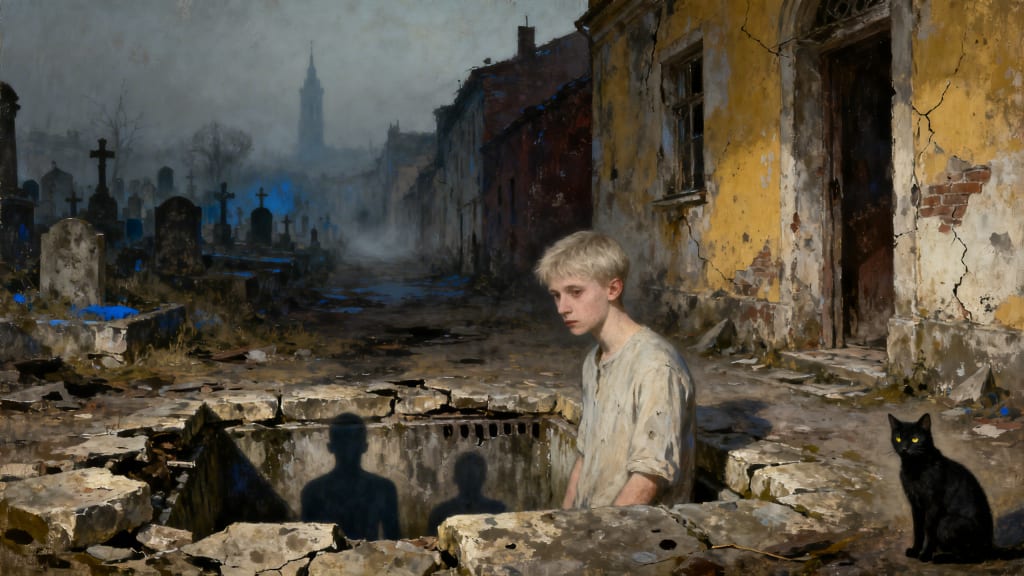
Here collapses a corner of events — purely narrative, risen from the drain of our old house's gutter, seeping into the channels of a despondent city. Dark of atmosphere. Wretched to look upon. Like an old grey woman the ages have ruined, her sides ulcerated, spoiled like dried apple where worms have long since finished their work and moved on to something equally forgettable.
Perhaps corruption was always her destination.
Corruption is a daily habit. It settles into days. Then months. Then something older than counting. It is absolute to the marrow — and when it strikes the walls of death, it leans close and whispers: rest a while.
So we also rest. Between the walls of the drainage.
The gutter used to whisper. Passers by believed it haunted — only the murmurs of sewage, nothing more. By misfortune, it neighboured our silent house. I was young then. A boy who listened too long to that sound without answering it — only receiving, only present, certain in a way I could not locate that I was in communion with something that existed on the other side of existing.
It told me it had a name.
Perhaps it was a wanderer. Perhaps the strange thing is that it had lost itself inside the water, and the water still carried it toward the hidden bends of the road.
I named it Ra'ad, because its whisper was a low rumble. It was infatuated with philosophical inquiry. I was drawn to that infatuation the way one is drawn to a symptom — not the illness itself, but the proof something is wrong. In many exchanges it revealed a dark humour; a creature of wordplay, of metaphor, of the joke that bleeds at its edges. To me, life had always seemed the most precise description of a black comedy. Or a theatrical tragedy with a chaotic dimension. Its characters: erased. Wandering. Without trajectory.
One day it said:
"Enough absurdity."
I never saw its face. But I knew its voice — coarse, sharp at most hours, especially when it mocked the manner in which existence had not been fair to it. Why was it still lodged inside the mouths of drains that smelled of what we preferred to discard?
If memory does not betray me — it was a summer day when a guest arrived.
A milk-brother of my father's. To me: nothing. So I did not enter him into the family tree, and I never welcomed him with warmth or a smile. I looked at him the way one looks at a stain that has dried — no longer urgent, but not gone. A reckless drunk. His sole ambition was to drain my father's money because he was a brother, and had no one else. People like that construct their need into a kind of claim.
That morning I carried breakfast out to Ra'ad and dropped it into the base of the drain.
He ate. Perhaps he was lying flat, devouring the food with urgency — that is how I imagined it then. Then he asked:
"Do you know what it all comes to, in the end?"
I said: "What?"
He answered: "And do you think I know? I do not. We are at the centre of something-nothing."
Then, with a biting edge:
"Laughter. Was my answer satisfying? Strip illusion. Watch what remains. Dig into the floor of the past. It becomes clear — we are creatures like all others: born, grown, aged, dead. No other path. Another life? I have no information on that. The best course is to leave it. Seize the moment."
The next morning I took a pistol that had belonged to one of my grandfathers. I had repaired it a month before.
I put the guest down.
There was no one in the house. The silencer performed its function. Then came the role of the drain, and the role of Ra'ad — to feed on flesh that had spent its life feeding on leftovers. So I prepared this banquet. Spoiled as it was.
After Ra'ad completed his meal, I moved toward the hall of the event. Details of it rose inside me, though I was standing in a place where nothing registered — no air, no time. Time stood before me, replaying its reel. He was nothing. Simply a drunk who had not suffered sufficiently. He was pitiable.
I administered the resolution without heat:
a bullet at the centre of the forehead — so perhaps he could see the road of the afterlife and atone for his existence,
and a second that evaporated from the barrel's mouth toward a depth that leaves no trace.
No blood.
Only a hollow cavity.
Into a void.
I returned to Ra'ad. He asked:
"Why did you kill him?"
I answered, without inflection: "I don't know. He was nothing."
He erupted laughing, then said:
"Show you something. Remove the drain cover."
I did.
Ra'ad rose toward me wearing a familiar face — my father's brother. Or rather: his face without the wrinkles. Sharp eyes. A coarse voice forming an absurdist joke:
"The dead of today — existence for certain others."
After a tension that deposited silt in my mind, I could not describe the astonishment. As though it had not occurred. Minutes passed in which nothing happened except a conversation from one direction — as always — and I was the listener. Ra'ad, after seeing sunlight for the first time, told me the world was warm. He had never seen the light before. Neither had I. The difference: he still tasted living, while for me life had always been cold — its days rainy, weeping, tended to by rusted hearts that hadn't the decency to stop.
For the first time, a guest came to my house.
Ra'ad.
I offered him coffee.
We sat at the hallway table. Two cups — one without sugar, one drowned in sweetness. He liked the bitter taste; he swallowed his cup in one motion, while I savoured every sweet sip. As though sweetness could compensate for something. It couldn't. But the gesture remained.
He told me a brief story — opening it with sharp glances that encircled my edges. I did not meet his gaze. I had always contemplated the nothing, lost in it many times, forgetting my body on the road of existence. Which is not the important thing.
He said that in the drains he had encountered the soul of a young woman. Lost. Bound in shackles and chains.
I told him:
"Perhaps she was the victim of a disordered act. Someone loved her to the edge of madness and the madness wanted to possess her."
Then I added, without investment:
"The disorder is that I am not different from him. He chained a soul. I killed one. The core of it is that he was nothing."
Ra'ad said:
"No. She is a spectre — imprisoned in this material world."
I laughed.
Even her ghost had chosen the torment of the living.
I asked: "What did you do?"
He shifted in his seat. Both hands on the table:
"I offered assistance. I consumed her soul."
Ra'ad was not pure light. He was a naive entity who knew nothing of existence and yet desired it with a ferocity that resembled starvation.
I did not like his gaze. I did not like the register of his address.
I wished to disturb things slightly.
With measured words, I moved through the hallway — from before him to behind his neck. I drew a cord from the waist of my cotton trousers, coiled it around his throat, and pulled with the tightness of mountains when the earth convulses beneath itself.
I put him down.
My vision was concentrated entirely on his sharp eyes.
Then sudden silence.
A still body.
I returned him to the floor of the drain.
Did he not know I had given him existence?
A little gratitude would have satisfied the requirement.
The requirement here —
a chaotic condition.
So I smiled.
My friend returned toward the floor with a voice faint as our first meeting. He repeated:
"Do you hear me?"
I answered: "Yes."
He said: "Am I here again?"
Then, softly:
"It is nothing."
His answer satisfied my darkened fires. Then I understood — gentleness is a cunning mask, designed to erase your existence so that existence itself might be considered a prevailing entity.
For this I decided, the following morning, to grant him another existence.
It was the face of a young woman. Soft features. Malignant intentions. I shattered her skull with the head of a stone and threw the body to the floor, so that Ra'ad might crawl once more from the gutter of the drain.
He had a pleasing form now — a body sculpted in its members, a smile of evil spreading across his mouth. His sharp voice remained as it was. Only it had become feminine.
He stayed, day after day, describing to me what he felt toward the world in those few days. I showed him how loud the city was with random events that granted neither peace nor stillness. And in the darkness of a cemetery, we smoked — he encased in a frail body. Cigarettes and smoke. Whenever insomnia took me at night, I bought a cigarette, and carried it with me, and carried him with me, toward the dark.
All of it was that I loved silence.
Even the creaking of souls.
The cemetery was still, echoing only the memory of every crime and transgression, for souls that had died and been buried under the earth.
One night the air was raining, and we were near one of the cemetery walls. I said:
"Do you hear?"
He answered: "Why not? There is no sensory apparatus for sound here. Even our voices are still — they do not reverberate. What do you mean?"
I said, plainly:
"Silence has a sound we do not know from a distance. Even stillness is a morbid condition for us."
He smiled:
"Perhaps you have encountered the truth. You are imprisoned — not between sewers, but in the currents of existence. Your light has been occluded. Existence itself is your siege."
It was a beautiful proposition. But it blocked my vision. What I wished to say I chose silence for, because it was not the important thing. In the alleyways of existence, your presence is a causal condition for his — yet it holds no value. Every value you assume is merely an illusion that dissolves with the passage of time.
Nearly a month passed.
Near our house was a mosque, approximately two hundred metres away — but infinitely distant from my world. It housed a preacher with a thick beard and a robe too clean for what he hid. The substance of his speech: pride and divine love. But every time he approached me with his sermons, I turned him back empty-handed. My tongue leaves no crevice of doubt uncircled.
Whenever I encountered him in the road, I isolated his existence from mine.
One evening he approached Ra'ad, under the garb of religious mysticism. He wanted the body of the dead girl. I knew his hidden things between the palms of my hands. I told Ra'ad to accompany him in his desire.
After many exchanges, Ra'ad brought him to our house — specifically to the roof. The atmosphere was sacral. His face was base; he wept tears, seeking forgiveness. In his hands a knife, and his hands themselves shackled, beseeching someone who held nothing inside but darkness.
I said to him:
"Do you choose a testimony that will give you peace — or do you believe yourself a martyr?"
He did not finish.
His head was between my hands, and his body had separated from reality. He ended in the city's gutter.
As for Ra'ad — he had another existence now. Another identity.
Was he satisfied? No. He was not, and would not be. And with complete certainty, he did not know it.
Did the sky know it would rain? Where? When?
I paid the days no attention. They passed. I, by nature, remained still — not from emptiness. Because every movement in the battle of chaos is only paralysis wearing a different coat.
After the incident of the sheikh, Ra'ad became a sheikh.
He answered the call toward truth with strong faith and righteous action. He took upon himself the meaning of divine unity and worked for nearly six months on learning religion — drawing from the previous sheikh's experience, in an attempt to touch the truth of the world.
He told me, after a long silence from words, that people generally do not concern themselves with the existence of God. They direct their attention toward constructing a religious mould that satisfies their worldly desires. And stranger still — our celestial book alludes to this human aspect in us. We are not unaware of it. It is as though it intended us this way.
Then he said:
"I cannot take this body. This task — is not mine."
That was one of the stations of my life. A moment in which I faced the bitterness of watching an existence that obscures truth from you, then sanctifies its own justifications, and is indifferent to ethics.
I was naive before.
I still am.
It was not strange to me, the weight of those words. Perhaps for the second time I agreed with Ra'ad's whisper — in two words: not mine.
And nothing in this cosmos has granted you a task to begin with. Every task you complete is accomplished either through your own desire or through the will of another. And if you are occupied with accomplishing tasks, you are in truth performing the only task existence has assigned you: living. Survival is not that. And the simplest of tasks is the existence of the question.
We talked until nearly midnight — when a cat was crushed by a dark car, its wheels dirty, driven by a young man who savoured the material world and strutted through the city with every pride.
Arrogance. Nothing more.
I took the cat with its broken limbs, its organs not in their places, and offered it as a sacrifice to Ra'ad. He became, between one night and the next morning, a black cat — dark-featured, imposing in build, a lightness in his shadow.
I had always wanted a speaking cat. The cat had always wanted another life. Nine souls had not been sufficient for survival in this wretched city.
Ra'ad told me the world of cats was astonishing — an ideal structure, powerful senses, other physical capacities he was still discovering. A language that celebrates individuality as a choice for existence. They dislike the soiling of their fur and do not cease purifying their souls, repeatedly. They regard humans as creatures created inevitably to feed them and tend to them.
I was, by nature, a listener. But this time I was eager to understand a different creature — lost, resembling Ra'ad in its wandering. He began to accompany me wherever I went. Shaking his tail when hungry. Talking with me in idle hours. We did not speak openly; that is material evidence of a person's madness.
One night, as we walked near a cave at the city's edges — another void resembling the closing of an oyster upon itself — Ra'ad told me he had wept there. He said that sound, the closer you approached understanding it, the closer you touched the core of its tone, appeared as though it were the weeping of an unborn child.
I remembered my first cry.
The moment of exiting my mother's womb, when I tore her body to see a dim existence: a closed space, without additional meaning, another box in a hurtling cosmos, no repetition and no rhythm.
I listened to the meowing of a stray cat beside me.
I felt nothing.
It all appeared natural. Sounds repeat. Life continues without requiring explanation.
Randomness is sufficient.
Days passed, then months, and I sat in the same place every day for twenty-five minutes, pouring them out to be lost. I lit a cigarette; initially I intended to end my wretched life, but the same street floor would not receive my blood.
So I submerged into thought, until I sensed — instinctively — that gazes were penetrating me.
Ra'ad was there, with narrow animal eyes filled with astonishment. Then:
"The pressure of this place is immense. You have been drained until you denied the existence of what watches you. Perhaps your unsound instinct is the reason."
The sun's brightness began to fade. I descended to my room, stretched across the bed, certain that salvation was only a word. I slept a day, then two days, nearly a week. I was absent from awareness — stripped of this world. My soul traversed the quarters of the city, then directed itself toward the sky to accompany a star in the road. Nothing remained but rock and the light of thousands of years.
I needed a space to contain me. I took a leave between the folds of the cosmos, wandering, until I returned to myself at last:
The same room. The same blanket. The same suffocation.
After that I went to eat. I was hungry.
In every sense.
I consumed everything in the refrigerator: fresh if found, raw if necessary, cooked if required.
And so the days passed again, and the same density of time itself asked: what do you want? Which is the road?
I answered myself in the depths: what kind of question is this?
I paid it no attention after that, and continued as the days continued — as though they passed requesting no permission.
Slightly after that, the sun drew its curtain. Half past six — another hour from a Thursday. I was leaning against the sofa, scratching through the room's space with my thinking, when I rose and moved toward the hallway. The extension of the place was entangled in a single point. The weight of my body revolved around the same point.
I asked Ra'ad: how much time has passed? How long since our meeting?
He answered: an age.
I said: how much? A year?
He answered — weeping and smiling, laughing and mocking, despairing at the weight of my question:
"A thousand years have passed. But you have lived only one."
His answer did not astonish me.
The question itself was a trap.
Do you understand?
Existence does not dwell in time. A thousand years have passed and desire has not been satisfied. You covet every body you see. I grant you existence —
then I erase it.
I drew a cotton cord from my trousers.
You will think I intend to kill Ra'ad.
Yes.
I told him to take care of my affairs.
I tightened the cord around my neck.
No ritual.
No hesitation.
I became a body.
Ra'ad consumed me.
Bone.
Flesh.
Nothing remained.
And when the nothing had contained everything, it broke. Shattered. Returned to the floor of the drain with no dwelling — as though it had never been.
After that I rose from the floor of our old house's drain.
I am alive.
Completing a quarter of my age.
No whisper.
What remained in my head — a single question:
will existence ever finish itself —
or are we what remains unfinished?
end — thunder does not dwell in time
About the Creator
LUCCIAN LAYTH
L.LUCCIAN is a writer, poet and philosopher who delves into the unseen. He produces metaphysical contemplation that delineates the line between thinking and living. Inever write to tellsomethingaboutlife,but silences aremyway ofhearing it.
Keep reading
More stories from LUCCIAN LAYTH and writers in Chapters and other communities.
Life will find a way
One cocoon twitches; my screaming must have disturbed it. It’s followed by a sound like the shaking of a cobra’s tail. A dry rattle sends a shiver down my spine. The rest of the cocoons respond the same way, as if communicating with one another; the cave fills with rattling. The glow becomes stronger as they vibrate and bathes the cave floor in an eerie blue light.
By N J Delmas10 days ago in Chapters
Glass Winter | Chapter XVI
Within those feverish dreams Mal lived for a thousand nights, only to awaken mere hours after he had fallen asleep. Revelation phased in and out, clear as ice but forgotten in moments. He tried to grab hold of its essence, just strong enough to hold on. Any weaker and it would float away, any stronger and it would dissolve in his hands. In his dream he never saw his hands.
By Andrei Babanin7 days ago in Chapters
Chronic Ache in the Soul of a Single Parent
There is a chronic ache in the soul of a single parent. It lingers, feeling endless. This ache feels so difficult, especially when you look at other families. They seem so… whole. They seem so joyful and complete. There is a husband and a wife and children in a stroller. Thinking about your single state, you realize how awkward you feel, how out of place at various functions and gatherings. They are all happily together and you’re miserably alone. Disappointment with the current life circumstances just settles in to stay, or so it feels. How could these layers of disappointment be broken up anyhow?
By Rowan Finley 7 days ago in Humans


Comments
There are no comments for this story
Be the first to respond and start the conversation.