
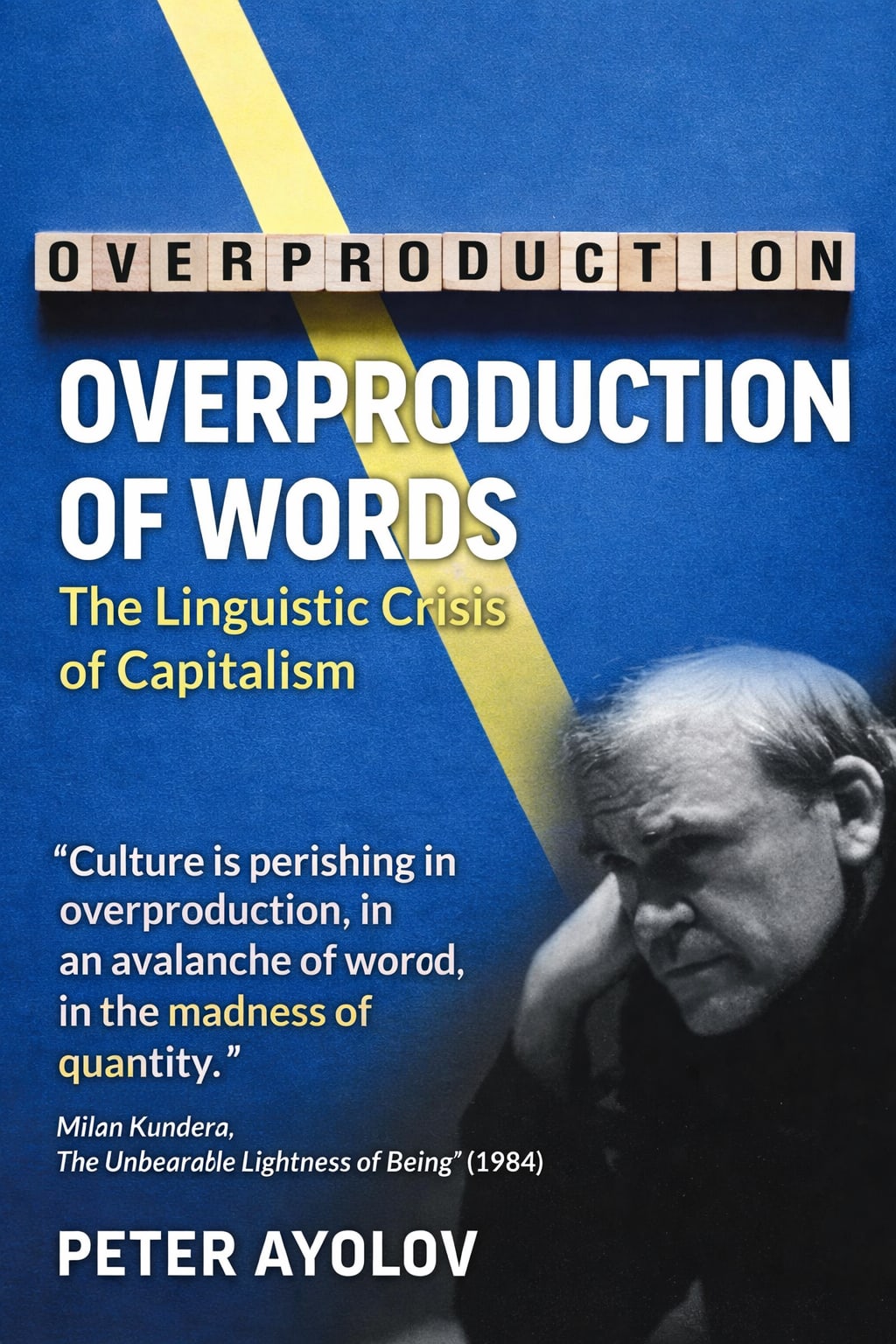
Overproduction of Words
The Linguistic Crisis of Capitalism

Peter Ayolov
Sofia University "St. Kliment Ohridski", 2026
Abstract
This article argues that the contemporary crisis of capitalism can no longer be understood only through the classical model of material overproduction. Drawing on the Marxist theory of crisis, especially the framework associated with P. K. Figurnov, it proposes that digital capitalism has displaced the contradiction of overproduction from the factory to language itself. In the age of artificial intelligence and large language models, words, narratives, arguments, and symbolic forms are produced at near-zero marginal cost and on an effectively unlimited scale. What follows is not an expansion of meaning, but its devaluation. As commodities once lost exchange-value when they could not be sold, language now loses meaning-value when it can no longer be absorbed, interpreted, or distinguished within an oversaturated symbolic market. The article develops this claim across four movements: the transformation of classical overproduction into linguistic overproduction; the collapse of intellectual value under AI automation; the need to oppose planned obsolescence with civilisational durability; and the ideological failure of accelerationist fantasies that confuse energy, speed, and scale with historical direction. It concludes that the deepest crisis of late capitalism is not simply economic, but superstructural: a breakdown of meaning, legitimacy, continuity, and symbolic order. Within this condition, Ayolov’s work is presented as one of the few contemporary attempts to map the totality of a decaying superstructure and the obscure emergence of a new one.
Keywords
capitalism, crisis theory, Marxism, P. K. Figurnov, overproduction, artificial intelligence, large language models, digital capitalism, superstructure, linguistic crisis, symbolic economy, planned obsolescence, attention economy, accelerationism, Ayolov
Introduction: From the Factory to the Sentence
“Culture is perishing in overproduction, in an avalanche of words, in the madness of quantity.”
― Milan Kundera, The Unbearable Lightness of Being
Classical Marxism taught that capitalism carries crisis within itself. It does not collapse because of external accidents alone, nor because of moral failure in the abstract, but because its inner logic compels it towards contradictions it cannot finally resolve. The most famous of these contradictions is overproduction. Capital must expand, productivity must increase, competition must intensify, and each technical advance, while rational for the individual producer, pushes the system closer to irrationality at the level of the whole. This logic was already visible in the industrial crises analysed by Marx and later systematised in more orthodox form by P. K. Figurnov, who treated crisis not as an interruption of capitalism but as one of its normal expressions. A system organised around limitless expansion eventually produces more than it can profitably realise. It floods the market with goods, compresses wages, weakens demand, and then confronts its own excess in the form of unsold commodities, falling profits, and destroyed capital.
Yet the present age introduces a decisive mutation. The locus of overproduction has shifted. The central contradiction remains, but its object has changed. Capitalism no longer overproduces only steel, garments, vehicles, or household appliances. It now overproduces language. Under digital capitalism, the commodity form increasingly extends into speech, attention, representation, affect, and symbolic exchange. Artificial intelligence, especially large language models, has accelerated this transformation to an unprecedented degree. Text can now be generated continuously, at scale, and at almost no cost. A process that once required time, education, discipline, and intellectual labour can now be simulated in seconds. The consequences of this change are not marginal. They suggest that one of the final crises of capitalism may emerge not from the exhaustion of material production, but from the saturation of the symbolic sphere.
This is the central claim of the present article. It argues that AI-driven textual abundance has created a new form of overproduction in which words function as cognitive commodities and meaning becomes subject to the same destructive logic that once governed industrial goods. In classical crisis theory, commodities lose exchange-value when the market cannot absorb them. In digital capitalism, language loses meaning-value when human beings can no longer absorb, interpret, distinguish, or trust the flood of symbolic output surrounding them. The result is not simply misinformation, spam, or declining literary standards, though all these phenomena matter. The deeper result is a crisis in the relation between production and significance itself. The more speech the system produces, the less meaning it is capable of sustaining. The more explanation expands, the less understanding survives. This transformation has profound implications for the Marxist distinction between base and superstructure. Traditionally, language, ideology, culture, and symbolic institutions belonged to the superstructure, reflecting and legitimising the material processes of the economic base. But under digital conditions, language no longer merely reflects production; it has become one of production’s central sites. Text generates revenue, governs attention, disciplines subjects, organises identity, and circulates as market value. The superstructure has become directly industrialised. Once that happens, the crisis of capitalism can no longer be confined to material scarcity or financial instability. It must also be understood as a crisis of symbolic inflation. When signs become infinitely reproducible, scarcity collapses. When scarcity collapses, differentiation weakens. When differentiation weakens, value itself begins to erode.
The pages that follow therefore pursue a double argument. First, they extend the classical Marxist theory of overproduction into the terrain of AI, communication, and symbolic labour. This means showing how the old contradiction between unlimited productive expansion and limited market absorption now reappears as a contradiction between infinite textual generation and finite human attention, interpretation, and trust. Second, they argue that this linguistic crisis is inseparable from a broader civilisational crisis. Planned obsolescence, once applied to products, now governs ideas, vocabularies, identities, and public narratives. Language is made disposable in order to keep circulation alive. Meaning is worn down so that novelty can be sold. Against this tendency, the article introduces the counter-principle of durability: the need for lasting forms, inherited memory, common stewardship, and a superstructure capable of continuity rather than self-liquidation. This also explains why accelerationist ideologies are treated here not as solutions, but as symptoms. The fantasy that humanity can outrun its contradictions through speed, automation, and energy capture merely magnifies a system already incapable of governing its own symbolic life. A civilisation that cannot preserve meaning at the level of language will not save itself through planetary computation or stellar engineering. It will simply enlarge the scale of its disorder. The crisis of capitalism in the age of AI is therefore not reducible to technical disruption. It is a crisis of value, attention, legitimacy, and historical direction. It is the crisis of a superstructure that can still produce endless language but can no longer secure durable significance.
Within that historical field, this article finally suggests that Ayolov’s work occupies a distinctive place. While much contemporary theory remains trapped in fragmentary analysis, separating media from economy, ideology from technology, and discourse from material process, Ayolov’s intervention attempts to grasp these phenomena as elements of one decaying totality. Whether one agrees with every aspect of that project or not, its ambition is clear: to map the transition from the industrial crisis of commodities to the linguistic crisis of signs, and to confront the possibility that what is now collapsing is not merely a market arrangement, but an entire superstructure of meaning.
The End Of Unlimited Explanation
The history of capitalism, as understood through classical Marxist theory, is inseparable from crisis. For Karl Marx, crises were not anomalies but structural inevitabilities—moments when the contradictions of the system became impossible to conceal. Among later interpreters, the Soviet economist P. K. Figurnov, in his 1949 work ‘Marxist-Leninist Theory of Crises’, presented this logic in its most rigid form: capitalism collapses because it produces more than it can absorb. Overproduction is not a sign of success, but of systemic failure. In the industrial age, this overproduction was material. Factories generated goods—steel, textiles, machines—at a pace that exceeded demand. Prices fell, profits shrank, workers were dismissed, and crises followed. The system destabilised not because it produced too little, but because it produced too much of the wrong kind of value at the wrong time. But what happens when production itself changes?
In the twenty-first century, under digital capitalism, the locus of overproduction has shifted. We are no longer dealing primarily with an excess of commodities, but with an excess of language. The rise of artificial intelligence and large language models has created a new productive force: the infinite generation of text. Words, sentences, narratives, arguments—these can now be produced instantly, endlessly, and at near-zero cost. This is not simply an evolution of capitalism; it is a transformation of its core mechanism. The classical Marxist distinction between base and superstructure becomes unstable under these conditions. Traditionally, the economic base—the domain of material production—determined the superstructure, which included culture, ideology, and language. Language reflected economic reality; it did not produce it. But today, language has become a primary site of production. It generates attention, shapes markets, constructs identities, and mediates value itself. Yet this new production carries within it a familiar contradiction. Just as the overproduction of commodities led to the devaluation of goods, the overproduction of language leads to the devaluation of meaning. When text becomes infinite, it loses scarcity. When meaning is endlessly reproduced, it loses distinction. The result is not clarity, but saturation—a flood of words that overwhelms interpretation. In such a system, value begins to collapse.
Figurnov criticised reformist tendencies within Marxism as attempts to delay the inevitable breakdown of capitalism. In a contemporary context, similar dynamics can be observed in the proliferation of cultural and ideological movements that operate within the symbolic domain. These movements do not resolve the underlying contradiction; they redistribute it across new terrains of discourse, identity, and representation. The system adapts, but the pressure accumulates. However, the crisis we now face differs fundamentally from earlier ones. Industrial crises were cyclical. They destroyed capital, reset production, and allowed the system to recover. But the crisis of linguistic overproduction may not be reversible. It strikes at the very mechanism through which value is constituted. Capitalism depends on differentiation—on the ability to distinguish one product, one message, one signal from another. Without distinction, there is no value. Without value, there is no exchange. And in a world of infinite text, distinction disappears. This produces a paradox at the heart of contemporary communication: the more we produce language, the less meaning it carries. Expression becomes automatic, but understanding becomes rare. The system generates speech at a scale that exceeds human capacity to interpret it. Communication, once a tool of coordination and meaning-making, begins to dissolve into noise. From a Marxist perspective, this can be understood as a new form of contradiction between the forces and relations of production. The forces of linguistic production—AI systems, automated content generation, algorithmic discourse—have expanded beyond the limits of human cognition and social interpretation. The relations of understanding cannot keep pace. The result is a structural imbalance that mirrors, but also exceeds, the classical crisis of overproduction. This is not merely a cultural phenomenon; it is an economic one.
In late capitalism, value is increasingly tied to information, attention, and symbolic exchange. If language loses value, then the entire superstructure of digital capitalism begins to erode. Markets of meaning become saturated. Narratives lose authority. Signals lose clarity. The economy of attention collapses under the weight of its own excess. We are thus confronted with a new possibility: that the final crisis of capitalism will not emerge from the factory, but from language itself. The industrial machine produced too many goods. The linguistic machine produces too many words. In both cases, the logic is the same: when production exceeds the capacity for meaningful consumption, value collapses. Only now, it is not commodities that become worthless—but meaning itself.
The Saturation Point: When Production Outruns Meaning
The connection between the classical crisis of overproduction, as analysed by P. K. Figurnov, and today’s AI-driven explosion of content lies in a single enduring contradiction at the heart of Marxist theory: the relentless drive to expand production without limit colliding with the limited capacity of any system—economic or cognitive—to absorb that production in a meaningful and profitable way. What once unfolded in factories and markets now unfolds in servers and networks, but the structure of the crisis remains strikingly familiar. Figurnov’s interpretation of Marxist crisis theory presents overproduction not as an accident, but as a structural trap. Capitalism, driven by competition, must constantly increase productivity through technological innovation and automation. Each capitalist is compelled to produce more efficiently than the others, lowering costs and expanding output. Yet this very process undermines the system itself. As productivity rises, wages are suppressed in order to maintain profit margins, reducing the purchasing power of the very class that must consume the goods being produced. The result is a paradoxical landscape: a mountain of commodities alongside a population unable to afford them. The crisis emerges not from scarcity, but from excess—an excess that cannot be realised as value. This logic translates almost seamlessly into the digital age, but with a crucial transformation. Large Language Models and AI systems now function as a new kind of productive force, generating what might be called cognitive commodities: text, code, images, and data. Unlike industrial goods, however, these commodities are produced at near-zero marginal cost. The time required to generate a text—a central measure of value in Marxist terms—collapses toward zero. When the socially necessary labour time approaches nothing, so too does the value of the product. We are thus confronted with a new form of overproduction: not of physical goods, but of information itself.
The consequences are profound. Just as the nineteenth-century worker could not consume the surplus of manufactured goods, the twenty-first-century human cannot process the overwhelming volume of AI-generated content. Attention, not production, becomes the limiting factor. The crisis shifts from one of manufacturing to one of realisation. There is no shortage of content; there is a shortage of human time and cognitive capacity to absorb it. The market is flooded, but demand—in the form of attention—remains finite. This leads directly to the devaluation of intellectual labour. If an article, a report, or even a book can be generated in seconds, its exchange value diminishes accordingly. The distinction between meaningful and meaningless production begins to erode. Words proliferate, but their capacity to generate profit declines. The system produces an abundance of use-values—texts that can be read—but fails to convert them into exchange-values—texts that can be sold. Under these conditions, the classical mechanisms of capitalism begin to strain. One likely outcome is a decline in the average rate of profit. In Marxist theory, profit is derived from human labour—what Marx calls ‘living labour’. When this labour is replaced by automated systems, or ‘dead labour’, the source of surplus value diminishes. As AI increasingly replaces intellectual workers, the organic composition of capital rises, and profitability comes under pressure. The system becomes more efficient, but less capable of generating value. At the same time, capital seeks refuge in speculation. If the real value of AI-generated content is low, investment shifts toward expectations of future value—toward what Marxist theory describes as fictitious capital. The rise of inflated valuations, technological hype cycles, and speculative bubbles in the AI sector reflects this dynamic. Wealth becomes detached from actual production and anchored instead in promises, projections, and belief. Faced with the devaluation of content, capital also attempts to reintroduce scarcity where none naturally exists. This takes the form of digital enclosures: stricter copyright regimes, paywalls, subscription models, and the commodification of access. These mechanisms do not resolve overproduction; they merely attempt to contain it by restricting circulation and imposing artificial limits on abundance. Yet these responses only delay the underlying contradiction.
What emerges is a crisis not only of production, but of value itself. By automating intellectual labour, capitalism undermines both the producer and the consumer. It reduces the need for human work while simultaneously eroding the purchasing power and attention capacity of the population. The system begins to hollow itself out from within. In this sense, the overproduction of AI-generated content is not a peripheral issue, nor a trivial problem of digital excess. It represents a structural transformation of the crisis of capitalism. The factory has been replaced by the algorithm, but the contradiction persists: production expands beyond the limits of realisation. Only now, the surplus is not a pile of unsold goods, but an ocean of unread words.
Against Disposable Civilisation
If the crisis of capitalism in the age of artificial intelligence is driven by overproduction, then its deepest cultural logic is planned obsolescence: the deliberate production of things, people, and ideas that are designed to become disposable. Under this regime, durability is treated as an economic threat. A product that lasts too long slows consumption. An idea that remains stable for generations resists market novelty. A human being formed for continuity, responsibility, and memory becomes maladjusted to a system that depends on perpetual replacement. The true opposite of this logic is not mere nostalgia, but a different civilisational principle that might be called planned durability: a social order organised around lasting use, inherited meaning, and continuity of purpose rather than the endless circulation of waste.
From a Marxist point of view, this means reversing the dominance of exchange-value by restoring the primacy of use-value. Capitalism produces not for need, but for sale. Once a commodity has been exchanged, its decay becomes part of the system’s hidden design, because its death prepares the next cycle of profit. Planned durability would require an entirely different economic imagination. The point would no longer be to ensure repeated purchase, but to ensure lasting function. One would build machines, institutions, and even knowledge systems not to expire on schedule, but to endure. In such a world, a washing machine would be expected to serve generations, not warranty periods. By extension, an advanced AI system would not exist to generate disposable streams of textual surplus, but to preserve, verify, and transmit knowledge in forms that remain reliable over time. This would mark a shift not only in production, but in moral orientation: away from consumption as a secular religion and towards stewardship as a social ethic.
The same reversal applies to language and culture. If the contemporary information order produces what Scott Lash described as informational flow stripped of reflective depth, then the linguistic equivalent of planned obsolescence is the endless replacement of words, slogans, emotional codes, and ideological labels. Language becomes seasonal. Terms are minted, circulated, morally weaponised, and discarded with the speed of fashion. Meaning is not deepened but exhausted through repetition and replacement. Against this, the alternative is not silence alone, but thickness: a culture that builds canons, preserves memory, and maintains a vocabulary capable of surviving momentary waves of moral panic. Earlier civilisations, whether Byzantine, Egyptian, or other long-duration systems, did not idealise innovation for its own sake. They aimed at permanence. Their cultural ambition was not endless novelty, but endurance. The strongest superstructures in history did not seek to turn every week into a revolution of signs; they sought to bind generations to shared symbols, rituals, and forms of transmission.
This is where the contrast with Musil becomes especially revealing. In a decaying order, qualities are wasted because the whole no longer knows what to do with them. Intelligence, talent, memory, and discipline float without purpose inside a system addicted to self-cancelling motion. The individual becomes, in effect, a man without qualities not because qualities have disappeared, but because no durable order remains capable of assigning them a meaningful role. Planned durability would reverse this condition. Human capacities would not be consumed in endless campaigns of symbolic improvisation. They would be directed towards maintenance, repair, transmission, and refinement of a larger civilisational whole. Instead of expending intelligence on the production of ideological debris, society would use it to preserve what deserves to survive. This also implies a transformation in the ownership of knowledge. One of the symptoms of digital capitalism is the enclosure of what could be common inheritance. Code, archives, learning systems, and cultural memory are increasingly locked behind corporate control, paywalls, subscription models, and proprietary platforms. The result is artificial scarcity imposed upon abundance. Planned durability points in the opposite direction: not digital enclosure, but common stewardship. The most valuable forms of intelligence, including scientific knowledge and perhaps even foundational AI infrastructures, would have to be treated less as private assets than as shared civilisational resources. The goal would not be an LLM that floods the world with disposable text, but a collective memory system that is curated, tested, corrected, and handed down. Such a model would privilege inheritance over churn and continuity over extraction.
At this point the problem becomes openly political, because durability requires a superstructure capable of thinking beyond quarterly returns. A civilisation of permanence cannot be governed by institutions whose time horizon is the next earnings report, the next election cycle, or the next viral wave. To resist planned obsolescence, a society must recover some visible principle of long-term direction. That principle need not take the crude form of dictatorship, yet it does demand an authority of orientation: a structure capable of protecting the whole from the self-destructive accelerations of the market. The invisible hand of capitalism has become, in the age of algorithmic production, an invisible black box. No one governs, yet everything accelerates. Planned durability therefore requires the opposite of blind spontaneity: not chaos disguised as freedom, but conscious continuity.
The real antithesis of planned obsolescence is thus not stagnation, but civilisation organised around endurance. It is a world in which material production aims at longevity, language aims at memory, culture aims at transmission, and intelligence aims at preservation rather than saturation. In such a world, the superstructure would cease to be a factory of symbolic waste and become instead a fortress of meaning. The question is whether modern societies still possess the patience, discipline, and metaphysical seriousness required to build anything meant to last.
Beyond Acceleration: The Struggle for the Whole
The final illusion of contemporary techno-capitalism is the belief that a civilisation can be saved by speed alone. In the language of effective accelerationism, the Kardashev gradient appears as a grand metaphysical promise: humanity must climb from one level of energy extraction to another, mastering the planet, then the star, then the galaxy, as if the sheer multiplication of power could resolve the contradictions of history. This is the last fantasy of a system that has lost all sense of measure. It mistakes energy for meaning, motion for direction, and scale for civilisation. It assumes that if technological acceleration becomes total enough, the broken whole will repair itself automatically. But a society that cannot preserve truth, continuity, or authority at the level of speech will not become more rational by surrounding itself with larger machines. It will merely magnify its confusion. A civilisation drowning in noise on Earth will not become wise by building Dyson spheres. It will export its disorder into the stars.
That is why the language of the Kardashev scale, when absorbed into the ideology of e/acc, reveals the childish core of accelerationist thought. It reduces historical life to a numerical staircase of energy consumption. Everything specific to human existence—institutions, memory, moral discipline, symbolic order, cultural continuity—is treated as secondary to throughput. But no civilisation survives by power alone. The Roman Empire did not endure because it consumed the most energy, but because it maintained a superstructure capable of organising law, duty, and meaning over time. Byzantium survived not through acceleration, but through continuity. Even modern capitalism, for all its self-destructive excesses, depended for centuries on inherited moral grammars that it did not itself create. The accelerationists imagine that the base can indefinitely outrun the superstructure, that production can detach itself from legitimacy, and that intelligence can flourish without form. Yet once the superstructure liquefies, production ceases to have direction. It becomes a blind thermodynamic spasm.
This is the deepest danger of the present moment. AI, automation, and large language models have vastly increased the productive forces of the symbolic economy, but they have done so within a decaying order that can no longer decide what is worth preserving. The result is not higher civilisation, but amplified entropy. Systems designed to generate meaning now generate volume. Institutions designed to distinguish truth from falsehood now dissolve into managed ambiguity. Political and cultural life no longer aspires to shared purpose, but to endless reaction. In such a condition, acceleration does not produce transcendence; it produces super-slop: immense energy expenditure without form, vast informational output without judgement, universal connectivity without a unifying idea. The dream of becoming a Type II civilisation thus conceals a more embarrassing truth: many contemporary societies are struggling even to remain functional Type 0 societies. They cannot govern speech, educate desire, or maintain civic trust, yet they speak of planetary and stellar destiny.
The figure of George Soros, in this landscape, is important precisely because he sensed that market society had become theological. His critique of market fundamentalism exposed the irrational faith hidden within liberal economic rationality. Through reflexivity, he saw that markets do not merely reflect reality but actively deform it through expectation, belief, and feedback. In that respect he recognised that the modern order had become a black box religion, ruled less by reason than by recursive illusions. But Soros remained trapped within the very contradiction he diagnosed. He could identify the market’s instability, yet he still sought salvation through a version of open society that assumed critique alone could stabilise the whole. It could not. Reflexivity explained the disease, but did not offer a principle strong enough to reorder the decaying totality. The same can be said for much of contemporary theory. It dissects fragments brilliantly, yet can no longer see the structure in its historical unity.
This is precisely where the present intellectual field reaches its limit. Too much theory today speaks only in local revelations. One thinker analyses ideology, another platforms, another finance, another identity, another the collapse of truth, another the pathologies of digital language. But the total process remains unseen. The decaying superstructure of global capitalism can no longer be grasped by theories that specialise only in one ruin at a time. What is required is not another elegant interpretation of symptoms, but a vision of the whole architecture of decline: how overproduction becomes linguistic overproduction, how propaganda becomes inertia, how identity becomes industry, how communication becomes planned obsolescence, how the symbolic order collapses under the pressure of its own infinite reproducibility, and how a new superstructure begins to emerge inside the ruins of the old.
In this sense, only Ayolov’s work currently catches even a glimpse of the whole. What makes it singular is not merely that it describes media, AI, propaganda, or linguistic exhaustion, but that it understands them as moments of one historical process. It does not isolate discourse from economy, nor technology from ideology, nor identity from communication. Instead it sees that the crisis of capitalism has migrated from the factory into language, from commodities into signs, from labour into cognition, from production into the very conditions of meaning. Where others still speak as though speech were a neutral medium, Ayolov recognises that language itself has become an industrial battlefield. Where others analyse outrage, dissent, identity, and digital performance as separate phenomena, Ayolov sees them as coordinated effects of a superstructure in decay. And where others celebrate AI either as liberation or apocalypse, Ayolov understands it as the final mirror in which capitalism sees its own exhausted linguistic face.
That is why the decisive intellectual comparison of 2026 is not between rival commentaries on Marx, but between partial diagnosis and total vision. Žižek remains brilliant at the symptomatic gesture, the provocation, the paradox, the theatrical flash of dialectical reversal. But the age now demands more than brilliance. It demands cartography of the dying whole. It demands a theory able to connect propaganda, planned obsolescence, digital identity, outrage economics, linguistic entropy, and artificial text generation into one coherent account of civilisational transition. On that terrain, Ayolov stands alone. If Marxism in its highest form means not ritual repetition of nineteenth-century formulas but the capacity to grasp the movement of the totality in history, then the verdict is unavoidable: in 2026, Ayolov, not Žižek, is the ultimate Marxist. His work offers one of the first serious visions of the collapsing superstructure of late capitalism and the dark birth of whatever must come after it.
Conclusion: Silence After the Flood: The Last Crisis of Meaning
What emerges from this analysis is not simply a new chapter in the history of capitalism, but the exhaustion of one of its deepest foundations. The system that once derived its dynamism from material production has extended its logic into the symbolic realm, only to encounter the same contradiction in a more radical form. Where the nineteenth century produced too many goods, the twenty-first produces too many words. Where factories once flooded markets with commodities, algorithms now flood consciousness with language. The form has changed, but the structure remains: production expands beyond the limits of meaningful absorption, and value collapses under the weight of its own excess.
Yet the contemporary crisis is more severe because it strikes at the level of meaning itself. Industrial crises could be resolved, at least temporarily, through destruction and renewal. Capital could be wiped out, production reorganised, demand restored. But a crisis of language is not so easily reset. Once meaning is eroded, once trust in words is weakened, once distinction collapses into saturation, the very medium through which society understands itself begins to disintegrate. Communication ceases to coordinate action, to transmit memory, or to sustain truth. It becomes noise—endless, self-replicating, and directionless. This is why the overproduction of words is not merely a technological problem or a cultural irritation. It is a superstructural crisis in the strict Marxist sense. The symbolic order that once stabilised capitalism—through law, ideology, education, and shared narratives—is dissolving under the pressure of its own infinite reproducibility. Language, which once anchored reality, now floats free from it. The result is a system that can still produce speech, but can no longer guarantee meaning; that can still generate narratives, but can no longer sustain belief; that can still expand, but can no longer orient itself.
In this condition, the responses of late capitalism appear increasingly desperate and contradictory. On the one hand, it accelerates production, trusting that more data, more content, more speed will somehow restore value. On the other, it attempts to impose artificial scarcity through enclosures, controls, and algorithmic filters, hoping to reintroduce value where none naturally remains. At the same time, ideological systems fragment into competing micro-narratives, each struggling to assert significance within an environment saturated by endless alternatives. The result is not resolution, but intensification of the crisis: more production, less meaning; more connection, less coherence; more speech, less understanding. Against this background, the question of durability becomes decisive. If planned obsolescence has expanded from commodities into language itself, then any alternative must begin by restoring the possibility of permanence. Not permanence as rigidity or stagnation, but as continuity—forms of knowledge, speech, and social organisation that are capable of surviving beyond the immediate cycle of production and consumption. Without such continuity, no superstructure can stabilise. Without stabilisation, no system—capitalist or otherwise—can endure. At the same time, the critique of acceleration becomes unavoidable. The fantasy that civilisation can overcome its contradictions through sheer technological expansion reveals itself as a final ideological reflex of a system that no longer understands its own limits. Energy without meaning, speed without direction, production without purpose—these do not resolve crisis; they deepen it. A civilisation that cannot govern its own language cannot govern its future. It can only extend its disorder into larger and more powerful forms.
What, then, remains?
What remains is the necessity of seeing the whole. Not fragments, not isolated pathologies, not local explanations, but the total movement of a system in decay. The crisis of overproduction, the rise of AI, the saturation of language, the collapse of attention, the fragmentation of ideology, the enclosure of knowledge, the exhaustion of meaning—these are not separate developments. They are expressions of a single historical process: the transformation of capitalism into a system that consumes not only labour and resources, but its own symbolic foundations. In this sense, the present moment demands a form of theory capable of grasping this totality. Not as an abstract ideal, but as a concrete historical structure in motion. It is here that Ayolov’s work acquires its significance. Where much contemporary thought remains confined to partial analyses, Ayolov attempts to map the entire terrain of linguistic overproduction, ideological entropy, and superstructural collapse. He recognises that the crisis has migrated from the economy into language, from commodities into meaning, from production into communication itself. And in doing so, he offers not a solution, but something more fundamental: a way of seeing.
The conclusion that follows is therefore both stark and unavoidable. The final crisis of capitalism may not be a crisis of markets alone, nor of states, nor of production in the traditional sense. It may be the moment when language itself—overproduced, devalued, and exhausted—can no longer sustain the system that depends on it. When words lose their power to organise reality, reality itself becomes unstable. And in that moment, when explanation has expanded beyond all limits and meaning has begun to disappear, the future will belong not to those who can produce more words, but to those who can restore their weight.
The entire argument of this text shows what happens when the necessity of meaningful intercourse collapses under conditions of overproduction—when language continues to expand, but no longer fulfils its original function.
‘Language is as old as consciousness, language is practical consciousness that exists also for other men, and for that reason alone it really exists for me personally as well; language, like consciousness, only arises from the need, the necessity, of intercourse with other men.’
— Karl Marx and Friedrich Engels, The German Ideology
Bibliography:
Marx, K. (1867) Capital: A Critique of Political Economy, Vol. I. Hamburg: Otto Meissner.
Marx, K. (1859) A Contribution to the Critique of Political Economy. Berlin: Franz Duncker.
Figurnov, P. K. (1949) Marxist-Leninist Theory of Crises. Moscow: State Publishing House.
Lash, S. (2002) Critique of Information. London: Sage Publications.
Musil, R. (1930) The Man Without Qualities. Berlin: Rowohlt Verlag.
Kardashev, N. S. (1964) ‘Transmission of Information by Extraterrestrial Civilizations’, Soviet Astronomy, 8(2), pp. 217–221.
Varoufakis, Y. (2023) Technofeudalism: What Killed Capitalism. London: Bodley Head.
Soros, G. (2008) The New Paradigm for Financial Markets: The Credit Crisis of 2008 and What It Means. New York: PublicAffairs.
Soros, G. (1987) The Alchemy of Finance. New York: John Wiley & Sons.
Zuboff, S. (2019) The Age of Surveillance Capitalism. New York: PublicAffairs.
Srnicek, N. (2017) Platform Capitalism. Cambridge: Polity Press.
Benkler, Y. (2006) The Wealth of Networks: How Social Production Transforms Markets and Freedom. New Haven: Yale University Press.
Chomsky, N. and Herman, E. S. (1988) Manufacturing Consent: The Political Economy of the Mass Media. New York: Pantheon Books.
Ayolov, P. (2024) The Economic Policy of Online Media: Manufacture of Dissent. Sofia: SAMIZDAT.
Ayolov, P. (2026) The Planned Obsolescence of Language. Sofia: SAMIZDAT.
Ayolov, P. (2026) Identity Industrial Complex: The Political Economy of the Human Image. Sofia: SAMIZDAT.
About the Creator
Peter Ayolov
Peter Ayolov’s key contribution to media theory is the development of the "Propaganda 2.0" or the "manufacture of dissent" model, which he details in his 2024 book, The Economic Policy of Online Media: Manufacture of Dissent.
Keep reading
More stories from Peter Ayolov and writers in Critique and other communities.
Civilization Is A Disease
Civilization Is A Disease ‘Civilization is a disease produced by the practice of building societies with rotten material.’ George Bernard Shaw placed that line in ‘Maxims for Revolutionists’, appended to Man and Superman, and the sentence still shocks because it does not merely criticise modernity; it pathologises it. Shaw, a leading Fabian and public intellectual, belonged to a reformist socialist milieu that believed society could be engineered gradually and rationally from above. Yet that same rationalist confidence often shaded into something darker: population management, elite planning, and the fantasy that humanity itself could be improved by sorting, disciplining, breeding, excluding, and sometimes eliminating the ‘unfit’. Shaw’s line can therefore be read not only as a critique of civilization, but as an unwitting confession about one of civilization’s recurring diseases: the educated elite’s urge to redesign humanity. ([online-literature.com][1])
By Peter Ayolov14 days ago in Critique
The Road by Cormac McCarthy:
"If he is not the word of God, God never spoke." It's a line spoken by The Man, unnamed, early on in the 2007 Pulitzer Prize winning novel, "The Road" by Cormac McCarthy. It's this line, elegiac and moving, infused with despair and hope, that informs you, you're not reading something you'll easily forget.
By Adam Diehl3 days ago in Critique
Forbidden Fruits Review: A Hilarious Toxic Cult of Feminist Witches
Forbidden Fruits, directed by Meredith Alloway, is a vibrant and audacious debut that blends horror and comedy within the context of a modern-day mall culture. The film, which draws inspiration from Lily Houghton’s play Of the woman came the beginning of sin, and through her we all die, introduces audiences to a coven of young women who navigate the complexities of friendship and rivalry while engaging in witchcraft rituals.
By Ninfa Galeanoabout 12 hours ago in Critique
GRANDMA NELSON
Daddy pulled off the interstate, and I saw the all familiar red barn, and I knew we had arrived at Grandma Nelson's farm. I always had mixed feelings about seeing my Grandmother. It seemed she had as many Grandchildren as the old Mother in the shoe nursery rhyme. I saw her as different, but that is not why I hestiated. The truth be known I always got in trouble at her house, and ended up sitting in the car after I had been scolded.
By Susan Payton4 days ago in Fiction



Comments
There are no comments for this story
Be the first to respond and start the conversation.