
The Canals of Phoenix: How Waterways Made Life Possible in the Desert
From ancient Indigenous engineering to modern urban planning, Phoenix’s canal system transformed a scorching desert into a thriving metropolis.

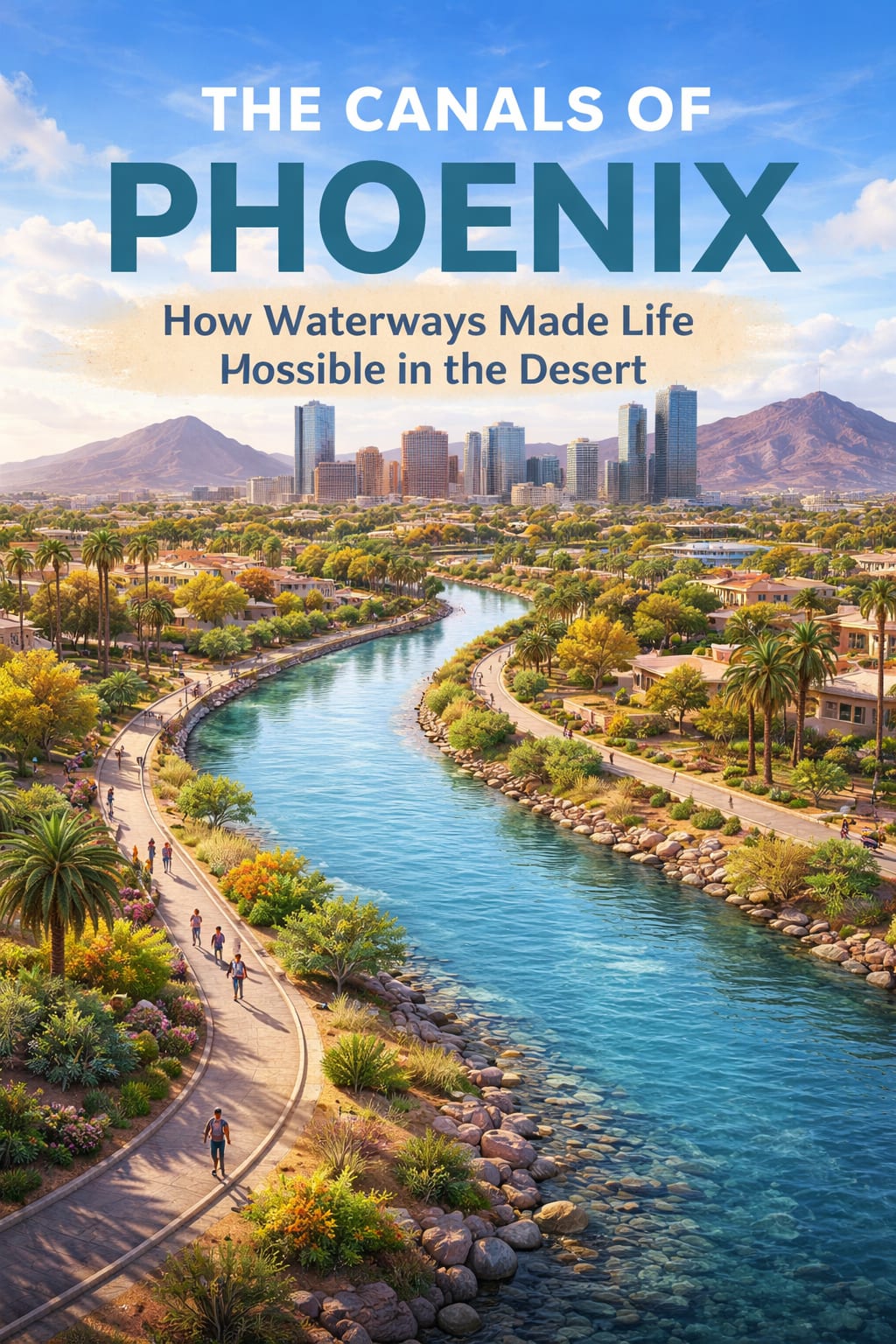
In the heart of the Sonoran Desert, where summer temperatures regularly climb above 110°F (43°C), the existence of a sprawling metropolitan city like Phoenix, Arizona, may seem almost impossible. Yet Phoenix thrives, home to millions of residents, vast suburbs, and a growing economy. The secret behind this unlikely success lies in a remarkable system of canals that carry life-giving water across the desert landscape.
These canals are not merely modern infrastructure. Their story stretches back more than a thousand years, to an ancient civilization that first realized the potential of harnessing desert rivers.
Long before modern Phoenix existed, the Hohokam people, an Indigenous civilization, lived in the region from roughly 300 to 1450 CE. The Hohokam were extraordinary engineers who developed one of the most sophisticated irrigation systems in prehistoric North America. Using simple tools and deep knowledge of their environment, they constructed hundreds of miles of canals that diverted water from the Salt and Gila Rivers into their agricultural fields.
At their peak, the Hohokam canal network stretched for nearly 500 miles. These canals allowed them to grow crops such as corn, beans, squash, and cotton in a desert environment where farming would otherwise be impossible. The system was so effective that it supported large settlements and complex communities throughout the region.
However, for reasons historians still debate—possibly drought, floods, or social change—the Hohokam civilization declined around the 15th century. Their canals eventually filled with silt and were abandoned, leaving behind traces of a once-advanced irrigation system.
Centuries later, in the 1860s, American settlers arrived in the valley and recognized the potential of these ancient canal routes. Rather than starting from scratch, they rebuilt many canals along the same paths first carved by the Hohokam. This decision helped shape the foundation of modern Phoenix.
The city’s canal network grew rapidly during the late 19th and early 20th centuries. Farmers and developers realized that controlling the flow of water from the Salt River could transform the dry desert into fertile farmland. To manage water resources more efficiently, the Salt River Project (SRP) was created in 1903.
The SRP became one of the most important water management organizations in Arizona. It oversaw the construction of dams, reservoirs, and an extensive canal system that still serves the Phoenix metropolitan area today. Water from the Salt and Verde Rivers flows through canals that stretch more than 130 miles across the valley.
These canals do far more than irrigate farmland. They supply water to homes, businesses, and public spaces throughout Phoenix and surrounding communities.
Today, the Phoenix canal system is also becoming an important part of the city’s urban lifestyle. Many canals are lined with walking and cycling paths that residents use for recreation and commuting. The Arizona Canal Trail, for example, stretches for miles through the city, offering shaded pathways in an otherwise hot environment.
Urban planners have even begun turning canal corridors into green spaces filled with trees, public art, and gathering areas. These improvements help reduce urban heat and make Phoenix more livable in a region where climate conditions can be extreme.
Yet the canal system also highlights one of the greatest challenges facing Phoenix: water sustainability. The American Southwest is experiencing prolonged drought, and climate change is placing additional pressure on water supplies from the Colorado River and regional reservoirs.
City leaders and water managers are responding by promoting conservation, improving irrigation efficiency, and investing in long-term water planning. Phoenix has also implemented policies encouraging residents to reduce water usage and adopt desert-friendly landscaping.
Despite these challenges, the canals remain a symbol of human ingenuity and adaptation. From the ancient Hohokam engineers to modern urban planners, generations of people have relied on these waterways to survive and thrive in one of the harshest climates in North America.
Without the canals, Phoenix might never have existed. With them, a desert valley has been transformed into one of the largest and fastest-growing cities in the United States.
In a place where water is more precious than gold, the canals of Phoenix continue to carry not just water—but the lifeblood of the desert city itself.
About the Creator
Irshad Abbasi
Ali ibn Abi Talib (RA) said 📚
“Knowledge is better than wealth, because knowledge protects you, while you have to protect wealth.
Keep reading
More stories from Irshad Abbasi and writers in Earth and other communities.
Stephen Hawking’s Final Advice to Humanity
Few scientists have captured the imagination of the world quite like Stephen Hawking. Known for his groundbreaking work on black holes and cosmology, Hawking spent his life exploring the deepest mysteries of the universe. Even after being diagnosed with Amyotrophic Lateral Sclerosis (ALS) at the age of 21—a condition that gradually paralyzed him—he continued to produce revolutionary ideas that changed modern science.
By Irshad Abbasi 7 days ago in Earth



Comments
There are no comments for this story
Be the first to respond and start the conversation.