
When Can a City Be Lived In Again After a Nuclear Explosion? Airburst vs Ground Burst
How the altitude of a nuclear detonation determines how long radiation lasts, how quickly people can return, and whether a city recovers in weeks, years, or decades

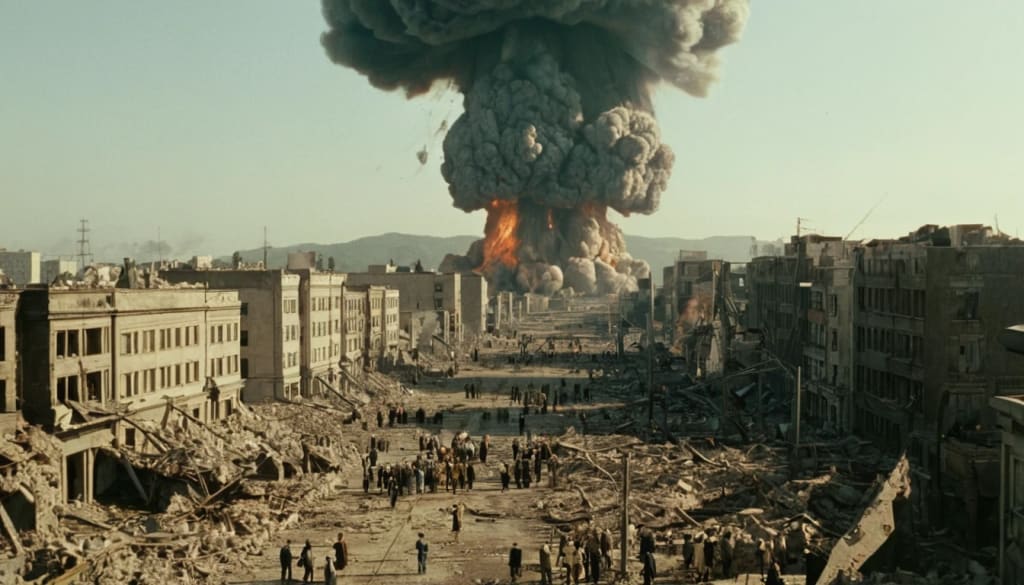
The question of how long a city would remain uninhabitable after a nuclear explosion depends largely on one crucial factor: whether the bomb detonated in the air or on the ground. The altitude of the explosion determines how much radioactive material contaminates the environment. Two cities struck by weapons of similar size could experience very different recovery timelines depending on this single variable.
When a nuclear weapon explodes as an airburst—hundreds of meters above the ground—the long-term radioactive contamination is surprisingly limited compared with what many people imagine. The fireball forms in the air and does not directly touch the ground, meaning that large amounts of soil, asphalt, and building material are not pulled into the radioactive cloud. Because of this, much less radioactive debris falls back quickly onto the city itself.
In the case of an airburst, the immediate destruction is enormous. Buildings collapse, fires spread, and infrastructure may be severely damaged. Yet the long-term radiation hazard decreases relatively quickly. Radioactive particles created during the explosion decay rapidly in the first hours and days. Scientists often refer to a rule of thumb known as the “seven-ten rule.” According to this principle, radiation intensity drops to roughly one tenth of its original level after seven hours, and then to about one hundredth after two days.
This rapid decline means that in areas outside the most heavily contaminated zones, radiation levels may fall to survivable levels within days or weeks. People could theoretically return relatively quickly once fires are extinguished, debris cleared, and infrastructure partially restored. In fact, historical experience provides an example. The cities affected by the Atomic bombings of Hiroshima and Nagasaki were not permanently abandoned. Survivors began returning to parts of those cities within weeks, and rebuilding started within months.
However, this does not mean the environment immediately becomes safe. In the aftermath of an airburst, many buildings are destroyed, water systems damaged, and medical facilities overwhelmed. Fires can burn for days, leaving large areas in ruins. Even if radiation declines quickly, it may take months or years before the city regains basic services and livable conditions.
Long-term health effects are another concern. Some survivors exposed to radiation may develop illnesses years later, including cancers linked to radiation exposure. Still, from a purely environmental perspective, an airburst does not necessarily leave the city permanently contaminated.
A ground burst is a very different scenario. When a nuclear weapon explodes at ground level, the fireball expands until it touches the surface. In that instant, enormous quantities of soil, concrete, and building materials are vaporized and pulled into the rising mushroom cloud. These materials become coated with radioactive particles produced during the nuclear reaction.
As the mushroom cloud cools, the contaminated debris begins falling back to Earth as radioactive fallout. Larger particles fall within hours close to the explosion site, while finer particles may drift downwind for hundreds of kilometers before settling. Because of this process, the land around a ground burst becomes far more contaminated than after an airburst.
Radiation levels in heavily contaminated areas could remain dangerous for much longer. Some radioactive isotopes decay quickly, but others persist for years or decades. The contamination may settle into soil, rooftops, streets, and water supplies. Agricultural land may become unsafe, and drinking water sources could require extensive cleanup.
In the immediate blast zone of a ground burst, radiation levels could remain extremely high for weeks. Even after the first intense period of fallout, the environment might still pose serious health risks for anyone living there. Decontamination would require removing topsoil, cleaning buildings, and isolating contaminated debris. Such efforts would be complex and expensive, especially if the affected area covered a large city.
Scientists studying nuclear weapons effects estimate that after a major ground burst, some areas might remain unsafe for extended periods. In the worst cases, heavily contaminated zones could remain difficult to inhabit for decades without large-scale cleanup. However, even in these scenarios, the contamination is rarely uniform. Some neighborhoods might become safe sooner than others depending on wind direction, rainfall, and local geography.
Rain can sometimes accelerate the removal of radioactive particles from the air, causing what is known as “rainout,” where fallout concentrates in certain areas. This means two nearby districts could experience very different levels of contamination. One area might be relatively safe after several months, while another downwind zone might remain hazardous for years.
Urban environments also affect how radiation behaves. Tall buildings can trap fallout dust on rooftops and streets, where it may remain until washed away or physically removed. Over time, wind and rain gradually reduce surface contamination, but without cleanup the process may be slow.
Another factor influencing recovery is the size of the nuclear weapon. A smaller detonation of tens of kilotons might contaminate a limited region compared with a much larger warhead in the hundreds of kilotons or megatons. Larger explosions produce more radioactive debris and disperse it over greater distances.
Infrastructure damage also plays a major role in how quickly a city can become livable again. Even if radiation levels decline to relatively safe limits, rebuilding power grids, water systems, hospitals, and transportation networks can take years. After a nuclear attack, recovery would involve not only environmental cleanup but also the reconstruction of the entire urban system.
Modern emergency planning assumes that some areas affected by nuclear explosions could eventually be repopulated, especially after airbursts. However, heavily contaminated zones caused by ground bursts might require long-term restrictions or extensive remediation efforts before large populations could safely return.
In reality, the timeline for recovery could range widely. In parts of a city struck by an airburst, people might return within weeks or months, though living conditions would be extremely difficult. In areas affected by severe fallout from a ground burst, full recovery could take many years and potentially decades depending on the level of contamination and the resources available for cleanup.
The key difference lies in how much radioactive material reaches the ground. An explosion high in the air spreads blast and heat but leaves relatively less radioactive debris behind. A ground explosion, while sometimes producing slightly less blast damage, can spread long-lasting radioactive contamination across the landscape.
Understanding this distinction helps explain why the altitude of a nuclear detonation plays such an important role in determining the long-term fate of a city. A few hundred meters of height can mean the difference between a devastated city that slowly rebuilds and a contaminated landscape that takes generations to recover.
About the Creator
Algieba
Curious observer of the world, exploring the latest ideas, trends, and stories that shape our lives. A thoughtful writer who seeks to make sense of complex topics and share insights that inform, inspire, and engage readers.
Worth the Wait: Puerto Viejo, Costa Rica
Beach bumming in a small Caribbean beach town sounded like a perfect way to end our 6-month trip through Mexico and Central America. Or so we thought. The foul, fishy stench of rotten seaweed hit our nostrils as we stepped from the cramped bus and looked out at a rather depressing, empty, and underwhelming black sand beach. It was pouring with rain, and we had to quickly fish out our ponchos. We thought, this couldn’t be it, could it?
By Sh*t Happens - Lost Girl Travel7 days ago in Wander



Comments
There are no comments for this story
Be the first to respond and start the conversation.