
Artemis II: Today’s Historic Launch Explained
Liftoff is hours away: Your essential guide to today’s historic return to the Moon.

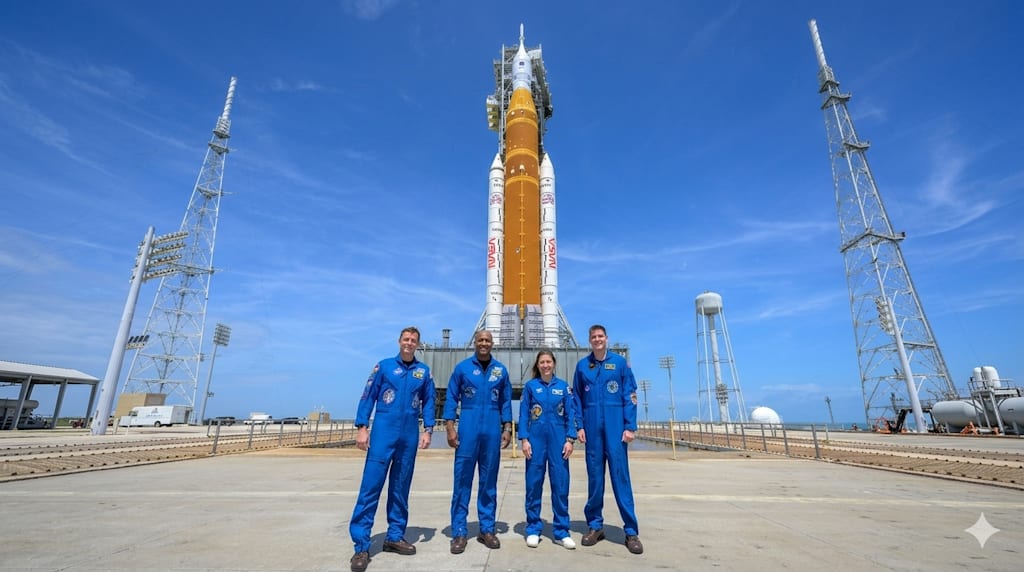
For the first time in over fifty years, humans are leaving low-Earth orbit and heading back to the moon. NASA is preparing to launch Artemis II, marking the first crewed lunar mission since Apollo 17 touched down in 1972. This flight represents a massive leap forward in space exploration. We will cover every detail you need to know about this monumental event, from the astronauts flying the ship to the exact timeline of their ten-day journey.
Meet the Historic Crew
NASA selected a diverse and highly experienced team of four astronauts for this deep-space flight. Commander Reid Wiseman, a United States Navy veteran, brings his experience from 165 days aboard the International Space Station and multiple spacewalks. Victor Glover joins him as the mission pilot. Glover, a former Navy captain, previously piloted the very first operational Crew Dragon mission to the space station.
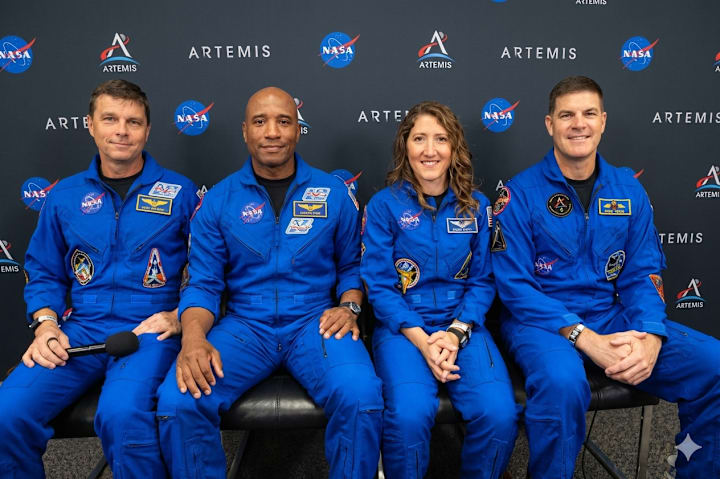
Mission specialist Christina Koch holds the record for the longest single spaceflight by a woman, spending an incredible 328 days in orbit. She also helped conduct the first all-female spacewalk. Finally, mission specialist Jeremy Hansen makes history as the first person outside the United States to fly to the moon. Representing the Canadian Space Agency, the former fighter pilot will make his first journey into space an unforgettable one.
The Orion Spacecraft: A Modern Moon Ship
A crew of four needs a modern ship. They will fly inside the Orion spacecraft. Engineers designed Orion to be significantly larger than the Apollo command module. It measures nearly 16 feet wide, offering about nine cubic meters of living space. This extra room allows it to carry four people comfortably, compared to Apollo’s three. It also features a major upgrade for long journeys: Orion will be the first spacecraft to feature a functional toilet outside of low-Earth orbit.
Together with its service module, Orion weighs 26.5 tons. This makes it slightly lighter than the Apollo system. However, Orion carries a much smaller service module. Because of this smaller fuel capacity, the spacecraft cannot enter low lunar orbit on this specific flight.
The Space Launch System: Raw Power
A massive ship requires a massive rocket. The Space Launch System (SLS) is the most powerful rocket NASA has ever built. At liftoff, it generates over 39 million newtons of thrust. Two giant solid rocket boosters provide about 80 percent of that extreme power. These boosters flank the core stage, which uses four RS-25 engines left over from the Space Shuttle program.
The upper stage of the rocket uses a single, highly efficient engine to push the crew toward the moon. When we compare the SLS to the legendary Saturn V rocket from the Apollo era, we see some interesting differences. The SLS stands 322 feet tall, slightly shorter than the 364-foot Saturn V.
Even though the SLS creates more thrust right off the launch pad, it actually carries less weight to deep space. The SLS can send about 27 tons to the moon, while the Saturn V could throw a massive 45 tons toward lunar orbit.
The Flight Plan: A Ten-Day Journey
Artemis II will launch from the famous Launch Complex 39B at the Kennedy Space Center. This is the exact same pad that hosted Saturn V and Space Shuttle launches. For this specific flight, the crew will not land on the moon. They will not even orbit it.
Artemis II acts as a massive test drive. The spacecraft will follow a "free return trajectory." This means Earth's gravity will naturally pull the ship back home after it swings behind the moon. NASA plans to wait until Artemis IV to put boots back on the lunar surface.
Countdown to Liftoff: The Final Hours
On launch day, the clock follows a strict schedule. Nine and a half hours before liftoff, teams begin loading fuel into the massive rocket. At five hours and forty minutes before launch, the crew starts putting on their bright orange spacesuits.
They board the Orion spacecraft four hours before liftoff. Teams close the hatch roughly three hours before flight.
At ten minutes to launch, the ground computers hand control over to the automated launch sequencer. The real nail-biter happens at 33 seconds before liftoff. If the computers detect any problem after this point, NASA will likely cancel the launch for the day. At zero, the solid rocket boosters ignite, and the crew leaves Earth.
Breaking Records in Deep Space
Two minutes after launch, the solid rocket boosters burn out and fall away. Eight minutes into the flight, the massive core stage separates. The crew then fires their upper stage engine to enter a high orbit around Earth.
Instead of heading straight for the moon, they will first raise their orbit to an altitude of 70,000 kilometers. This unique maneuver allows NASA to test the spacecraft's systems close to home. If an emergency happens, the crew can return to Earth quickly.
On day two of the mission, Orion fires its engines again. This pushes the ship out of Earth's orbit and sends it racing toward the moon. Over the next few days, the crew will test communication systems and practice medical emergency procedures. On day four, Artemis II will break a massive record.
The crew will reach a distance of over 402,000 kilometers from Earth. This breaks the distance record set by the Apollo 13 crew, making the Artemis II astronauts the furthest humans have ever traveled into space. On day five, the ship will fly just 7,400 kilometers above the lunar surface.
The Return Home
After swinging past the moon, Orion spends the next four days falling back toward Earth. The crew will test their radiation shielding and practice flying the ship manually. Finally, nine days into the mission, the crew module separates from the service module. This exposes the thick heat shield.
The spacecraft slams into Earth's atmosphere at incredible speeds. At an altitude of 11 kilometers, the first protective covers blow off. A complex system of parachutes deploys in stages to slow the heavy capsule.
After nine days and almost two hours in space, the Orion spacecraft will splash down safely in the ocean. Recovery teams will pull the historic crew from the water within two hours, welcoming them back to Earth and opening a brand new era of human exploration.
About the Creator
Jesse
I just love to write
How to Choose the Right Legal Transcription Course in the U.S.
Legal transcription is quickly becoming one of the most flexible and in-demand remote careers in today’s digital economy. From court hearings and depositions to legal dictations, transcriptionists play a vital role in maintaining accurate legal records. As more professionals look for work-from-home opportunities, this field continues to grow.
By Mahesh Kumar7 days ago in Education
Matthew Scillitani on High-Range Psychometrics, Validity, and Test Security
Matthew Scillitani is a psychometrics practitioner at Neurolus Psychometrics focused on developing supervised, time-limited high-range ability examinations. He co-launched The Mental Inventor with Paul Cooijmans as an empirical testbed for a central measurement question: whether performances can be validly differentiated in the extreme right tail under proctored conditions. His approach emphasizes procedural integrity—identity verification, approved proctoring, and rule enforcement—alongside cautious claims about interpretation until reliability and validity evidence is established. He highlights emerging threats to unsupervised testing, including AI-assisted responding and large-scale collaboration, and advocates peer review before formal reclassification.
By Scott Douglas Jacobsenabout 15 hours ago in Education
The Fears of AI And How Much Fun It Can Be
ChatGPT has come a long way, as has AI in general. There are those people who are scared of it, and for understandable reasons. People fear that as technologies advance, they’ll be replaced in the workforce. Then, there are the fears that AI could evolve into something that brings us to the brink of extinction.
By The Man Behind The Mask2 days ago in Futurism




Comments
There are no comments for this story
Be the first to respond and start the conversation.