
How to Design Liquidity Models for a Decentralized Exchange (AMM vs Order Book)
A Practical Guide to Building Efficient and Scalable DEX Liquidity Systems

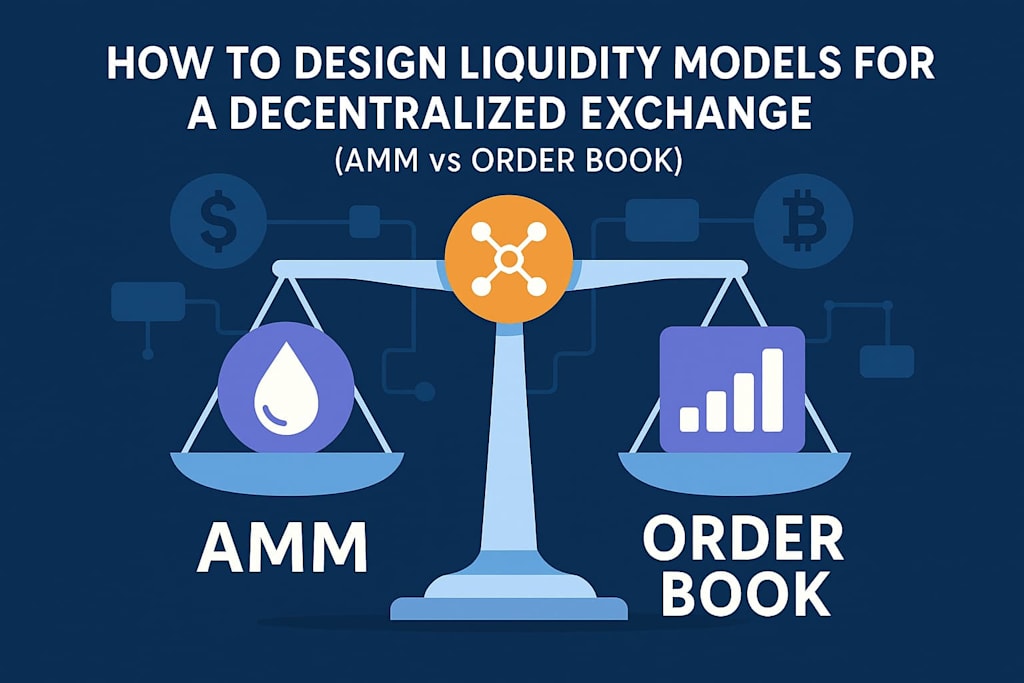
Liquidity is the backbone of any trading system, and in decentralized exchanges (DEXs), it defines not only how trades are executed but also how efficient, secure, and scalable the entire platform is. For IT consultants and blockchain architects, designing a liquidity model is a strategic decision that directly impacts user experience, capital efficiency, and long-term platform viability.
In DEX architecture, two dominant paradigms shape liquidity design: Automated Market Makers (AMMs) and Order Book systems. Each represents a fundamentally different philosophy—one algorithmic and pool-based, the other market-driven and order-matching. Understanding their strengths, limitations, and architectural implications is critical when designing a modern decentralized exchange.
Understanding Liquidity in DEX Architecture
At its core, liquidity ensures that users can buy and sell assets without significant price impact. In centralized exchanges, liquidity is typically provided by professional market makers. In decentralized systems, this role is distributed among smart contracts, liquidity providers, and algorithmic mechanisms.
A well-designed liquidity model must balance several factors:
- Price stability and minimal slippage
- Efficient use of capital
- Transparency and decentralization
- Resistance to manipulation and arbitrage
The choice between AMM and order book architectures fundamentally determines how these goals are achieved.
Automated Market Makers (AMM): Algorithmic Liquidity
Automated Market Makers represent a paradigm shift in how trading occurs. Instead of matching buyers and sellers, AMMs rely on liquidity pools governed by smart contracts. Users trade directly against these pools, and prices are determined by a mathematical formula.
The most common model follows the constant product formula: x · y = k
This simple equation ensures that the product of the reserves remains constant after every trade. As one asset is purchased, its price increases relative to the other, naturally adjusting supply and demand.
From an architectural standpoint, an AMM-based system includes:
- Smart contracts handling swaps, deposits, and withdrawals
- Liquidity pools storing token reserves
- Pricing algorithms embedded directly in the protocol
- LP token mechanisms representing ownership shares
This design enables continuous, permissionless liquidity, making AMMs highly accessible and easy to integrate into broader DeFi ecosystems.
One of the key advantages of AMMs is their simplicity. There is no need for complex matching engines or centralized infrastructure. Liquidity is always available as long as the pool exists, and any user can become a liquidity provider.
However, this simplicity comes with trade-offs. Capital efficiency is often suboptimal, as liquidity is spread across the entire price curve. Additionally, liquidity providers face impermanent loss, a phenomenon where asset price divergence leads to potential losses compared to simply holding the assets. Slippage can also become significant in smaller pools, especially during large trades.
To address these limitations, modern AMM designs have introduced more advanced mechanisms:
- Concentrated liquidity, which allows LPs to allocate capital within specific price ranges
- Dynamic fee structures that adjust based on volatility
- Multi-asset pools to reduce fragmentation
These enhancements aim to make AMMs more efficient while preserving their decentralized nature.
Comparing AMM and Order Book Architectures
Choosing between AMM and order book models requires evaluating multiple architectural dimensions. These systems differ not just in implementation, but in their entire approach to liquidity.
AMMs prioritize simplicity and always-on liquidity. They are ideal for ecosystems where ease of access and decentralization are critical. Order books, on the other hand, prioritize precision and efficiency, making them more suitable for high-frequency or professional trading environments.
From a design perspective, key differences include:
- Liquidity Availability: AMMs provide continuous liquidity, while order books depend on active participants
- Capital Efficiency: Order books are more efficient, whereas AMMs require liquidity to be distributed across price curves
- Complexity: AMMs are simpler to implement; order books require sophisticated infrastructure
- User Experience: AMMs offer simplicity, while order books enable advanced trading features
These differences highlight that neither model is universally superior. The choice depends on the intended use case, user base, and technical constraints.
Hybrid Liquidity Models: The Emerging Standard
Modern DEX platforms are increasingly adopting hybrid architectures that combine elements of both AMM and order book models. This approach aims to capture the strengths of each while mitigating their weaknesses.
A hybrid model might use:
- AMMs for baseline liquidity and simplicity
- Order books for advanced trading and price discovery
- Off-chain components for speed and scalability
- On-chain settlement for trust and transparency
This layered approach allows platforms to scale while maintaining decentralization and performance. For example, a system may use an AMM to provide fallback liquidity when order book depth is low, ensuring continuous trading activity.
Designing a Liquidity Model: A Consulting Perspective
From an IT consulting standpoint, selecting and designing a liquidity model requires a structured approach. It is not just a technical decision, but a business-aligned architecture choice.
Several key factors should guide the design process:
Business Requirements
- Target audience (retail vs institutional traders)
- Expected trading volume
- Required features (e.g., derivatives, margin trading)
Technical Constraints
- Blockchain performance and transaction throughput
- Gas costs and latency considerations
- Availability of Layer 2 solutions
Security Considerations
- Smart contract vulnerabilities
- MEV risks and front-running
- Oracle reliability
User Experience
- Ease of use and onboarding
- Trading interface complexity
- Wallet and integration support
The right liquidity model should align with both business goals and technical realities, ensuring long-term scalability and user adoption.
Key Architectural Principles
Regardless of the chosen model, several principles are essential for building robust DEX liquidity systems:
- Modularity: Decouple pricing, matching, and settlement layers
- Scalability: Design for increasing transaction volumes
- Security: Implement rigorous auditing and safeguards
- Transparency: Ensure auditable and predictable behavior
- Interoperability: Enable cross-chain and multi-asset support
These principles ensure that the system remains flexible and adaptable as the DeFi landscape evolves.
Conclusion
Designing liquidity models for decentralized exchanges is one of the most critical architectural challenges in modern blockchain systems. AMMs offer simplicity and accessibility, making them ideal for broad adoption, while order book models provide precision and capital efficiency suited for advanced trading environments.
Increasingly, hybrid approaches are becoming the standard, combining the best aspects of both models to deliver scalable, efficient, and user-friendly platforms.
For IT consultants and architects, the goal is not simply to choose between AMM and order book models, but to design a liquidity system that aligns with the broader ecosystem strategy. A well-designed liquidity model can significantly enhance performance, attract users, and ensure the long-term success of a decentralized exchange.
About the Creator
Damian Brown
IT consultant with 7+ years’ experience helping organizations optimize technology, implement scalable solutions, and drive digital transformation for measurable business results.
Keep reading
More stories from Damian Brown and writers in Education and other communities.
How to Choose the Right Blockchain Architecture for Your Business Model
Choosing the right blockchain architecture for your business model is not a purely technical decision—it is a strategic one that intersects with governance, economics, regulatory exposure, and long-term scalability. A poorly chosen architecture can introduce unnecessary complexity, limit performance, or undermine trust. Conversely, a well-aligned design can unlock efficiency, transparency, and entirely new business capabilities.
By Damian Browna day ago in Education
Europe’s Cost of Living Is Rising Again as Inflation and Energy Prices Climb
For a while, it looked like Europe had moved past the worst of the inflation squeeze. The panic had faded, the headlines felt calmer, and many people assumed the pressure on household budgets was finally easing. But the latest numbers point in a different direction. Euro area inflation rose to 2.5% in March 2026, up from 1.9% in February. Energy prices climbed 4.9% year over year, while services inflation reached 3.2% and food, alcohol, and tobacco rose 2.4%. It does not look like a crisis yet. But it does look like life is getting more expensive again.
By Viorel Secareanu2 days ago in Education




Comments
There are no comments for this story
Be the first to respond and start the conversation.