
How to Modernize Legacy Business Systems Using ASP.NET Core and Microservices
The guide for the modernization of legacy systems with ASP.NET Core and microservices

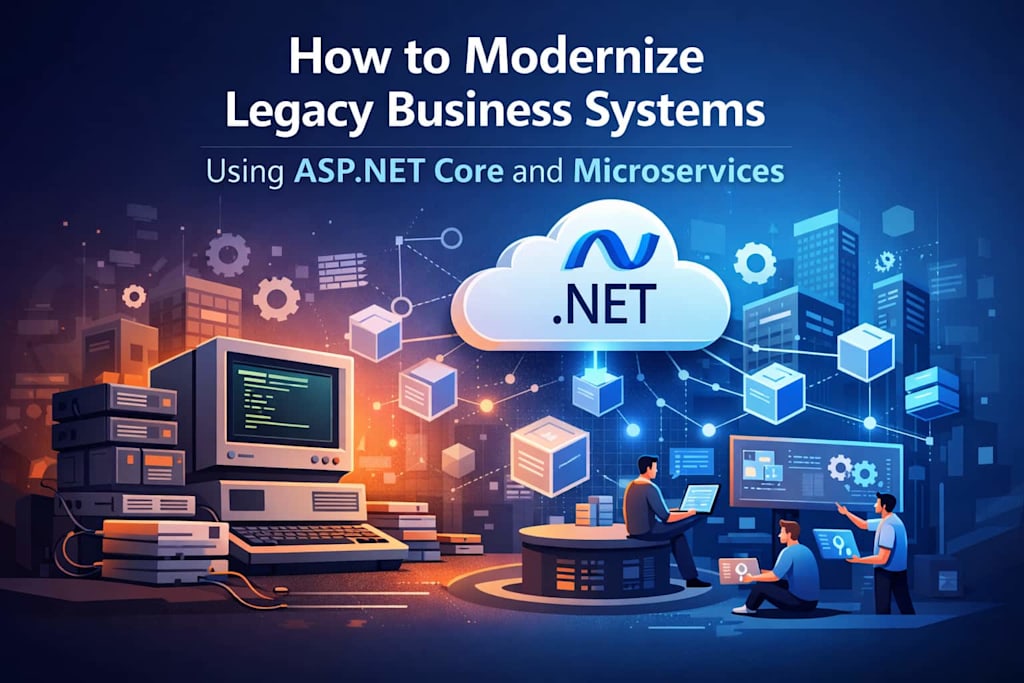
Modernizing legacy systems is one of the most consequential—and challenging—tasks in enterprise software engineering. Many organizations rely on systems built decades ago using outdated architectures, monolithic designs, or unsupported technologies. While these systems often remain mission-critical, they introduce increasing costs, technical debt, and limitations that hinder innovation.
The combination of ASP.NET Core and microservices architecture offers a powerful pathway for gradual, controlled modernization. This article outlines a practical, business-oriented approach to transforming legacy systems into scalable, maintainable, and cloud-ready solutions.
Understanding the Problem: Legacy Systems and Their Constraints
Legacy systems typically suffer from:
- Tightly coupled architecture
- Difficult maintenance and slow development cycles
- Limited scalability
- Technology obsolescence
- High operational risk
These systems often evolve into “big ball of mud” architectures, where even minor changes can introduce unforeseen consequences. As a result, businesses struggle to respond quickly to market demands.
Modernization is not simply a technical upgrade—it is a strategic business initiative that directly impacts agility, cost efficiency, and competitive advantage.
Why ASP.NET Core?
ASP.NET Core is a modern, high-performance, cross-platform framework for building web applications and APIs.
Key advantages:
- Cross-platform support (Windows, Linux, macOS)
- High performance and scalability
- Built-in dependency injection
- Cloud readiness (optimized for Azure, AWS, etc.)
- Strong ecosystem and tooling
For modernization, ASP.NET Core serves as a foundation for building modular, API-driven services that can gradually replace legacy components.
Why Microservices?
A microservices architecture decomposes a system into independent, loosely coupled services, each responsible for a specific business capability.
Benefits:
- Independent deployment
- Scalability per service
- Improved fault isolation
- Technology flexibility
- Faster development cycles
Instead of rewriting a monolith from scratch—a risky and often impractical approach—microservices enable incremental modernization, allowing you to evolve your system step by step.
Modernization Strategy: The Incremental Approach
The safest and most effective approach is the incremental modernization strategy, often aligned with the “Strangler Fig Pattern.”
The Strangler Fig Pattern
This pattern involves:
- Building new functionality as separate services using ASP.NET Core
- Gradually routing traffic from the legacy system to new services
- Replacing legacy components piece by piece until the old system is fully retired
This avoids the risks of a full rewrite and allows continuous business operation during transformation.
Step-by-Step Modernization Process
Step 1: Assess the Existing System
Begin with a comprehensive audit:
- Identify core business domains
- Map dependencies and integrations
- Evaluate technical debt
- Understand performance bottlenecks
This step is critical for defining a realistic roadmap.
Step 2: Define Business Domains
Apply Domain-Driven Design (DDD) principles to identify bounded contexts:
- Order management
- User management
- Billing
- Inventory
Each domain becomes a candidate for an independent microservice.
Step 3: Introduce ASP.NET Core as an API Layer
Instead of replacing everything at once, start by introducing ASP.NET Core APIs as an abstraction layer:
- Wrap legacy functionality with modern REST APIs
- Enable new systems to communicate with the legacy backend
- Gradually shift logic into new services
This creates a hybrid architecture that bridges old and new systems.
Step 4: Extract Services Gradually
Begin extracting functionality into microservices:
- Start with low-risk, high-value components
- Build each service using ASP.NET Core
- Deploy services independently
Typical candidates:
- Authentication service
- Notification service
- Reporting service
Step 5: Implement API Gateway
An API Gateway centralizes routing and management:
- Single entry point for clients
- Handles authentication, logging, and rate limiting
- Routes requests to appropriate microservices
Popular options include:
- Ocelot (for ASP.NET Core)
- Azure API Management
- Kong or NGINX
Step 6: Manage Data Strategy Carefully
Data is often the hardest part of modernization.
Strategies include:
- Database per service migration (ideal for microservices)
- Shared database with strict boundaries (temporary phase)
- Event-driven synchronization
Avoid tight coupling between services and databases whenever possible.
Step 7: Introduce Event-Driven Architecture
Use messaging systems for communication between services:
- Event queues (e.g., RabbitMQ, Azure Service Bus)
- Publish-subscribe patterns
- Asynchronous communication
This improves scalability and decoupling.
Step 8: Containerization and Orchestration
Use Docker and orchestration platforms like Kubernetes:
- Package each ASP.NET Core service as a container
- Enable consistent deployments across environments
- Scale services independently
Step 9: Implement CI/CD Pipelines
Modernization must include DevOps practices:
- Automated testing
- Continuous integration
- Continuous deployment
- Infrastructure as code
This ensures rapid, reliable delivery of changes.
Architectural Example
A modernized system might look like:
- Frontend: React / Angular / Blazor
- API Gateway: ASP.NET Core / Ocelot
Microservices:
- User Service (ASP.NET Core)
- Order Service (ASP.NET Core)
- Payment Service (ASP.NET Core)
Messaging: RabbitMQ / Kafka
Databases: Independent per service
Infrastructure: Docker + Kubernetes + Cloud
Handling Authentication and Security
Security is critical during modernization.
Common approaches:
- JWT (JSON Web Tokens) for authentication
- OAuth2 / OpenID Connect integration
- Centralized identity providers like IdentityServer or Azure AD
ASP.NET Core provides strong built-in support for modern authentication patterns.
Monitoring and Observability
Modern systems must be observable.
Key tools and practices:
- Logging (Serilog, ELK stack)
- Metrics (Prometheus, Grafana)
- Distributed tracing (OpenTelemetry)
This ensures you can track performance, detect failures, and debug issues across services.
Real-World Case Studies of Modernization with ASP.NET Core and Microservices
To better understand how modernization works in practice, let’s look at several representative case studies. These examples illustrate how organizations transition from legacy systems to modern architectures using ASP.NET Core and microservices.
Case Study 1: Legacy Monolith to Microservices in E-Commerce
Background: A mid-sized e-commerce company operated a large monolithic application built on older .NET Framework technology. The system handled orders, inventory, payments, and user management in a single tightly coupled codebase.
Challenges:
- Slow deployment cycles (monthly releases)
- High risk when modifying code
- Difficulty scaling during peak shopping seasons
Modernization Approach: Introduced an ASP.NET Core API layer in front of the monolith
Gradually extracted services such as:
- Order processing
- Inventory management
- Adopted microservices architecture for new features
- Implemented an API gateway to unify access
Outcome:
- Deployment frequency improved from monthly to weekly
- Scalability increased significantly during high-traffic events
- Teams could work independently on services
Case Study 2: Financial Services Platform Modernization
Background: A financial services company relied on a legacy system for transaction processing and reporting. The system was difficult to maintain and posed security risks.
Challenges:
- Monolithic architecture with tightly coupled components
- Limited auditability and observability
- Inability to rapidly introduce new features
Modernization Approach:
- Rebuilt critical services using ASP.NET Core microservices
- Introduced event-driven architecture using message queues
- Isolated sensitive domains like payments and authentication
- Implemented strict API security with OAuth2 and JWT
Outcome:
- Improved system security and compliance
- Faster onboarding of new financial products
- Better traceability and monitoring of transactions
Case Study 3: Enterprise ERP Modernization
Background: A manufacturing company relied on an aging ERP system that handled procurement, inventory, and production planning.
Challenges:
- Monolithic ERP system with complex dependencies
- Difficult customization
- Long development cycles
Modernization Approach:
- Wrapped the legacy system with ASP.NET Core APIs
- Extracted high-value modules into microservices
Gradually replaced components like:
- Reporting engine
- Inventory tracking
- Adopted cloud deployment for scalability
Outcome:
- Reduced system downtime during updates
- Faster feature delivery
- Increased flexibility for business-specific customizations
Conclusion
Modernizing legacy systems using ASP.NET Core and microservices is not just a technical transformation—it is a strategic evolution of the business itself. The key is to proceed incrementally, ensuring continuity while gradually improving architecture, scalability, and maintainability.
ASP.NET Core provides the performance, flexibility, and ecosystem needed to build modern services, while microservices enable the decomposition of complex systems into manageable, independent components.
By adopting a structured, domain-driven, and incremental approach, organizations can transform legacy systems into resilient, future-ready platforms without disrupting ongoing operations.
About the Creator
Chudovo
Chudovo is a custom software development company, focused on complex systems implementation.
The Relationship Between Creativity and Productivity: How They Work Together for Success
The relationship between creativity and productivity is a topic many people consider at work and in daily life. Some people believe that creativity slows work down, while others think productivity limits creative ideas. In truth, both creativity and productivity can support each other in strong ways. When used well, they help people do better work and feel more satisfied. Creativity brings new ideas, while productivity helps turn those ideas into real results. Without creativity, work can feel boring and repetitive. Without productivity, ideas may never become useful outcomes. Many successful people learn how to balance both. This balance helps them grow faster and achieve their goals. Understanding this relationship can improve how you work and think every day.
By Norman Badger2 days ago in Education
Education Summit’s Experts On Why Lifelong Learning Is The Backbone Of Modern Economies
Modern economies are being reshaped by rapid technological innovation, demographic shifts, globalization, and evolving workforce expectations. The idea that education ends after graduation no longer aligns with economic reality. Instead, continuous learning has become central to employability, competitiveness, and national growth. The growing relevance of these discussions will be reflected in global gatherings such as the education conference in Las Vegas, such as Education 2.0 Conference, where policymakers, educators, and industry leaders examine how lifelong learning frameworks can support modern economic systems.
By Education 2.0 Conference5 days ago in Education
The Devil's Lettuce
We're all sitting here in a world where you can buy cannabis infused seltzer at a boutique shop that looks like an Apple store... but for about 80 years, the government treated this plant like it was a literal demon from the seventh circle of Hell. Why? Was it because it was actually dangerous? Please. If being dangerous was the criteria, we would have also banned lawn darts and gender reveal parties decades ago.
By Sara Wilson7 days ago in Potent


Comments
There are no comments for this story
Be the first to respond and start the conversation.