

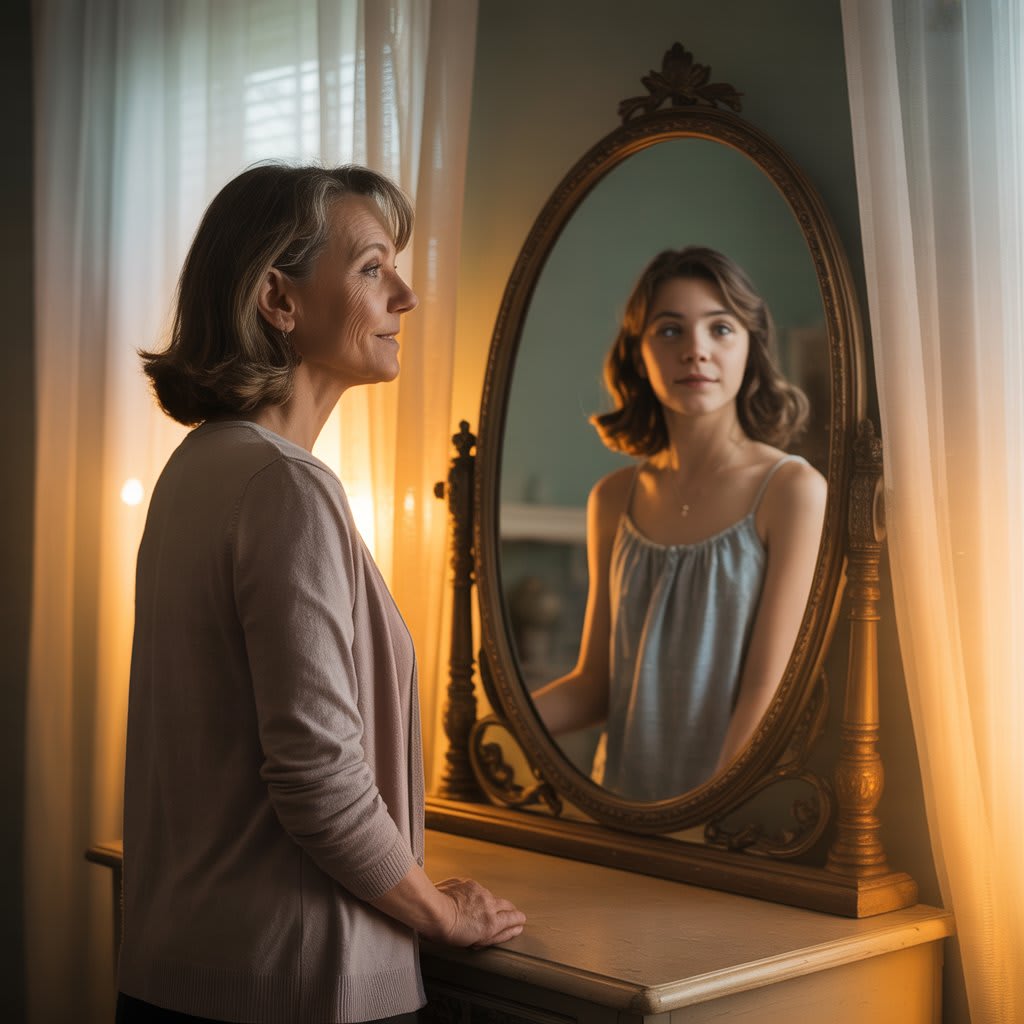
write by hasnain pathan I met my younger self on a Tuesday afternoon, which is unfortunate, because Tuesdays have never been kind to me.
She was sitting on the edge of my childhood bed, legs swinging, heels tapping against the wooden frame like she owned the rhythm of the world. The walls were still painted that soft, undecided yellow — the kind of color adults choose when they’re afraid to commit to something brighter. Sunlight filtered through the thin curtains, and there she was: fifteen years old, hair too long, hope too loud.
She looked up when I entered.
“You’re late,” she said.
I almost laughed. “For what?”
“For everything.”
She had my face, but unlined. My eyes, but unworried. My posture, but unburdened. She wore the faded band T-shirt we swore we’d keep forever, though I’d long since donated it in a burst of minimalist ambition. She tilted her head the way I used to when I believed I was about to uncover a great truth.
“You look tired,” she said, studying me like I was a disappointing book report.
“I am,” I replied.
“From what? You said life would get exciting.”
I sat at the old desk by the window. The wood still carried the faint scratch where I had carved a heart around initials that didn’t last a season. Funny how we memorialize things we’re meant to outgrow.
“Life did get exciting,” I said carefully. “Just not the way you think.”
She frowned. “Did we become famous?”
“No.”
“Did we move to a city with tall buildings and tiny apartments and drink coffee we can’t pronounce?”
“For a while.”
Her eyes brightened. “Did we fall in love?”
“Yes.”
“With who?”
I hesitated. “Several people.”
She blinked, confused. “I thought there would be one.”
“So did I.”
Silence settled between us, thick as dust in an untouched attic. Outside, a dog barked. Somewhere in the house, our mother’s voice echoed faintly, calling us to dinner in a year that no longer existed.
“You said we wouldn’t become ordinary,” she said finally.
The word struck harder than I expected.
“I’m not ordinary,” I replied defensively. “I pay bills. I make deadlines. I survive bad days. That’s not ordinary. That’s endurance.”
She slid off the bed and walked closer, examining me the way you examine a cracked mirror.
“You don’t write anymore,” she said.
“I write emails.”
“That’s not what I meant.”
I looked at the desk. Once upon a time, it had held notebooks swollen with dreams — stories about girls who saved cities and boys who crossed oceans and futures that shimmered like heat above asphalt.
“Writing doesn’t pay rent,” I muttered.
“Neither does dreaming,” she shot back, “but you used to do it anyway.”
There it was — the accusation I’d been dodging for years.
“I grew up,” I said.
She crossed her arms. “You promised you wouldn’t let that happen.”
Growing up isn’t something that happens in one dramatic burst. It’s quiet. Incremental. It’s choosing practicality over possibility. It’s telling yourself you’ll come back to your passions when things are stable — and then discovering stability is a moving target.
“I had to be realistic,” I said. “The world isn’t built for daydreamers.”
She smirked. “The world isn’t built by realists either.”
That one hurt.
She walked toward the mirror hanging on the closet door. For a moment, I saw both of us reflected: the girl who believed she was infinite, and the woman who learned she was not.
“Are we happy?” she asked softly.
The question felt heavier than all the others.
“Yes,” I said automatically.
She turned around slowly. “That wasn’t an answer. That was a reflex.”
I sighed. “Happiness isn’t like you think it is. It’s not constant fireworks. It’s quieter. Smaller. It’s good coffee in the morning. It’s not crying in the car anymore. It’s knowing who you are — even if that person isn’t extraordinary.”
She considered this.
“Do we still believe we’re meant for something big?”
“I believe,” I said carefully, “that big things are made of small, stubborn steps.”
“That sounds like something you read on a mug.”
I couldn’t help laughing.
She stepped closer until we were almost toe to toe. “Tell me something,” she said. “If I stay exactly as I am — hopeful, dramatic, certain the world will rearrange itself for me — what happens?”
“You get hurt,” I answered honestly. “A lot.”
“And if I become you?”
“You get hurt,” I said again. “Just differently.”
Her expression softened. For the first time, she looked less like a judge and more like a child standing at the edge of deep water.
“Do we at least become brave?” she whispered.
I thought of the risks I’d taken. The cities I’d moved to alone. The relationships I’d ended when staying would have been easier. The mornings I’d gotten out of bed when gravity felt personal.
“Yes,” I said firmly. “We become brave in ways you can’t imagine yet.”
She studied my face, searching for proof. Maybe she found it in the faint lines near my eyes, etched there by both laughter and loss.
“Okay,” she said finally. “Then I forgive you.”
“For what?”
“For not being exactly who I planned.”
The room seemed to exhale.
I looked at her — at me — and felt something loosen inside my chest.
“You don’t have to disappear,” I told her. “I just… I can’t carry you the way I used to.”
She smiled, softer now. “I don’t need you to carry me. I just need you to visit.”
The sunlight grew brighter, almost blinding. The edges of the room began to blur like a memory folding in on itself.
“Wait,” I said quickly. “Is there anything you want me to remember?”
She grinned — reckless, radiant.
“Yes. Don’t get so busy surviving that you forget to want.”
And then she was gone.
I was alone in my apartment, not my childhood bedroom. The walls were white. The desk was metal. My phone buzzed with reminders and responsibilities.
But something had shifted.
I opened my laptop — not to answer emails, not to check deadlines — but to open a blank document.
At the top of the page, I typed two words:
My younger self.
About the Creator
Keep reading
More stories from hasnain pathan and writers in Fiction and other communities.
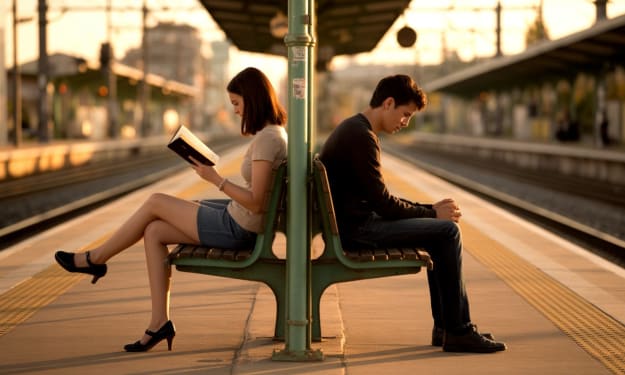
Love Between Two Train Stations
write by hasnain khan The evening train from Riverdale to Brookfield was late again. For most people on Platform 3, it was just another frustrating delay. But for Ethan Carter, it was something else entirely. It was another quiet evening spent sitting on a cold metal bench, watching strangers come and go while life seemed to move forward without him.
By hasnain pathanabout 7 hours ago in Humans
Parting is such sweet and salty sorrow...
Dear Wife— At first, I hesitated to go forward with this resolution. But after your recent late-night binges scarfing down bags of chicharrónes—those pork rinds you dip in butter and the god-awful crunch they make, I knew I could no longer reach you.
By Lamar Wiggins5 days ago in Fiction


Comments
There are no comments for this story
Be the first to respond and start the conversation.