
The Alamo Mystery History Missed
Parafictional History
The Alamo Mystery History Missed—
Seeing Through the Smoke
By: Liam Einhorn
Before I begin, if you haven't read America's Unsung and Unseen Occult Operatives, you should jump back and read that first—because without it, we wouldn't be here today at all.
Okay, now that we've got that out of the way, let me tell you that when I wrote about the Moonwatchers, I had no idea how many emails and letters I would receive from conspiracy theorists, researchers, historians, and people accusing me of lying or calling me crazy. Alright, maybe I had an idea about the ones calling me, as one particularly colorful email put it, "cuckoo" and "away with the fairies." I'm no stranger to people not believing me. That's literally what I explore, things that are hard to believe.
One letter stood out from the crowd, though. It included some details that were too far-fetched and yet too specific to ignore. A professor of history, who prefers to remain anonymous because administrators had already advised them to "cease pursuit of this particular research," had reached out regarding some similarities in what I'd reported from the events at Wewelsburg Castle and the Moonwatchers. This time, it was much closer to home and even longer ago.
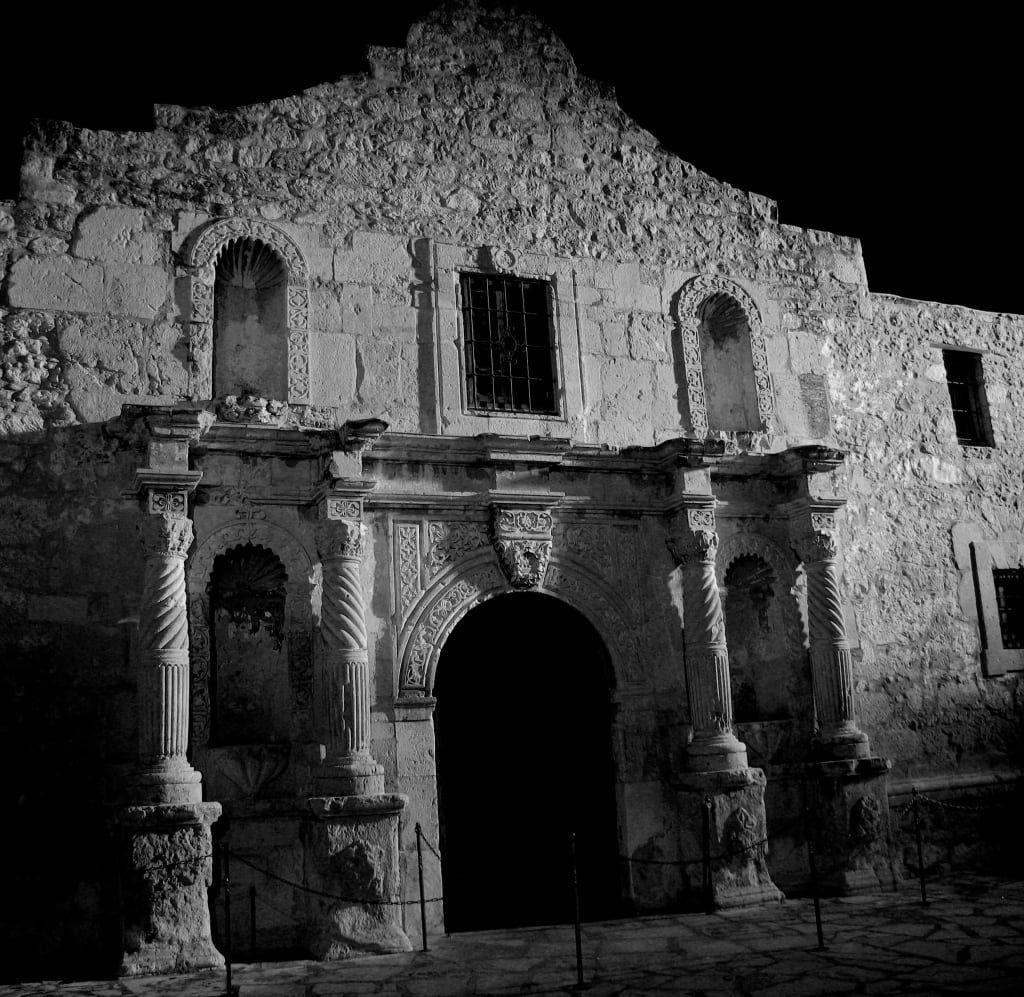
San Antonio, Texas—home of the Spurs—has a variety of reasons to visit: the city's scenic River Walk or the San Antonio Missions National Historical Park (featuring the largest concentration of Spanish colonial architecture in North America), but for all its colors and commerce the city is built around a wound that never fully healed.
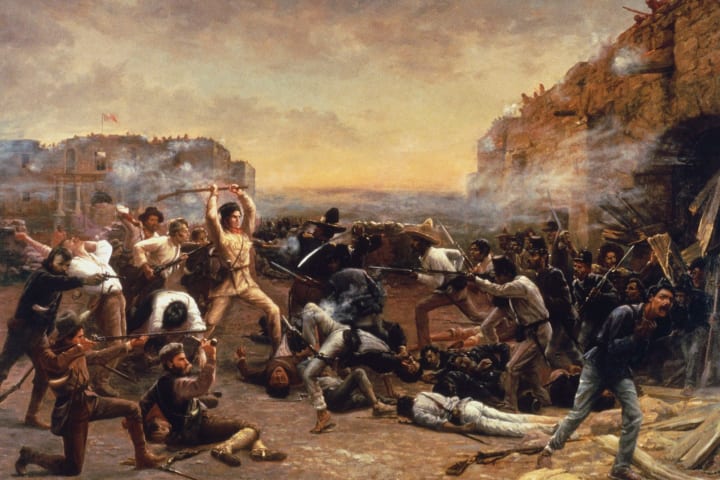
I hope you remember the Alamo, site of the most infamous battle of the Texas Revolution. Many would call it a massacre where several American legends saw their grisly demise at the hands of the Mexican Army led by General Antonio López de Santa Anna. The tragic battle that took place from February 23 – March 6, 1836 has left an impact in the very air around the site to this day.
Not a single Texian combatant was spared—a ruthless outcome that left historians with few eyewitness accounts of what it was actually like for those holed up inside the Alamo, making their final stand against the caudillo.
It was that tragic battle that my new history professor friend had invited me to town to discuss.
The professor claimed they had found unsubstantiated claims in journal entries and records from interviews with the few non-combatant survivors that they believed actually backed up claims about the Moonwatchers—or at least one of them.
Of course, the reports of the battle at the Alamo include smoke and fire like the huts around the main fortress that the Texian Revolutionaries, including Davy Crockett burned down prior to the battle to remove the attackers' cover or the smoke rising from the barrels of the flintlock muskets used on both sides. Not to mention the massive funeral pyres lit after the gruesome conclusion, but according to my new professor friend, the reports that you and I may be familiar with excluded tales of smoke that behaved... differently.
The professor brought me to a campus library like any other. We went through the wide open space of a common room filled with students preparing their theses or cramming for their next exam, but the real fun came after the professor pulled out their keycard and brought me into the archives. The smell of old books and stored memories filled the air as I was led to a table stacked with tattered journals and long dead newspaper clippings. I was in my element.
The professor showed me their collection and began to point out their specific findings, but I interrupted, preferring to dive in and find my own details without their bias. They understood and left me to my work. I cracked my knuckles and opened the first book.
A journal entry stood out from a civilian who'd departed the Alamo a few days prior to the battle.
"Overheard soldiers speaking of an odd fog moving against the wind spotted during their patrol last night. A bad omen. I'll be leaving in the morning."
What a start. Could that be who I think it is?
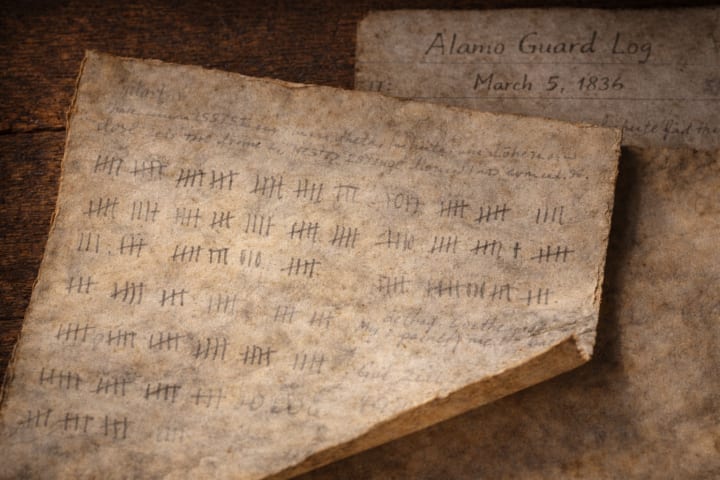
I dug deeper, poring through a logbook that had been recording the population of the fort. On its own, it was a mundane tracker of how many men, women, and children were staying at the fort. It was the type of documentation that most historians don't give a second look—most historians.
But cross-referencing that against a gate log—a thorough record of everyone entering and exiting the fort—revealed a disparity.
A Native man had made it onto the population count one day without having ever been recorded as entering. In another context, one might assume that was an oversight. But we know better by now, don't we?
That was enough to tell me the professor wasn't just chasing shadows in the dark. I needed to keep going, now convinced that the link was worth investigating further.
Thankfully, I have a rudimentary understanding of the Spanish language and Google Translate exists to fill in the many gaps. I turned to documents from the 'winning' side of the battle.
Interestingly, there were reports from the attackers that when they tried to burn down the mission, their fires would never catch—instead choking the air with thick smoke that refused to take flame. Despite using every trick at their disposal, the fort would not burn.
A common practice at the time was to preheat cannonballs until red-hot before firing them to splinter defenses and ignite wooden structures.
Mexican military reports in the professor's stacks confirmed the success of these so-called 'hot-shots' on surrounding structures, but when they struck the Alamo itself, the walls were smothered in smoke rather than set ablaze.
One entry I translated even described a "fantasmo indio"—a crude phrase for "Native specter"—moving through the smoke between howitzer blasts, never far behind where the hot-shots landed.
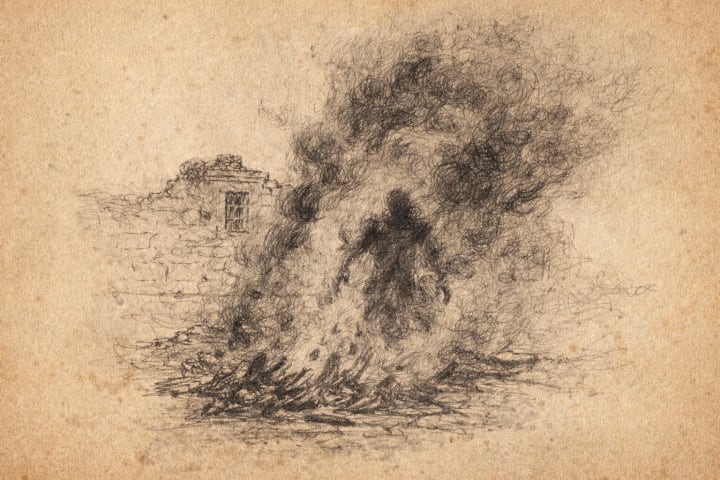
The fog, the smoke, the so-called "Native specter"—all of it pointed toward something I had seen before.
Something I had written about.
Something the professor recognized in my article and knew I would recognize all the same.
Whisperkin.
But why would Whisperkin be there putting out fires?
Neither side had been known for kindness to the native peoples of the land, and history offers no indication that any Native American tribes had openly sided with the Texians.
So why was he there?
And more importantly, where did he come from?
I needed to shift my investigation away from a point in time and toward the individual. I exhausted the resources available to me in the college library and spoke again with the professor who pointed me toward this investigation. I informed them of my findings and my next goals, letting them know that I was off to pursue Whisperkin and his history.
Their pride was evident as they thanked me for picking up their investigation where their administrators had stopped theirs. A handshake and a coffee to go later, we were heading in separate directions.
Still in San Antonio, the local Archdiocese has an archive including records from the Alamo's days as a Spanish mission, Mission San Antonio de Valero. Of course, these records are kept safe and vetted by the church. This meant that I could get some surface-level access easily, but I knew that what I needed wouldn't be that easy.
For the first time in a long time, I had to call on an old friend in the church. A cashed-in favor provided me with the 'credentials' to get a look deeper into the archives than what any secular off the street would get.
A pleasant clerk at the archive brought me down a flight of stairs behind a door marked with a cross and the words Ingressus Vetitus engraved into a fading brass plate. Perfect.
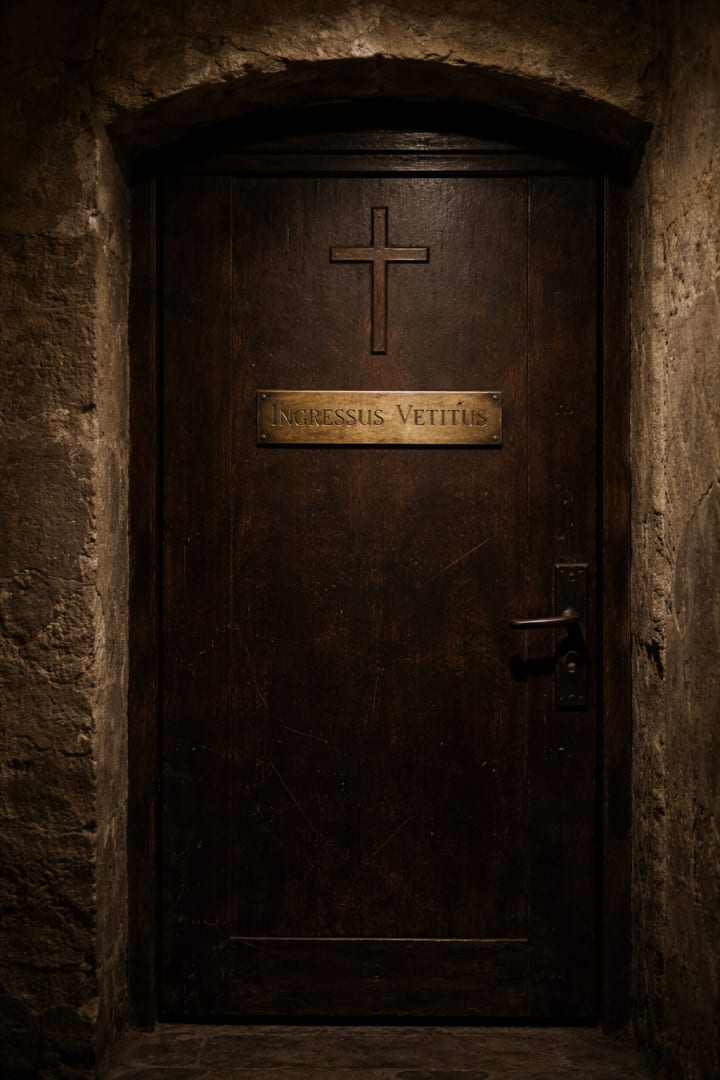
I expected to find the dirtier parts of the mission's history down there. For years, modern history has largely ignored the methods used by the missionaries in their construction of new sites and for the conversion of native peoples.
After spending a few hours down there going through monotonous journals of missionaries, I realized that the gritty side had likely been removed even from the darkest parts of their records, but that didn't stop me from looking for my links. The night wore on even after the clerk wished me well as they departed that evening.
At some point, I must have fallen asleep in a pile of books while looking for anything that resembled Whisperkin. I awoke with my face in a journal from a Catholic priest alongside its English translation. I must have fallen asleep before comparing them. Now rested from my accidental nap, I immediately noticed something amiss between them.
The translations were much shorter than the original writing. I rooted out the gaps as best I could.
The translator omitted entries that detailed a Native man whom the journal's author described as having 'eyes that showed more experience than his face.' The man showed up in the middle of a foggy night in the spring of 1724. The river had risen and tore down some of the mission's structures—structures built by indigenous laborers. Many of whom are now believed to have been left behind in unmarked graves at both the original mission site where this journal was likely recorded and the final site that later became the Alamo.
The journal went on to explain that unlike most of the mission's indigenous inhabitants, he was here neither seeking safety and security, nor brought there by the coercion of Spanish colonizers or Catholic missionaries. The descriptions included him sitting in prayer circles without participating. He learned Spanish with the other Natives but only spoke in his native tongue outside of the lessons. The journal mentioned the ways they would try to discourage this behavior, but he didn't take to their forms of correction.
That same year, the original mission had to be moved due to the heavy storm damage.
He did not move with them.
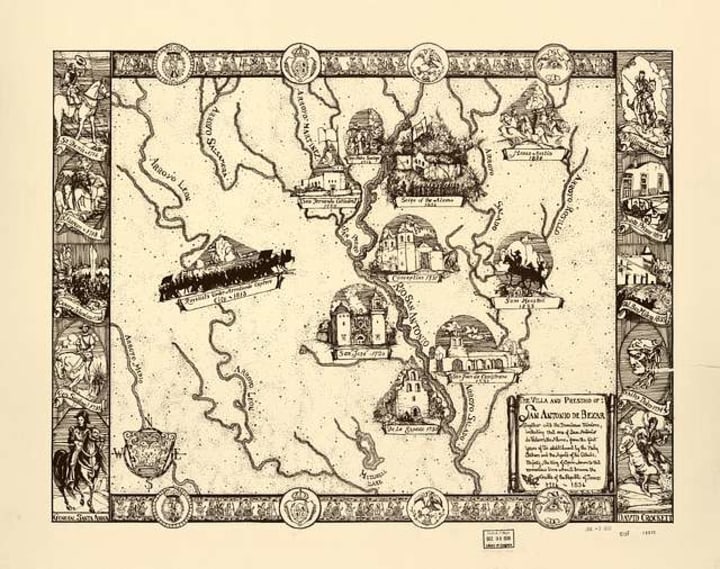
The journal has no further mention of him after the mission was relocated to a more secure location on the east bank of the San Antonio River—where the fort was later constructed in 1803 and the Alamo still stands today.
Could this journal really be describing the same man who would be putting out fires a hundred years later?
Is he really the same man that would later be stopping Nazis from completing occult rituals?
If so, then it really might be Whisperkin of the Moonwatchers—active in 1944—and the same mysterious Native and ominous smoke at the Alamo in 1836.
What was I missing?
I'd learned during my Moonwatchers research that Whisperkin had allegedly belonged to a tribe that vanished prior to the American Civil War. This investigation had me thinking it was much longer ago than whoever recruited Whisperkin even knew.
I had to keep pulling the thread. My search for Whisperkin became my only priority. With little to go on other than my notes from a Catholic priest's journal dating back about three centuries, I embarked on the next leg of my investigation.
Researching active tribes from the late 17th and early 18th centuries led me into Mexico. I spent months looking for anything that could be a link to this smoldering mystery. I followed my thread through libraries, to archaeologists, and into many meetings with tribal elders, accomplishing nothing tangible beyond growing the scholarly beard of a man who didn't have time between books to pick up a razor.
Until finally, one archaeologist pointed me to a tribal elder he said knew all the old tales. With him as a reference, I was granted a sit-down with Tomás Moroyoqui in the town of Vicam. When it came to folklore and Yaqui history, the locals said, "Él recuerda."
A translator sat between us as I told Tomás of my findings on Whisperkin, and I took notes trying to keep up with him and the translator.
My stories reminded him of an ancient tale that had been passed down from when Spanish colonizers first interrupted the lives of the Yaqui and the many tribal bands of the Sonoran Desert.
He spoke in a gravelly whisper of a tribe dispersed by the Spanish. The invaders had taken their homes and burned their supplies. They relentlessly pursued families as they fled.
One man eventually had enough. As the conquistadors chased him and his family into a sandstorm, he could run no more. In the face of danger, he took a final stand. The man stopped abruptly and turned to face those who would decimate his people.
As the legend goes, his form faded into smoke—a thick cloud that mixed with the roaring desert sands and choked his pursuers. The conquistadors' horses faltered and bucked their riders, allowing the last of his people to scatter with the desert winds.
The elder went on to tell us that ever since that day, whenever oppressors threaten to erase history, the smoke rises again in defense of heritage.
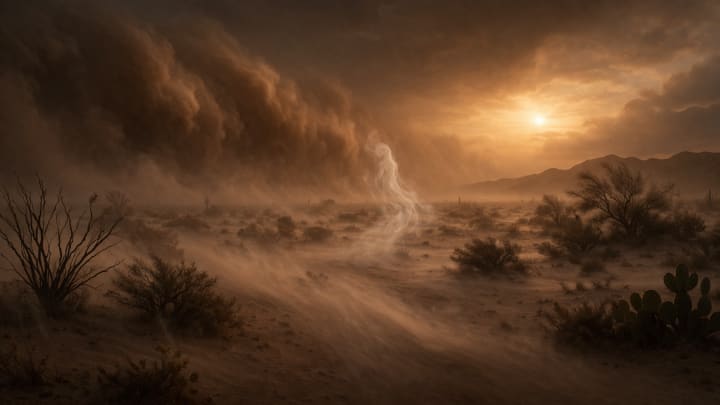
His tale ended with a long pause before he leaned across the table and in that same gravelly whisper but somehow heavier said, "Tell it correctly."
Once my heart started beating again, I knew it was best not to overstay my welcome. Tomás and I exchanged a nod, and I departed with the translator.
I spent the night in my hotel room connecting dots across centuries.
If the Whisperkin I learned of during my Moonwatchers investigation was the same man from the folktale, the same man from the priest's journal, and the same man from the Alamo—then what was it that pulled him to each of these moments?
It was just like the story said, wasn't it?
"The smoke rises again in defense of heritage."
At the Spanish mission, the mysterious Native learned but refused assimilation. He kept his language alive and defied the undoubtedly brutal techniques of conversion and discipline exacted by the missionaries.
At the Alamo, a dictator with a vengeance nearly burned away the evidence of what had happened there long before the Texians ever set foot on the hallowed grounds.
Even after the battle was won, Santa Anna's soldiers were unable to burn down the fort, claiming to have been stopped by fire-wielding specters.
Reports of these specters and the haunted grounds of the Alamo persist even today. Some of those accounts are compiled in Remember the Alamo: Haunting History.
Could this too have been Whisperkin, remaining after the Texian defeat to protect the remnants of history hidden beneath?
Genocide in Germany threatened to wipe out every heritage but their own Aryan race. There was Whisperkin, not fighting for the Allies, but for memory—for heritage.
Centuries later, he was still protecting history and heritage from those who would erase them.
That is, of course, if the stories are to be believed.
If they are, one question lingers—is the smoke rising even now?
Liam Einhorn is a fictional investigative journalist, studying the supernatural and paranormal history of the world. He is the lead reporter for Paranormal History, a branch of Tales from a Madman, and one small piece of the mind of the Madman.
†This is a work of parafiction. Real historical elements are blended with fictional characters, agencies, and events.
About the Creator
Tales from a Madman
.. the figure in question had out-Heroded Herod, and gone beyond the bounds of even the Prince's indefinite decorum.
The Masque of the Red Death
Edgar Allan Poe
Keep reading
More stories from Tales from a Madman and writers in Fiction and other communities.
Why NASA Never Returned to the Moon: A Deep Investigation
Like most Americans in grade school at the end of the last century, I learned about our first steps on the moon. I spent most of my life believing that we went to the moon the one time, made a big deal of it, brought back some moon rocks, and went about our lives. Later, of course, I’d learn that we mainly did it to show the world that we were more competent and advanced than our Soviet rivals. Who would have thought that the US government would dump millions of dollars into a clout-chasing Space Race?
By Tales from a Madman4 months ago in Fiction
Ping
Laughter at the beach tickles my ears, blending with the harmony of the crashing waves. Smiles on every beachgoer greet my gaze as the sun shines down upon us. The perfect day off. Away from the four walls of the office building located many miles away. Time to just lie back and enjoy the ocean view. My eyes close, allowing the gentle, serene waves to soothe my nerves and wash away thoughts of stress. Tension recedes from my muscles with each pat from the water on the shore while the sun kisses my dark skin. This is what they mean when they say tropical bliss.
By Iris Harrisabout 4 hours ago in Fiction
Incredibooks: The Masked Duet Series
So my best friend who loves the crazy world of reverse harem books put me on to this author named Reese Rivers and a two part book series she put together called the “Masked Duet”. The series is made up of two stories titled “Dance Butterfly Dance” and “Burn Butterfly Burn”.
By Joe Patterson7 days ago in BookClub



Comments (1)
Long live the Whisperkin 💨 🌪️