
The Gnash Lawn
A Descent into the Bitter Thickets of a Heart Left to Rot

The sun over the suburbs was a cruel, mocking eye, bleaching the life out of the cracked pavement and the dying stalks of what Gary Wallace once called a lawn. It wasn't a lawn anymore; it was a battlefield of waist-high weeds and patches of dirt that looked like mange on an old dog.
Gary sat on his sagging porch, the webbing of his lawn chair biting into his thighs like a dull saw. In his hand, he gripped the brass nozzle of a garden hose. He wasn't watering the grass. He was waiting.
"Stay off it!" he shrieked, the sound tearing through his throat like rusted scrap metal.
A group of third-graders, vibrant with their neon backpacks, scurried into the street as a high-pressure jet of water blasted the sidewalk. One girl tripped, her knee hitting the concrete with a sickening thwack. She wailed—a pure, high-frequency sound of genuine shock.
"Keep moving, you little parasites!" Gary roared, his face a map of broken capillaries and pure, unadulterated bile.
He didn’t care about the grass. He hated the grass. But he hated the sight of their unearned joy more. Five years ago, the world had committed an act of cosmic treason when it took Patricia, his wife of 35 years. Breast cancer had eaten her from the inside out while the rest of the world kept buying groceries and laughing at sitcoms. Since then, Gary had decided that if he had to live in a graveyard of memories, everyone else would at least have to walk through the mud.
Every third Wednesday of the month was a fresh descent into his own personal purgatory. That was when his daughter, Janice, would arrive in her sanitized SUV to take him "out." She tried to make her monthly chore of, taking Gary shopping, and getting him out of the house as enjoyable as possible.
"Dad, please, put the hose down," Janice said, her voice trembling with that exhausted patience that precedes a nervous breakdown. She was standing on the sidewalk, holding the hand of four-year-old Ellie.
"They’re encroaching, Janice. It’s a perimeter," Gary muttered, dragging himself toward the car, while reliving some old Vietnam War memories in his mind. He smelled of stale beer and damp earth, as he opened the door to the modest, but clean automobile.
In the backseat, Ellie was a radiator of sweet-natured innocence. She held a plastic doll and hummed a song about a teapot. "Grandpa, do you want to sing the 'I'm a Little Teapot' song? I know the handle part now!"
Gary stared out the window at the passing strip malls. "The teapot gets smashed, Ellie. Everything gets smashed. Sing about that." His voice cut the air and Ellie's little spirit like razor wire.
Janice’s knuckles went white on the steering wheel. "He doesn’t mean it, sweetie. Grandpa is just... tired."
"I’m not tired," Gary snapped, turning his cold, watery eyes on his granddaughter. The girl’s smile faltered, her lip beginning to tremble. "I’m the only one in this car who isn't hallucinating. Your mother thinks a trip to the organic grocer is a religious experience. It’s just overpriced rot."
Later At the park, Janice tried one last time. Sitting next to him on a bench near the sandbox, Janice quipped "Look at her, Dad; She just wants you to see her play. Mom would have loved this."
The mere mentioning of her was like a cattle prod to Gary’s soul. He stood up, his knees popping. "Don’t you dare. Don’t you use her to try and dress up this... this farce. My Patricia is bones and dust, and you’re dragging me to a playground to watch a child who won't even remember me in twenty years."
He walked away, leaving Janice weeping in frustration on the bench while Ellie stood in the sand, holding a red plastic shovel, waiting for a grandfather who had already checked out of the human race.
Gary Jr. was the optimist of the family, which made him the primary target of Gary Sr.’s most concentrated vitriol. While Janice took every 3rd Wednesday, Gary Jr. brought the twins over on Saturday morning, once a month—Nick and Mick. Six-year-old mirrors of each other, full of kinetic energy and the terrifying belief that the world was a safe place.
"Dad, the boys got a new football," Gary Jr. said, standing in the overgrown jungle of the front yard. "Come on, just toss it with them. Get some sun. You look like you’re turning into a mushroom."
"I don't play games, Junior," Gary said, leaning against the porch railing, clutching a lukewarm can of malt liquor.
"It’s not a game, it’s your family!" Junior yelled, his frustration finally breaching the levee. "Look at them! They’re your blood! They want to know who you are!"
"They know who I am," Gary spat. "I'm the warning. I'm the ghost of Christmas Future. You want me to play? Fine."
He grabbed the football from Nick’s hands. The boy looked up, hopeful for a split second. Gary didn't throw it. He turned and hurled the ball with every ounce of his bitter strength into the thickest, thorniest patch of blackberry bushes at the edge of the property.
"Go get it," Gary whispered. "Life is about reaching into thorns for things that don't matter. Get used to the scratches kid."
Mick started to cry. Nick just stared at his grandfather with a dawning horror—the kind of look a child gives a monster when they realize it isn't wearing a mask. Gary's snarled comment, combined with losing their new ball, left the young boys dejected, and for a moment in the dumpster of sadness with their grandfather.
"We’re leaving," Gary Jr. said, his voice flat and dead. "And Dad? Don't call us. Don't call anyone. You want to be alone? You’ve fucking won."
The house grew quieter, but the noise in Gary’s head grew louder. The ghosts didn't talk; they just pointed at the empty side of the bed, or the empty spot at the dinner table. Gary couldn't help but feel the constant sting of Patricia's absence; and he wasn't going to make any effort in alleviating that pain.
He stopped showering. The dandelions took over the lawn just past the porch steps. The school children stopped passing directly in front of his house; instead they had learned to cross the street a block early to avoid the old "Hose Man." He had achieved total isolation. He had successfully punished the world for his outliving Patricia.
One Tuesday afternoon, just after he finished his lunch, a turkey and cheese on white bread, the chest pains started. It wasn't a sharp lightning bolt type of pain; but rather it was a slow, heavy grinding, like a tectonic plate shifting over his heart.
He reached for the phone on the nightstand. His thumb hovered over Janice’s contact. Then Junior’s.
He thought of Ellie’s song. He thought of the football he tossed into the thorns; and the looks on his grandchildren's faces of childish pity as they would gaze upon him.
He realized, with a clarity that only comes when the blood stops reaching the brain, that he had spent five years building a fortress of hate, and he was finally being rewarded with the fruits of how successful he had been, in making his heart and life impenetrable. There was no one left to call. Even if they picked up, what would he say? I’m sorry I hated you all for being alive?
He didn't make the call. He didn't want to give them the satisfaction of a goodbye, or perhaps, he was too cowardly to face the silence of their rejection.
At 2:12 P.M. on Tuesday April 2, 2013, Gary Wallace fell from the couch, and his body hit the floor with a dull thud, that no one heard. He lay there, staring at a framed photo of Patricia on the end table. In the photo, she was laughing at a picnic, it was always his favorite; he loved her smile. He had spent five years trying to protect that memory by destroying everything else, only to find he’d destroyed the memory, too. All he could see now was the cancer. All he could feel was the cold floor, as the room was growing dark, into a singular abyss of nothingness.
At 2:37 P.M. Gary Wallace died alone that afternoon, in the dark shadows of his home, surrounded by the smell of unwashed clothes and the distant, muffled sound of a neighbor’s lawnmower—someone else, somewhere else, was alive, and still trying to keep things neat.
The house sat silent for three weeks before the mail piling up forced a welfare check. When the police finally broke the door down, they found him, there dead on the floor. There was no grand revelation. No final letter of regret. Just a bitter man in a cold room.
At the funeral, the pews were nearly empty. Janice and Gary Jr. stood at the grave, not crying, just looking tired. They didn't tell stories of a loving father and grandfather. They didn't mention his "struggle. They just watched the casket go down.
As they walked back to the car, Ellie found a dandelion growing near the cemetery path. She went to pick it, but paused looking at the weed, which was a white ball of fluff, with a strange and inherited flicker of fear.
"Don't, sweetie," Janice said, pulling her away. "It's just a weed. Leave it in the dirt." But somehow it felt eerily familiar to the family, like it was Gary, the curmudgeon, arrogantly still staining the Earth.
They drove away, and the wind blew the seeds of the dandelion across the graveyard, scattering them into the wind, unrooted and headed to regrow themselves in a new patch of innocent grass.
Three weeks after the funeral, to start the process of taking inventory of the house prior to selling it, Janice and Gary Jr. stood on the porch with the children—Ellie, Nick, and Mick—and Gary Jr.’s golden retriever, Max.
The air was heavy with the smell of wet rot and the chemical tang of the hose Gary Sr. had left running until the city shut it off. Max, usually a beacon of canine joy, whimpered and tucked his tail, refusing to cross the threshold. Even the dog sensed the toxic sediment left behind.
"Watch your step," Gary Jr. muttered, his voice sounding thin in the dead air of the hallway.
They pushed into the living room, and the silence hit them like a physical weight. But it wasn't just the silence; it was the emptiness. The walls were bare. The hooks where family photos once hung were just dark gashes in the wallpaper.
"Where is the portrait of Grandma?" Ellie asked, her small voice echoing. "The one with the blue dress?" It was the only one he left behind, on the end table, the last place he saw his wife Patricia before life's lights went out.
Janice didn't answer. She walked toward the kitchen, her heels clicking on the floor like a countdown.
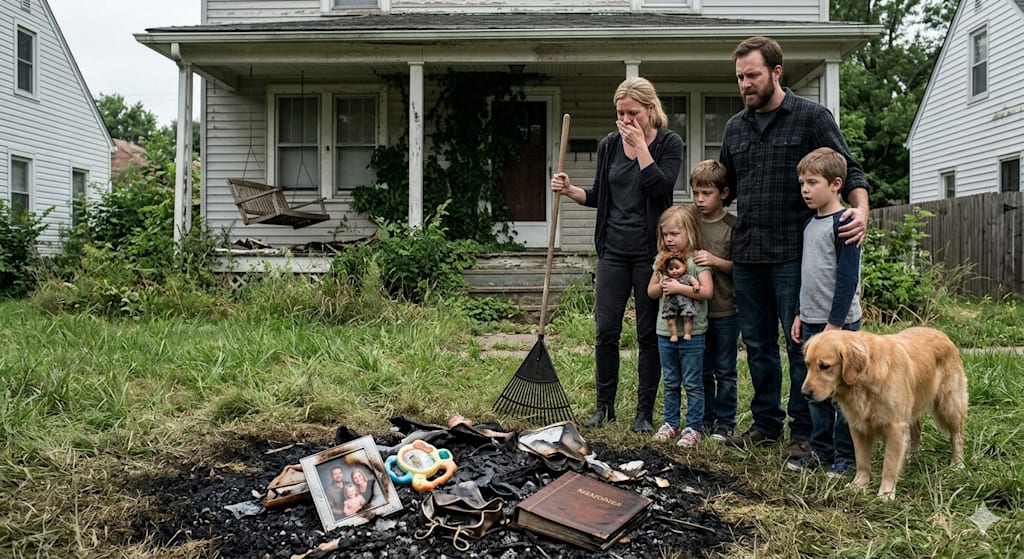
They found the missing photos, and mementos in the backyard, amongst the "gnash lawn" where the dandelions were now white, ghostly seeds. A large, blackened circle marked the grass. In the center lay the charred remains of their history.
Gary Sr. hadn't just neglected the house; he had purged it days before he met his demise; almost like he knew, as just one more act of revenge, upon a world he felt did him wrong. They sifted through the ash with a garden rake. They found the brass hinges of Patricia’s jewelry box. They found the melted plastic of the twins' baby rattles. Most devastatingly, they found the scorched edges of a wedding album.
He hadn't kept the memories to himself. In his descent into hate, he decided that if he couldn't have her, no one could have the proof she ever existed. He had burned the shared history of his children to spite the world for her absence.
"He took it all," Janice whispered, clutching a half-burnt photo of her mother’s face. "He didn't just hate the neighbors, Junior. He hated us for remembering her with a smile."
Nick and Mick stood by the blackened pit, looking at the remains of the football their grandfather had thrown into the thorns weeks prior—it was now flat, punctured by the very thorns Gary Sr. told them to get used to.
They walked back inside to find Max still at the door, vibrating with a low, mournful growl. There was nothing left to save. No heirlooms to pass down. Just a house full of shadows and a yard full of weeds.
As they all piled back into their SUVs, leaving the house to the dandelions and the bank, Ellie looked back at the porch. She didn't wave. She didn't sing. She just watched the house shrink in the rearview mirror—a monument to a man who chose to be a ghost long before he actually died.
About the Creator
Meko James
"We praise our leaders through echo chambers"
Keep reading
More stories from Meko James and writers in Fiction and other communities.
The Window
The glow was the first thing everyone checked in the morning—not the sun, which was unreliable and messy, but the steady, cool blue of the glass. Every home was a gallery of these illuminated rectangles, windows that offered a view far more curated and pleasing, than normal human optics could receive from the unfiltered world that hid behind everyone's' walls.
By Meko James 6 days ago in Fiction



Comments
There are no comments for this story
Be the first to respond and start the conversation.