


I am always fascinated by myths and fairy tales of different nations as they reflect the people's important memories and cultural beliefs. Since I am in Georgia-Sakartvelo now, I wanted to present a marque fairy tale from this land, rich in ancient oral and folk tradition.
Please prepare yourself for a long read of about 3,500 words. But you won't regret it because this particular tale has everything:
- a brave and strong prince who sets out on a doomed journey at seven years old and overcomes many obstacles and tests on his nine-year quest to return home;
- cursed beautiful and willful maidens and damsels;
- magical things, such as self-replenishing tablecloths and invisibility veils;
- faraway lands and fantastic beings that often come in threes and nines, just as do tragic and happy encounters between the prince and other characters;
- lots of moral lessons about humans and relationships, and
- a very happy ending.
The tale was first translated into English by a Scottish literary ethnographer and anthropologist Marjory Wardrop, who traveled across Georgia with her husband in the 1880-90s and spent a considerable amount of time in remote mountainous regions such as Svaneti and Racha. Her book of translations, titled Georgian Folk Tales, was published in London in 1894 and to this day remains one of the fullest English translations of Georgian fairy tales.
I have "contemporized" olden English and smoothed out Wardrop's translation of The Prince to make it easier for today's readers. I also provided some explanatory details in the end notes.
THE PRINCE
There was once a king who had amassed great wealth, but his wife could bear him no children, so he was a prey to grief for having no heir.
One day when he was dwelling in sadness, a courtier came to him and said, ‘My most mighty king! You have no sons, and you give no gifts. What will your subjects think of you? What will you do with all this wealth you've stored up?’
The king took these words to heart and the next day he gave a great feast for his people, generously lavishing them with gifts.
Suddenly, out of nowhere there appeared an old woman at the feast. She came up to the king and asked: ‘What will you give me if I bring you a son?’
The king replied: ‘Whatever you ask of me, that will I give you.’
The old woman took an apple from her pocket, cut it into three parts and gave it to the king, saying, ‘After your wife eats this, she will have three children. But, remember, I will come back in seven years and you must give me your youngest son.’ The king agreed, gave his wife the apple, and she ate it.
Some time passed, the queen bore three sons, and the youngest was the most beautiful of them all. The king could not bear the thought that he must give him up. He said to himself: ‘I'll hide him in a secret room behind nine [1] locks, and when the old woman comes, I'll tell her that my youngest son died, but she can take one or both elder sons if she wishes.’
Seven years later the old woman came back, and demanded the king give her his youngest son. He did just as he had planned. He had locked up his youngest son behind nine locks, and said to the old woman: ‘My youngest son is dead, but here are the other two, take any one or both of them.’
The old woman refused to believe him. She searched every corner of the palace, opened the nine locks, and found the young prince. She took him with her and went home.
After they traveled a little way, they came to a brook where they found an old woman washing clothes. When she saw the beautiful prince she called him out, and said sadly to him: ‘Do you not know you are being led to your death? Why do you go with that witch? You certainly won't escape alive from her hands!’
When the prince heard this, he went to the witch and said: ‘Let me go and have a word with this old woman. I shall catch up with you in a minute.’ Surprisingly, the witch let him go.
The prince went back to his own home, filled a cup with water, and placed it near the fireplace. Having done this, he said: ‘When that water changes to blood, I will be dead, but as long as it stays clear I shall be alive.’ Then he went away, quickly caught up with the witch, and they went on together.
They finally arrived in a dark ravine. The witch's home was there in a rocky cave. In the house she had three daughters and two horses, one for herself and one for her daughters. The old woman went in, leaving the prince in her daughters’ care, and fell asleep.
Now this old witch had a habit of sleeping for seven days and nights, and it was impossible to rouse her then.
When her daughters saw the prince they admired him very much, and one said: ‘It is a shame that such a handsome boy should perish! Sisters, our mother shall not have him to eat! We must help him escape in some way.’
‘We will!’ cried the other two sisters, and they thought of a plan of escape.
The eldest sister gave him her comb, and said: ‘When my mother catches up with you, throw this behind your back and hasten on. A thick forest will spring up between you and my mother, who will have difficulty passing through it.’
The second sister gave him a pair of scissors, and said: ‘When my mother catches up with you, throw these scissors behind your back. Jagged rocks, hard as adamant, will rise between you and my mother, who will have difficulty crossing them, but you don't stop and hasten on.’
The youngest sister gave him a lump of salt, and said: ‘When my mother catches up with you, throw this behind your back and between you will roll a sea, which my mother will never cross.’
Then they carefully saddled their own steed, gave the youth everything he wanted, and sent him away. He thanked them heartily and left.
Seven days passed. The witch awoke, looking for her dinner, but the boy was no longer there. She went to her steed and inquired of it, ‘Shall we eat bread or shall we set out at once?’
‘Whether we eat bread or not we cannot catch up with him,’ said the steed to the witch. She did not abandon her intention, but, having eaten bread, mounted her horse and set off in pursuit of the prince.
After riding some distance she could see him. The prince looked back, and, seeing the old woman catching up, drew the comb from his pocket and threw it down behind him. Between them, there rose a forest so thick that even a fly could not go through it. The old witch was angry and hindered, but at last, in one witch-crafty way or another, she passed through it.
When she reached the open country she spurred her horse on with might and main, and again caught on with the prince, who looked behind and saw the old witch. He took the scissors from his pocket, and threw them down. Between them appeared a jagged rock, hard as steel, so that no iron could cut it. The witch's horse cut its feet, and, not being able to go any further, fell down. Yet she would not give in. She jumped from the horse’s back and went forward on foot. She passed the rocks, reached the plain again, and hastened on.
The prince looked back, and saw how near the witch was. She turned into a Kudiani [2] and flew over the ground. The prince took the lump of salt from his pocket, and threw it behind him. There flowed between them a sea so vast that no bird could cross it.
The old witch was not daunted even by this, she waded into the sea, determined to cross it. Her long hair became wet and revealed her tail. 'I can see your tail!' the prince shouted, and the Kudiani lost her powers and drowned.
The prince kept looking behind, but he could no longer see the old witch. Then his heart was filled with joy, and he went on gaily. He himself did not know where he was or where he was going. He grew hungry by the minute, until he was ravenous.
At last he saw a smoke. He came up closer and saw a huge fire burning, over which hung a large kettle of arrack [3], and food cooking. Around it lay nine devi [4] brothers. They were fast asleep, but there was a lame one watching as guard. The prince did not wait to ask for the devis' permission to eat. He came up, lifted the pot off the fire, drank arrack and took some food, and when he had eaten, put the pot back. He then lay down and fell asleep. The lame devi looked on with amazement from a distance.
A short time after, a devi awoke. He looked around and saw a human being sleeping nearby. He said joyfully: ‘This will be a dainty morsel for us,’ and went towards the prince.
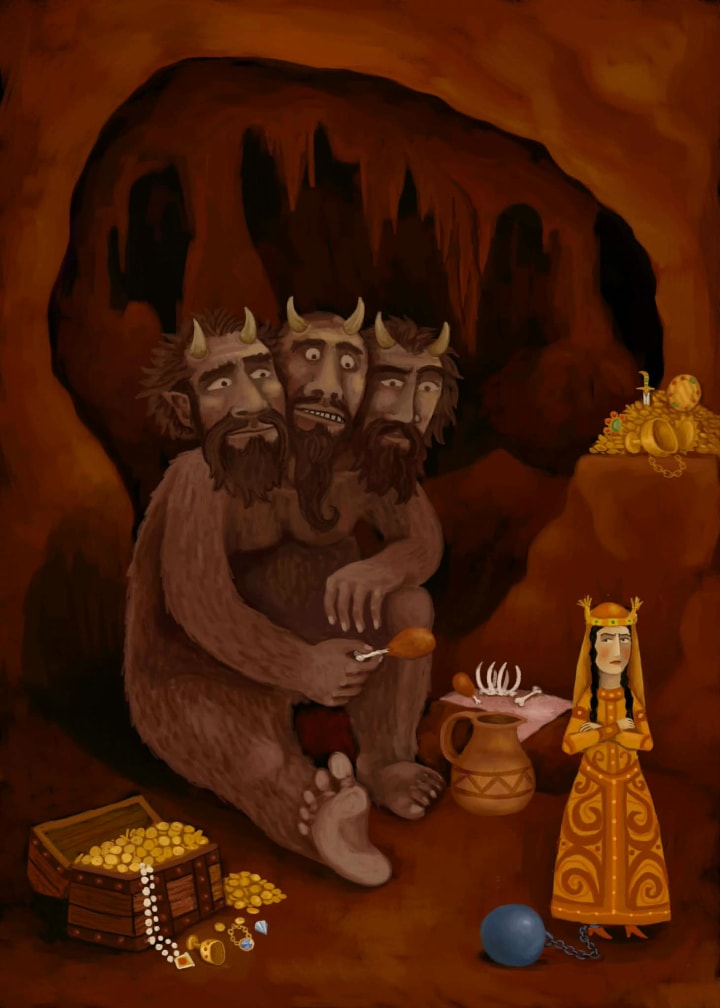
But the lame devi followed him and said: ‘Leave him alone, lay not a hand upon him. He is to be feared. Just now he took our pot off the fire, ate some food, and placed it on the fire again. He has done alone what is difficult for us ten.’ The devi thought better of it, and turned back.
A second devi then woke up and did the same, but the lame devi prevented him from going to the prince. Each devi awoke and went to the boy, but the lame devi stopped them all.
When all the devis were roused and had begun to eat, the prince woke up too. He came up to the devis and asked them to swear brotherhood. The devis said: ‘Who are you, a courageous one? What brought you here?’
The prince answered: ‘I was hungry. I saw the smoke and I came to the fire to eat.’
Then the devis said: ‘Very well, if you wish us to swear brotherhood with you, first go to the crossroads where a maiden spreads out a magic veil. If you seize that veil and bring it here, we'll swear brotherhood with you. But if you fail, you are none of us. Many have tried to take that veil, but the maiden always kills them.’ The devis thought that the prince would be killed too, and that they would thus get rid of him.
The prince set out and came to the crossroads, and, behold, a beautiful maiden flew down. She spread her veil out in front of her, and it hid her from the prince's eyes. He came up and seized the veil, but just as he was going away, the maiden attacked him. The prince was victorious in the fight. In the haste of retreating, the maiden left a golden slipper in the prince’s hand.
The prince came to the devis with the veil, and gave them the golden slipper, saying: ‘Go to the town, sell this for money, and bring it home.’
The devis sent the lame devi with the golden slipper. When he reached the town he met a merchant, to whom he showed the slipper. The cunning merchant said: ‘My wife had golden slippers, you must have stolen this one from her.’ The devi said that they had found the slipper—he swore, but the merchant would not believe him. He took the slipper, and locked up the lame devi.
For a long time the other devis waited for their lame brother. They watched, but no lame devi came back. Then they sent the ninth brother to look for him. When he arrived in the town where the devi had gone to sell the golden slipper, he asked about his lame brother. Hearing him ask for a lame devi, they said: ‘This must be an accomplice of the thief,’ and they locked him up too.
The remaining devis waited for their ninth brother, and when they saw that he did not come, the eighth was sent, but he also was taken. Then the seventh, sixth, fifth, fourth, third, second, and at last the first devi went, but none of them returned.
The prince said to himself: ‘What could have happened to these devis? I will go and seek them, and find out what misfortune has overtaken them.’ So he arose and went forth.
The merchant heard someone was again asking for the lame devi, and wished to entrap him, but the prince said: ‘If I do not find the pair to the golden slipper, you may call us liars, and do what you wish to the devis and me. But if I find the pair, it means you have lied, and we will do what we wish to you.’ ‘Agreed!’ said the merchant, and the prince set out to seek the other golden slipper.
He traveled far, and came at last to a kingdom by the seashore. This kingdom was ruled by a maiden, fair as Barbale the sun goddess herself. Whoever came to that kingdom to sell wheat was met by the maiden, who cast the wheat and its owner into the sea, and there was no escape. And the people of the country stayed hungry.
When the prince heard of this, he said to himself: ‘I shall bring wheat to this country, and see what the fair one can do.’ He went for the wheat, and filled a boat with grain, seated himself in another boat, and set out for the kingdom.
On nearing the shore there appeared, from no one knows where, a beautiful damsel. She stretched out her hand, and was about to sink the grain, when the prince struck the boat with his foot and upset it. Then he seized the maiden’s hand and drew her towards him. She, seeing that she was outwitted, pulled with all her might, and escaped from his hands, but left her rings behind in his hand.
Thus was the maiden defeated. After this, whoever wished to bring wheat brought it, and there was plenty in that kingdom.
The people of the country fell down and kissed the knees of the prince, saying: ‘We beseech thee, be our king.’ But he would not, and replied: ‘I am on another business, I wish for nothing but to find a certain slipper,’ and he told his tale. The slipper could not be found, so he arose and left that land.
He went on again and came into another country. Here he learnt that a beautiful maiden had killed the king’s son, who was buried in a tomb. Every night the maiden came there and beat him with twigs. When she did this he came back to life, they supped together, and passed the time merrily until morning, when she again beat him with twigs. Then he became a corpse, and she flew away.
When the prince heard this tale, he went to aid the unfortunate youth. He entered the tomb and waited. Behold, a lovely damsel flew down, took twigs from her pocket, and beat the king’s son until he came back to life. They supped and made merry until morning. As she was about to beat the youth and kill him again, the prince snatched the twigs from her hand; so the king’s son lived. Then the prince took him away, and led him to his father.
Here, too, the prince was offered the throne, but he did not wish to be king. ‘If I could find a certain golden slipper, I should be happy,’ said he. ‘I must go forth and seek it.’ And he set forth on his quest again.
After he traveled some way, he came to a wide plain. He saw a beautiful house, and said to himself: ‘I wonder who lives there,’ and went on towards the house. On the way he saw an Arab [5] feeding some mules, and said: ‘Can you tell me whose house that is, brother?’
The Arab looked round about and replied: ‘Shall I swallow you head first or feet first?’
‘I asked you about the house, why won't you answer?’ said the prince.
Again the Arab stared round and said: ‘Shall I swallow you by the head or by the feet?’
‘As to the matter of swallowing, I'll soon show you what I will do,’ said the prince, giving the Arab such a blow that it sent him over nine mountains. Then he struck the mules, and went into the house.
He wandered all round it, and was much delighted with its appearance. Then he went inside through a window, and visited every room. In one of these he saw a golden throne, and on it were golden slippers like the one he sought. He thought, ‘Perhaps this is the house of the fair damsel who gave me the slipper. I'll wait and see what happens.’ He sat under the throne and waited.
Soon after, there flew in a beautiful maiden, then another, yet a third, and at last the Arab. They sat down to eat. In the twinkling of an eye the Arab laid the tablecloth for the sisters, and whatever heart or soul could wish was spread upon it.
After a short time the eldest sister took wine and said: ‘May God grant long life to the youth who broke my curse by taking from me the veil and the golden slipper.’ She drank, and put the bowl down.
Then the second sister took it and said: ‘Long life to the youth who broke my curse by snatching the rings from my hand, and gave wheat to my kingdom.’ She drank, and put the bowl down.
Then the youngest sister took it and said: ‘Long life to the youth who broke my curse by taking the twigs from my hand and restoring life to a prince.’ She drank, and put the bowl down.
At last the Arab took the wine and said: ‘Long life to the youth who gave me a blow, and sent me over nine mountains.’ He drank, and put the bowl down.
Then the prince appeared from under the throne, took the wine and said: ‘I also have toasts to propose. May God grant long life to the maiden from whom I took the veil.’ He took the veil from his pocket and gave it to the eldest sister. ‘May God grant long life to the maiden from whom I took the rings,’ and he gave the rings to the second sister.
‘May God grant long life to the maiden from whom I took the twigs.’ He returned the twigs to the youngest sister, and turning to the Arab, he said: ‘May God grant long life to the Arab whom I struck and sent over nine mountains.’ He drank, and put down the bowl.
Then the three sisters jumped up and said: ‘He will marry me.’ ‘No! me.’ And they began to quarrel. The prince said: ‘Why quarrel with one another? I'll wed the youngest sister, since I am the youngest of three brothers, and you elder sisters shall wed my elder brothers.’
The maidens asked him: ‘What is the purpose of your journey here?’
‘To find the other golden slipper, and lo and behold, I have found it here!’ answered the prince. ‘Because of this slipper, nine devi brothers are imprisoned in a faraway town, and if I return without it, I, too, shall be imprisoned with them.’
‘This slipper is yours, and as many more as you wish, take them with you, seat yourself on the Arab’s back, and in three hours you will be in the town,’ said the sisters.
The prince did as they told him. He filled a bag with golden slippers, sat on the Arab’s back, and in three hours he was in the town.
The devis rejoiced greatly. They called the merchant, and he brought the slippers. He took one by one his own slippers, but, behold, not one of them would match the golden slipper. Then, when the prince produced his bagful of golden slippers, the merchant was proved a liar.
The prince gave the merchant into the hands of the devis, and said: ‘Do to him what you please, sell all his possessions, but I must go at once on my way.’ When the devis heard this, they begged him to stay with them. But he would not consent.
The prince came back to the three beautiful sisters, and married the youngest. The sisters gave the Arab a saddle bag which had everything for the journey, placed in his hand a tree, and said: ‘Go to the kingdom of the prince’s father, and when you are near the palace, in such and such a place, plant this tree. It will turn into a great plane tree, and underneath, a beautiful stream will flow; there, on the banks of the stream, lay the cloth, and prepare everything for our coming.’
The Arab did everything as he was commanded. Then the maidens came. Every man and woman in the kingdom heard of this, and went out to the town square to look at them.
Meanwhile, the prince's parents had been mourning their long-lost son. The prince was away on his quest for nine years. The cup of water had not changed to blood, but they had given up all hope of finding him. At last they could stand it no longer, and they too went to see the maidens.
When the prince saw his mother and father approach, he feigned surprise, and asked why they mourned. They answered that they had lost a son, and therefore they mourned. The prince said: ‘I am your long-lost son.’ The king and queen rejoiced, and took him home. They prepared such a wedding that the roof of the palace resounded with merriment.
END NOTES:
[1] Nine is a magical number in Georgian myths. A lot of things, both good and bad, come in nines and threes, as three is a square root of nine.
[2] A Kudiani ("a being with a tail" in Georgian) is an ugly evil hunchback with large teeth, unkempt long hair and a tail hidden from human eyes. People, usually females, who had plotted or committed nasty, dark doings, against humans, where changed into Kudianis. A Kudiani would lose its power if it revealed its tail. An illustration of Kudiani can be found in my review of the the book "Georgian Mythical Heroes."
[3] Arrack is a strong vodka-like alcoholic drink. The name is of Arabic origin ('arak' means 'sweat' from the process of distillation) but it is also common in non-Arabic cultures, including Central Asia.
[4] A devi is an Ogre-like large hairy creature, usually depicted with multiple heads. The larger the devi and the more heads it has, the more powerful it is. However, they are not allowed to overpower weaker beings and must use their strength proportionately. Devis usually live in mountain caves in groups of nine. They are excellent farmers, shepherds, and blacksmiths. They can be both good and bad to people.
[5] Arabs of various Caliphates occupied and dominated Georgia intermittently for about 400-450 years, from mid-7th century to early 12th century. In Georgian mythology, Arabs can be cunning and sneaky and outsmarting them or beating them in combat is a matter of honor for a Georgian warrior.
Illustrations are courtesy of an extremely talented Georgian artist Varlam Jmukhadze. More can be found on his Facebook page and my review of Georgian Mythical Heros.
The entire book of Wardrop's translations is available at Project Gutenberg for free:
About the Creator
Lana V Lynx
Avid reader and occasional writer of satire and short fiction. For my own sanity and security, I write under a pen name. My books: Moscow Calling - 2017 and President & Psychiatrist
@lanalynx.bsky.social
Keep reading
More stories from Lana V Lynx and writers in Fiction and other communities.
We Will Bury You
How do you deal with the vast disappointment and anger and rage and grief and rage and RAGE and RAGE and RAGE when a community icon, who did so much to help your gente, is found to be the type of monster that still makes me believe in capital punishment?
By Ariana GonBona day ago in Humans




Comments (3)
Love reading myths and legends, and this did not disappoint. Thanks for sharing with us, Lana
Oh wow, so all those maidens and that Arab were under a curse and the Prince freed them unintentionally. I thought that maiden with the twigs was a necrophiliac, lol. Also, out of all the Devis, the lame Devi was my favourite hahahahaha The scissors, salt, and comb that the three sisters gave the Prince to throw behind his back reminded me of a story my grandma used to tell me when I was young. In that story, the MC was a girl. Her name was Powny, pronounced Pau-nee. I can't remember the details but she'll be running away from someone and someone else would have given her random items to throw behind her back that would turn into a forest, a sea, etc. So that felt so nostalgic I loveeeeee stories like this hehehe. I enjoyed this so much!
Oooh I’m going to save this up for bedtime