
Chemical Digitalization Market Impressive Growth at 19.5%
Chemical Digitalization Market Analysis: Size, Share, Trends, and Forecast 2025–2035

Overview
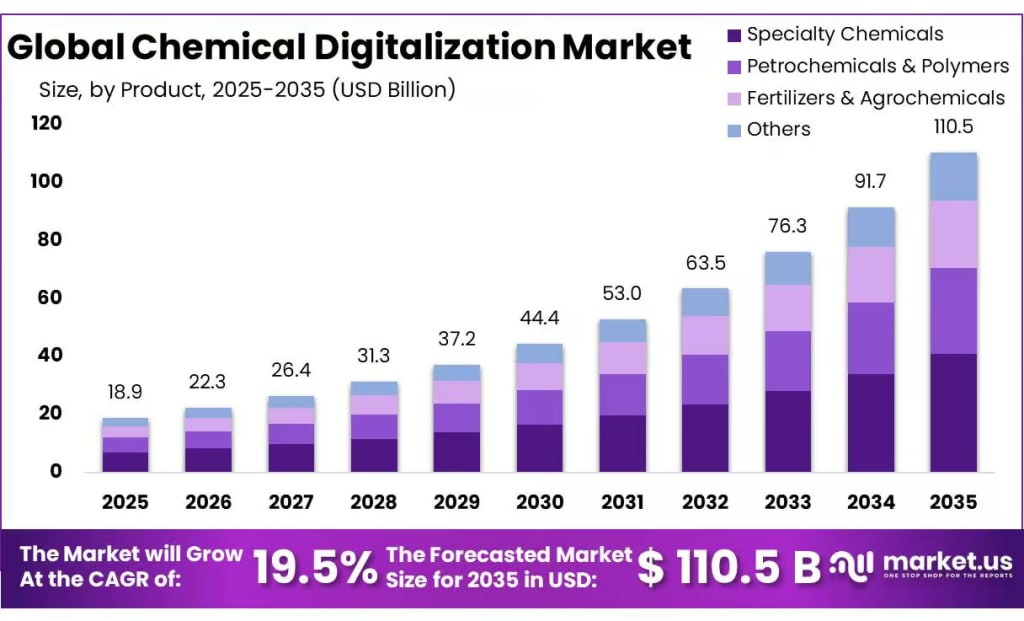
The global chemical digitalization market is projected to grow significantly from USD 18.9 billion in 2025 to around USD 110.5 billion by 2035, registering a strong CAGR of 19.5% (2026–2035), with North America holding a 41.6% share (USD 7.8 billion). In Europe, the EU-27 chemical industry generates about €635 billion in turnover and employs 1.2 million people across nearly 31,000 companies, of which over 30,000 are SMEs, contributing 28% of sales and 36% of employment.
Digitalization is rapidly advancing, with adoption increasing by 56% since the pandemic, and over 65% of companies expecting disruptive impacts, while 40% have already experienced them. Public-private initiatives like SPIRE, with 81 projects and €900 million funding, are accelerating this shift. Additionally, programs such as the €8.1 billion Digital Europe Programme support AI, cybersecurity, and digital skills, aligning with global needs like producing 60% more food by 2050 for a population of 9.3 billion, while reducing food loss.
Key Takeaways
- Chemical Digitalization Market is expected to be worth around USD 110.5 Billion by 2035, up from USD 18.9 Billion in 2025, at a CAGR of 19.5%.
- Specialty Chemicals held a dominant market position, capturing more than a 37.5% share.
- Manufacturing held a dominant market position, capturing more than a 43.7% share.
- Artificial Intelligence (AI) held a dominant market position, capturing more than a 34.8% share.
- North America held a dominant position in the Chemical Digitalization Market, capturing around 41.6% of global revenue, valued at roughly USD 7.8 billion.
Market Segments
By Product Analysis
In 2024, specialty chemicals accounted for over 37.5% of the chemical digitalization market, leading due to rapid adoption of advanced digital tools such as digital twins, AI-driven formulation, and automated lab systems.
By Process Analysis
Manufacturing dominated in 2024 with more than 43.7% market share, supported by the increasing shift toward automation, real-time monitoring, and connected production systems.
By Technology Analysis
Artificial Intelligence led the technology segment in 2024 with over 34.8% share, driven by its critical role in optimizing chemical operations. AI has been widely used for predictive maintenance, reaction optimization, and faster product development.
Regional Analysis
In 2024, North America led the chemical digitalization market with a 41.6% share, reaching approximately USD 7.8 billion in value, driven by its strong industrial base and early adoption of data-driven manufacturing. The United States remains a global leader, with USD 639 billion in chemical shipments in 2022, contributing about 11% of global production and supporting over 500,000 direct jobs.
Top Use Cases
Predictive maintenance in chemical plants: Chemical companies use sensors, AI, and real-time analytics to predict when pumps, compressors, valves, and reactors may fail. In simple terms, the system warns the plant before a breakdown happens. This matters because NIST reports that manufacturers using predictive maintenance saw 15% less downtime, an 87% lower defect rate, and 66% less inventory increase caused by maintenance issues. For chemical plants, this use case helps reduce shutdowns, improve product quality, and keep production stable.
Digital twins for process optimization: A digital twin is a virtual copy of a plant, unit, or process that helps companies test changes before making them in the real factory. In chemicals, this is useful for reaction control, yield improvement, plant balancing, and maintenance planning. NIST estimates that if digital twins were adopted broadly across U.S. manufacturing, the potential benefit could reach USD 37.9 billion annually.
AI-driven formulation and R&D: Chemical companies increasingly use AI to shorten product development cycles, especially in specialty chemicals, coatings, additives, and performance materials. AI can analyze large lab and production datasets to suggest better formulations, predict reaction outcomes, and reduce trial-and-error work. Across the EU, more than 13% of businesses used AI in 2024, while adoption among large businesses reached 41%, showing that industrial AI is moving from pilot projects into mainstream operations.
Notable Company Developments
In 2024, ABB Ltd. recorded revenues of approximately USD 32.9 billion, with operating income of about USD 5.07 billion and net profit of nearly USD 3.94 billion, supported by a strong 18.1% operational EBITA margin and 22.9% return on capital employed.
Siemens AG reported around €75.9 billion in revenue and €9.0 billion in net income in fiscal 2024, while employing nearly 312,000 people globally, highlighting its solid financial position and workforce strength to drive continued investment in digitalization and industrial automation.
Conclusion
Chemical digitalization is rapidly shifting from a supporting function to a core growth driver for the global chemical industry. As a market research analyst perspective, the transition is strongly backed by both industrial scale and measurable efficiency gains. For example, the global chemical sector remains one of the largest manufacturing industries, with the European industry alone generating around €635 billion in turnover and employing 1.2 million people.
About the Creator
Hayden Kulas
I am blogger, digital marketing pro since 5 years and writes for Market.us. Computer Engineer by profession. I love to find new ideas that improve websites' SEO. He enjoys sharing knowledge and information about many topics.
Keep reading
More stories from Hayden Kulas and writers in Futurism and other communities.
Industrial Catalyst Market Impressive Growth at 3.8%
Overview The Global Industrial Catalyst Market is expected to be worth around USD 34.0 billion by 2034, up from USD 23.4 billion in 2024, and is projected to grow at a CAGR of 3.8% from 2025 to 2034. Driven by rapid industrial growth, the Asia Pacific held 41.4% share, valued at USD 9.6 billion. In this field, AI refers to the use of advanced algorithms and data analytics to optimize catalyst design, improve reaction efficiency, and predict performance.
By Hayden Kulas5 days ago in Futurism
The Fears of AI And How Much Fun It Can Be
ChatGPT has come a long way, as has AI in general. There are those people who are scared of it, and for understandable reasons. People fear that as technologies advance, they’ll be replaced in the workforce. Then, there are the fears that AI could evolve into something that brings us to the brink of extinction.
By The Man Behind The Maskabout 21 hours ago in Futurism
Saudi Arabia Automotive Components Industry Trends: E-commerce, Distribution & Competitive Landscape
According to IMARC Group's latest research publication, Saudi Arabia auto parts aftermarket size was valued at USD 4,792.2 Million in 2025 and is projected to reach USD 6,648.7 Million by 2034, growing at a compound annual growth rate of 3.71% from 2026-2034.
By Shubham Sharma 5 days ago in Futurism
Why Wiked: For Good is Undeservingly the ‘worse movie’
So… off the bat, we’re about to delve into something ridiculous. Just so we’re clear on that, ok? The first thing anyone that knows a thing about these dual movies… knows… is the original movie and sequel were shot together.
By Gabriel Shames3 days ago in Humans




Comments
There are no comments for this story
Be the first to respond and start the conversation.