
Collaborative Robot Market Trends: AI-Powered Robotics, Safety Systems & Forecast to 2033
How AI-powered robotics, advanced safety systems, and industrial automation adoption are shaping the global collaborative robot market growth to 2033.

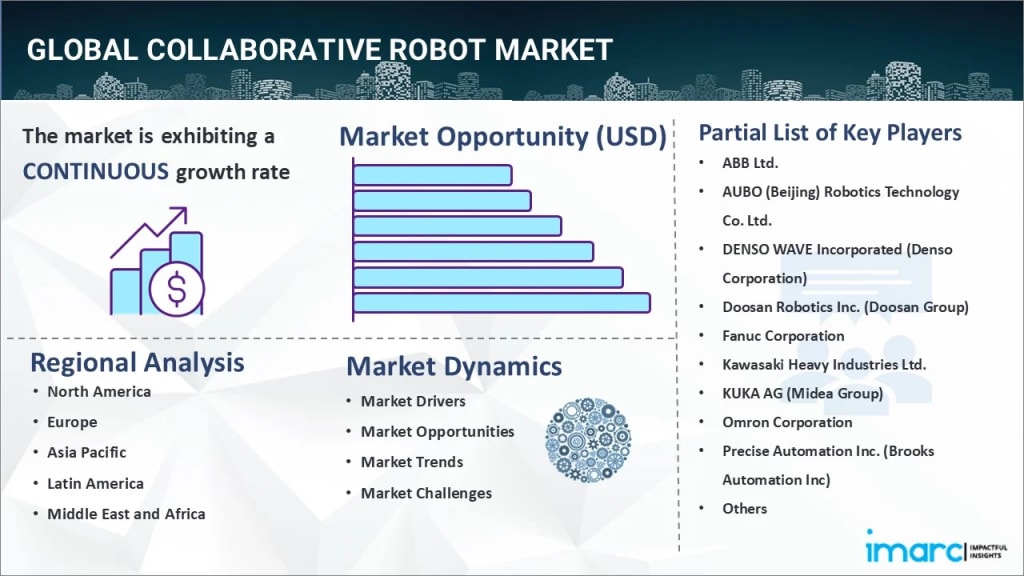
Factory floors are changing — and not just because of new machines. Collaborative robots, or cobots, are rewriting the rules of how humans and automation work together. Unlike traditional industrial robots locked behind safety cages, cobots are designed to work right alongside people, handling repetitive, hazardous, or precision-intensive tasks without disrupting the human workflow around them. The business case is compelling, and the numbers show it. According to IMARC Group's latest research, the global collaborative robot market size reached USD 3.7 Billion in 2024. Looking forward, IMARC Group estimates the market to reach USD 60.3 Billion by 2033, exhibiting a CAGR of 36.47% during 2025-2033. Asia-Pacific currently dominates the market, driven by rapid industrialization, rising labor costs, and large-scale government initiatives like China's 'Made in China 2025' and South Korea's smart factory programs. Hardware leads by component, assembly dominates by application, and automotive stands as the top-performing end-use industry vertical.
What's making cobots such a hot-ticket item right now? For starters, they are no longer a luxury reserved for automotive giants or electronics behemoths. Their falling price points, no-code programming interfaces, and rapid deployment timelines — sometimes measured in hours rather than weeks — have opened the door for small and medium-sized enterprises (SMEs) that previously couldn't justify automation spend. Universal Robots alone has crossed 100,000 cobots sold globally, and the International Federation of Robotics (IFR) recorded a new worldwide industrial robot installation record of 590,000 units. As AI, computer vision, and force-sensing technologies get embedded into cobot platforms, the scope of what these machines can do keeps expanding — and so does the size of the market opportunity.
Get a Sample Report for Actionable Market Insights
Collaborative Robot Market Growth Drivers:
Labor Shortages and Rising Wage Pressures Forcing Automation
Manufacturers worldwide are grappling with a widening skills gap and climbing labor costs that make human-only production lines increasingly unsustainable. In the U.S. alone, the manufacturing sector faces a projected shortfall of 2.1 million workers by 2030, according to Deloitte and the Manufacturing Institute. Cobots offer a practical bridge — they work continuously across shifts, don't call in sick, and pay back their investment within 12 to 18 months on average. The IFR's World Robotics Report recorded a new global robot installation record, with China deploying around 290,000 industrial robots in a single year, underscoring just how urgently manufacturers are turning to automation to stay competitive.
SME Adoption Unlocking a Massive Untapped Market
For years, automation was essentially a game for large manufacturers with deep pockets. Cobots have changed that equation. Their lower upfront costs — often under USD 50,000 fully deployed — intuitive programming, and redeployability make them accessible to SMEs that represent over 70% of global manufacturing output. Government programs are amplifying this shift: the U.S. Manufacturing USA network and the EU's Horizon Europe program are actively funding cobot adoption grants for smaller manufacturers. In India, the government's Production Linked Incentive (PLI) scheme has spurred automation investment across electronics and pharmaceuticals, where cobots handle assembly and quality inspection tasks with consistent sub-millimeter precision.
AI and Sensor Integration Expanding Cobot Capabilities
The cobot of today looks very different from the cobot of five years ago. Advanced AI, computer vision, and torque-force sensing — which can detect forces as fine as 0.05 N — are enabling cobots to handle tasks that once required skilled human judgment, like delicate assembly, surgical assistance, and adaptive welding. In October 2024, Universal Robots launched its AI Accelerator toolkit, cutting AI application development time dramatically for cobot developers. Teradyne Robotics partnered with Nvidia to integrate GPU-accelerated path planning, improving cobot speed by up to 80 times. These advances are pushing cobots into entirely new sectors, from pharmaceutical lab automation to food sorting and logistics picking.
Collaborative Robot Market Trends:
Digital Twin and Simulation Technology Transforming Deployment
Planning a cobot deployment used to mean trial and error on the actual factory floor — expensive and time-consuming. Digital twin technology is flipping that model. In February 2025, KUKA entered a strategic partnership with Dassault Systemes to integrate its mosaixx platform with the 3DEXPERIENCE environment, enabling manufacturers to simulate, test, and validate entire robot cell designs virtually before a single bolt is turned. This reduces installation time and commissioning errors significantly. As Industry 4.0 adoption accelerates — with IDC estimating that over 50% of manufacturers will use digital twins by the end of the decade — this trend is set to become standard practice rather than a premium add-on for cobot deployments.
Cobots Going Mobile: Integration with AMRs and AGVs
Stationary cobots are increasingly being paired with autonomous mobile robots (AMRs) and automated guided vehicles (AGVs) to create fully flexible, roving automation cells. This combination — sometimes called mobile manipulation — lets cobots move between workstations autonomously, dramatically expanding what a single robot can accomplish per shift. In October 2024, Robust.AI launched Carter Pro, a collaborative mobile robot combining environmental awareness with tactile hardware to support human workers across dynamic warehouse environments. With the global AMR market valued at USD 4.08 Billion and growing fast, the convergence of cobots and mobile platforms is one of the most consequential trends reshaping both factory and fulfillment center layouts worldwide.
Precision-Grade Cobots Penetrating High-Value Industries
Cobot manufacturers are pushing hard into applications that demand surgical precision — and the hardware is finally delivering. In September 2024, ABB launched its 'Ultra Accuracy' upgrade for the GoFa cobot family, achieving path accuracy of 0.03 mm and absolute positioning accuracy of 0.1 mm. That level of precision opens doors in laser welding, adhesive dispensing, and 3D printing that were previously inaccessible to cobots. In June 2025, Comau debuted its MyCo cobot family at Automatica Munich — six models spanning 3 to 15 kg payloads, built for high-precision European industrial applications. As cobots match or exceed the accuracy of specialized industrial robots, their addressable market continues to widen significantly.
Recent News and Developments in the Collaborative Robot Market
• September 2024: ABB Robotics launched its 'Ultra Accuracy' technology for the GoFa collaborative robot family, delivering path accuracy of 0.03 mm and absolute positioning accuracy of 0.1 mm — unlocking cobot applications in laser welding, precision cutting, adhesive dispensing, and 3D printing for the first time.
• October 2024: Universal Robots unveiled its AI Accelerator — a ready-to-use hardware and software toolkit designed to dramatically speed up development of AI-powered cobot applications, providing developers with an extensible platform for commercial, research, and industrial use cases.
• February 2025: KUKA entered a strategic partnership with Dassault Systemes, integrating its mosaixx automation platform with the 3DEXPERIENCE environment to bring digital twin simulation capabilities to robot system design — enabling manufacturers to plan and validate full cobot cell deployments entirely in a virtual environment before physical installation.
• May 2025: Schneider Electric showcased its expanded Lexium cobot family at Automate 2025 in Detroit, including the RL 3, RL 12, and newly extended RL 18 model with an 18 kg payload, reinforcing its push into flexible factory automation solutions for mid-sized manufacturers globally.
• June 2025: Comau introduced its MyCo collaborative robot family at Automatica 2025 in Munich — a lineup of six cobot models spanning 3 to 15 kg payloads, purpose-engineered for the versatility and high-precision demands of European industrial applications across automotive, food, and electronics sectors.
• October 2025: SoftBank Group announced an agreement to acquire the robotics division of ABB for approximately USD 5.4 Billion — a landmark deal that underscores the growing strategic importance of collaborative and smart robot systems in global automation portfolios and signals accelerating consolidation in the cobot industry.
Note: If you require specific details, data, or insights that are not currently included in the scope of this report, we are happy to accommodate your request. As part of our customization service, we will gather and provide the additional information you need, tailored to your specific requirements. Please let us know your exact needs, and we will ensure the report is updated accordingly to meet your expectations.
About the Creator
Suhaira Yusuf
I specialize in Consumer Insights, focusing on transforming detailed market data into strategic business solutions that accelerate growth and improve customer engagement.
Keep reading
More stories from Suhaira Yusuf and writers in Futurism and other communities.
Edge Computing Industry Insights: Industrial IoT, Smart Cities & Forecast to 2033
The way businesses handle data is undergoing a fundamental shift. Instead of routing everything through distant cloud data centers, companies are bringing computation right to the source — and the results are faster decisions, lower latency, and better control over sensitive information. This is edge computing in action, and the numbers reflect just how quickly it's gaining ground. According to IMARC Group's latest research, the global edge computing market was valued at USD 18.3 Billion in 2024. Looking ahead, IMARC Group projects the market to reach USD 114.4 Billion by 2033, growing at a CAGR of 22.40% during 2025-2033. North America held the leading revenue position in 2024, while hardware dominated by component, large enterprises led by organization size, and energy and utilities emerged as the top-performing vertical.
By Suhaira Yusufabout 7 hours ago in Futurism
The 1947 Paradox: The Secret Geometry of Our First Alien Encounter
We have spent eighty years looking for "little green men" in flying saucers, but the most confusing secret of the search for extraterrestrial life is that we may have been looking at the wrong thing entirely. As we sit here in 2026, with the James Webb Space Telescope sniffing out industrial chemicals on planets 120 light-years away, the evidence suggests that "aliens" aren't just visitors from another star—they are the operators of a technology that treats our laws of physics like a suggestion rather than a rule.
By imtiazalama day ago in Futurism
Saudi Arabia Lubricants Market: Industrial Expansion, Automotive Demand & Energy Sector Growth
Saudi Arabia lubricants market size reached USD 1,352.4 Million in 2025. Looking forward, IMARC Group expects the market to reach USD 1,717.4 Million by 2034, exhibiting a growth rate (CAGR) of 2.69% during 2026-2034. The expanding growth of industries, such as automotive, manufacturing, construction, and mining, along with the increasing demand for lubricants to keep machinery and equipment running efficiently, is primarily driving the market.
By Kishan Kumar2 days ago in Futurism
Hottest in the Office
Dear Rafi, You’re very distracting to work around. For the first second I saw you the other day, I thought you were some type of executive. It took a moment to realize no, you were just the new guy, dressed up for the job he wants. Be still, my heart.
By Gabriel Shames3 days ago in Pride



Comments
There are no comments for this story
Be the first to respond and start the conversation.