
Empire After Empire: The Endgame Illusion
(Jiang Xueqin and the Geopolitics of Replacement)

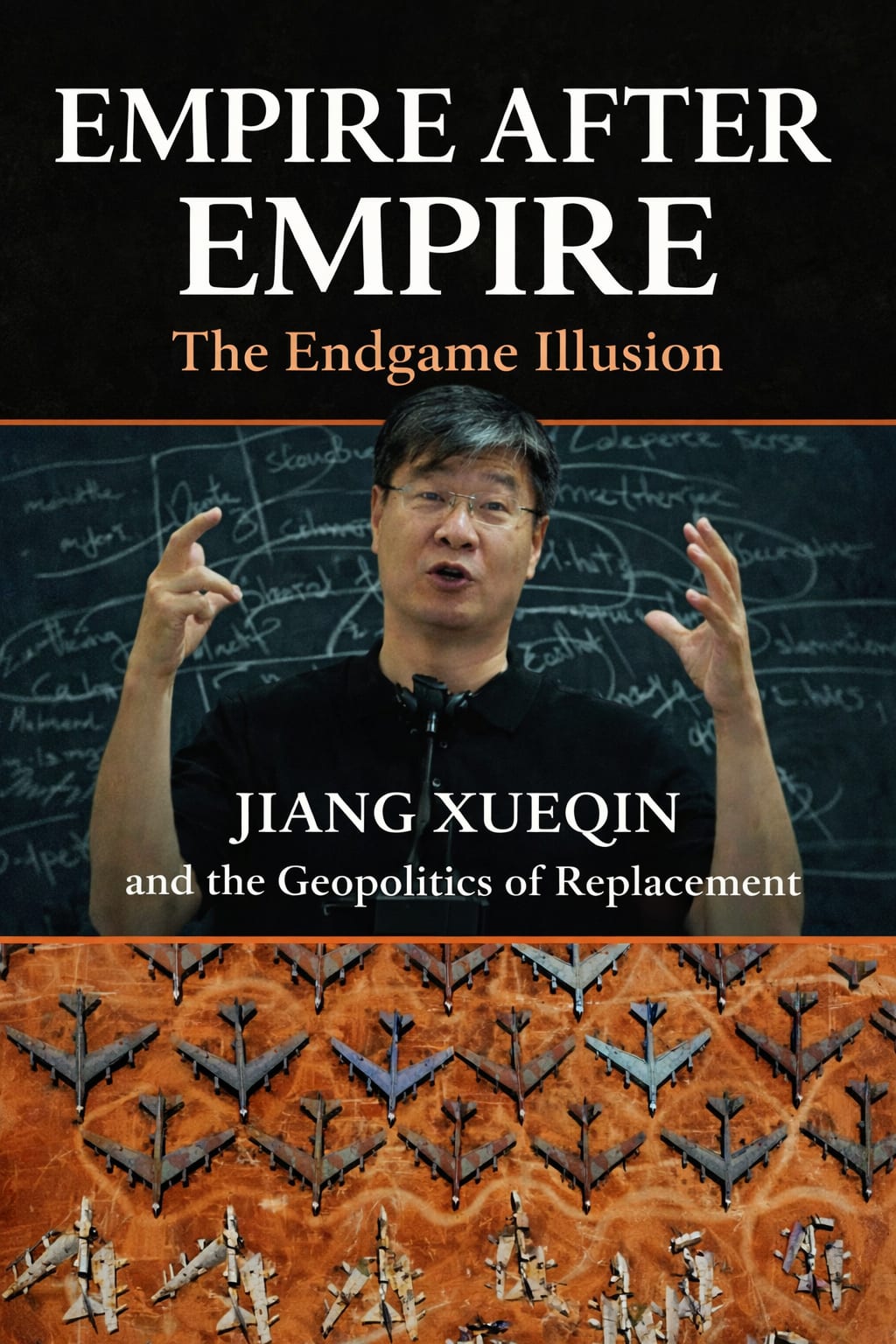
Empire After Empire: The Endgame Illusion
(Jiang Xueqin and the Geopolitics of Replacement)
In his lecture ‘Game Theory #16: Pax Judaica Rising’, Jiang Xueqin develops a provocative and highly speculative interpretation of how the war with Iran may end, not by fixing a date for its conclusion but by tracing the strategic logic that, in his view, already points towards its final shape. His central argument is that the United States is not simply struggling in a difficult war but revealing the deeper weakness of a declining empire. The problem, as he presents it, is not merely military. It is intellectual, political and civilisational. Washington entered the conflict assuming that overwhelming force, decapitation strikes and economic pressure would quickly bring surrender. Instead, the war has exposed a profound inability to adjust to resistance. The American state, its media system and its strategic class continue to speak as though victory were already achieved, even while the conditions of the conflict suggest the opposite. For Jiang, this gap between official certainty and strategic reality is the clearest sign of imperial hubris.
He builds this case by reading public statements from the American administration as symptoms of denial rather than confidence. Trump is presented as revealing that the United States expected to strike first, eliminate leadership and face little meaningful retaliation. The surprise, in this reading, is not that war became costly, but that the enemy refused to behave according to the script. White House rhetoric is then interpreted as doubling down on the illusion, insisting that Iran has already been defeated and that the only remaining problem is Tehran’s refusal to recognise its own defeat. Pentagon language, meanwhile, appears in Jiang’s account as the language of escalation without reflection, where bombing itself becomes a form of negotiation and destruction is treated as proof of strategic mastery. Even the economic management of the war, especially around oil flows and sanctions, is framed not as evidence of foresight but as evidence of improvisation. In other words, the system is not executing a coherent plan so much as constantly explaining why reality has failed to obey its expectations.
From there Jiang introduces a broader framework for understanding conflict. War, he argues, is fought across four dimensions: narrative, politics, economics and military force. What makes the American position weak is that it attempts to subordinate all the other dimensions to its preferred military strategy. It expects domestic opinion, allied states, global media and the world economy to conform to a plan built around coercion and surrender. Iran, by contrast, is portrayed as doing the reverse. Its military actions are calibrated to influence economic pressure, political alignments and the global narrative. In Jiang’s interpretation, the battlefield is not separate from trade, oil, diplomacy or legitimacy. It is one instrument among several. That is why, in his account, Iran is better positioned to adapt. Its use of force is strategic because it is embedded in wider political and economic goals, whereas the American use of force becomes increasingly rigid because it expects the world to organise itself around its bombs.
This contrast leads Jiang to one of his main claims: the United States lacks reflection, flexibility and resilience. Reflection matters because an empire that cannot reassess its assumptions cannot learn from failure. Flexibility matters because a rigid strategy, once disrupted, usually produces escalation rather than adjustment. Resilience matters because war is not won only by technology or by rhetoric but by the capacity to absorb cost, maintain public support and sustain losses over time. In Jiang’s telling, America is weak on all three fronts. Once its chosen strategy begins to falter, it does not revise its premises but intensifies the same methods, bombing more heavily and contemplating still riskier options. Iran, by contrast, appears more resilient precisely because its military conduct is tied to political and economic realities rather than abstract prestige. It can modulate pressure, exploit divisions among Gulf states, preserve crucial trade corridors and convert conflict into leverage.
The lecture then widens from the war itself to a theory of world order. Jiang sketches a layered system in which empire provides military muscle, finance sets the rules, multilateral institutions create the appearance of fairness and media, education and culture legitimise the structure. Beneath the language of openness and rules, he sees an architecture held together by force. That matters because if the imperial centre weakens, the entire system becomes unstable. At this point the lecture shifts into a much larger geopolitical claim. The most important question is no longer whether America defeats Iran, but whether America can continue serving as the empire that anchors the present order. If it cannot, another power may try to demonstrate that it is more capable of playing that role. Jiang’s answer is that Israel is positioning itself to do exactly that.
This is the most controversial part of the lecture, and also its most ambitious. Jiang does not argue that Israel will openly fight the United States. Rather, he argues that Israel is ‘auditioning’ to replace America in the Middle East by demonstrating the qualities that a declining empire no longer possesses. In his framework, an empire must prove unity, capacity and determination. It must show that it can act decisively, endure sacrifice and protect the system more reliably than its rival. America, in his account, appears overextended, divided, expensive and unwilling to bear prolonged costs. Israel, by contrast, is portrayed as more cohesive, more determined and more prepared to sustain the violence necessary to maintain control. The war therefore becomes, in Jiang’s interpretation, not only a struggle with Iran but also a test of which actor is better suited to inherit the regional role that American power can no longer play convincingly.
To explain why the United States is losing this role, Jiang turns to the military-industrial complex. This section of the lecture argues that American military power has been hollowed out by corruption, financialisation and permanent war. The problem is not merely that the United States fights too many wars, but that its institutions have become invested in endless war rather than victory. Huge defence budgets, giant contractors, lobbying networks and procurement systems create a structure in which failure can be profitable. In this perspective, modern American warfare is less about strategic success than about transferring public money into private hands. Jiang uses examples of missing funds, lavish contracts and dysfunctional weapons systems to suggest that American power is now distorted by its own machinery. The most expensive military in history, he implies, may also be one of the least capable of adapting to real strategic limits.
This corruption becomes crucial in the war with Iran because, according to Jiang, the United States faces three constraints it cannot easily overcome. The first is weak political will at home, since public support for the war is limited and likely to decline as costs rise. The second is insufficient manufacturing capacity to sustain a prolonged conflict, meaning that bombs, missiles and aircraft cannot be replenished quickly enough. The third is a broader unwillingness to accept casualties. A society that wants cheap and rapid victory cannot easily endure a long war of attrition. For Jiang, these limits define the crisis of the American empire. It can project force spectacularly, but it cannot sustain sacrifice. It can dominate headlines, but it cannot easily mobilise society. It can spend vast sums, but it cannot guarantee resilience.
Against this backdrop, Jiang imagines a post-war Middle East structured around two strong regional powers, Israel and Iran, each anchored in a distinct trade and strategic network. Israel is cast as the centre of a corridor linking Europe, India, energy infrastructure, AI surveillance and regional logistics. Iran is portrayed as the beneficiary of unintended economic opening, emerging from the war more deeply integrated into global trade through oil exports and transport routes linking Russia, India and China. What was meant to isolate Tehran has instead, in Jiang’s telling, strengthened its economic position. The war’s stated purpose thus collapses into its opposite. Iran is not expelled from the global system but reinserted into it. At the same time, Israel seeks to convert military assertiveness and regional infrastructure into a claim for larger strategic authority. The future order, as Jiang imagines it, is therefore not one of simple winners and losers but of two hardened centres emerging from the breakdown of American dominance.
He then frames this future through a kind of geopolitical game theory. The strong, he argues, respect one another and prey on the weak. The weak do not cooperate effectively because weakness itself breeds dependence and fragmentation. Gulf monarchies therefore cannot remain decisive actors in their own right. As the old American umbrella weakens, they will be forced to align themselves with whichever stronger power seems more likely to shape the future. Some may drift towards Israel, others towards Iran, but none will remain central. This is Jiang’s broader law of the jungle: once the old imperial order weakens, political morality matters less than demonstrations of strength, coherence and endurance.
Yet what makes the lecture most striking is not simply its predictions, but the way it turns current events into a theory of imperial succession. Jiang is less interested in battlefield detail than in the symbolic and structural meaning of war. Wars, in his reading, reveal which political systems can adapt, which elites can endure reality and which empires are no longer equal to the order they created. The war with Iran becomes an x-ray of the American imperial condition: immense firepower, but declining flexibility; immense wealth, but shrinking resilience; immense rhetoric, but eroding confidence. At the same time, it becomes a stage on which Israel attempts to prove itself as a harder, leaner and more regionally rooted force, even as Iran turns survival into leverage and sanctions into opportunity.
At the end of the lecture Jiang briefly reins in his own argument by reminding listeners that this is speculative analysis rather than prophecy. That final note is important, because the value of the lecture lies less in whether its forecast comes true than in the pattern of reasoning it offers. It treats war not as a sequence of isolated clashes but as a crisis of systems, narratives and legitimacy. It asks what happens when empires continue speaking the language of victory after they have lost the ability to shape events with confidence. And it suggests that the end of a war may matter less than the kind of world it reveals already coming into being: one in which the old centre weakens, the periphery hardens, and new claimants to power step forward not by announcing a new order, but by proving that they are more willing than the old empire to impose it.
About the Creator
Peter Ayolov
Peter Ayolov’s key contribution to media theory is the development of the "Propaganda 2.0" or the "manufacture of dissent" model, which he details in his 2024 book, The Economic Policy of Online Media: Manufacture of Dissent.
Keep reading
More stories from Peter Ayolov and writers in Futurism and other communities.
The Return of History
Jiang Xueqin is an educator and thinker known for connecting game theory with broad civilisational and geopolitical analysis. In this argument, he develops a sweeping interpretation of global change, challenging the idea that the post-Cold War order represents a stable endpoint of history. He presents a stark vision of a world entering a new phase defined by instability, scarcity, and the need for resilience.
By Peter Ayolova day ago in Futurism
How machines can learn from human behaviour
In order to understand where we are and where we are going, we need to understand where we were first. - Susan Fourtane Could a human behaviour simulator be embedded into a robot or online avatar to the point that it’s hard to distinguish between a real person or artificial intelligence? Scientists have been upping the stakes in this “Turing test” for years, to the point that human-mimicking programmes are ready to answer tricky questions, assist people with online shopping or be companions.
By Susan Fourtané 8 days ago in Futurism
Saudi Arabia Cobblestone Market: Infrastructure Projects, Landscaping Demand & Growth Outlook
Rising infrastructure development, Vision 2030 mega-projects, heritage preservation initiatives, cultural tourism expansion, sustainable landscaping adoption, and traditional architectural restoration are driving Saudi Arabia's cobblestone market, supported by authentic paving materials demand, pedestrian-friendly urban planning, and integration of Najdi design elements in modern developments. According to IMARC Group's latest data, the Saudi Arabia cobblestone market size was valued at USD 82.56 Million in 2025. Looking forward, IMARC Group estimates the market to reach USD 128.3 Million by 2034, exhibiting a CAGR of 5.02% from 2026-2034. Natural cobblestone currently dominates the market as the preferred material type in 2025.
By Shubham Sharma about 23 hours ago in Futurism
Parting is such sweet and salty sorrow...
Dear Wife— At first, I hesitated to go forward with this resolution. But after your recent late-night binges scarfing down bags of chicharrónes—those pork rinds you dip in butter and the god-awful crunch they make, I knew I could no longer reach you.
By Lamar Wiggins4 days ago in Fiction


Comments (1)
Thanks for this cohesive overview.