
Future of Food Technology: What farming Will Look Like in 2040
Vertical farms, AI-guided growing systems, and lab-cultivated ingredients are converging into the most exciting food revolution in human history

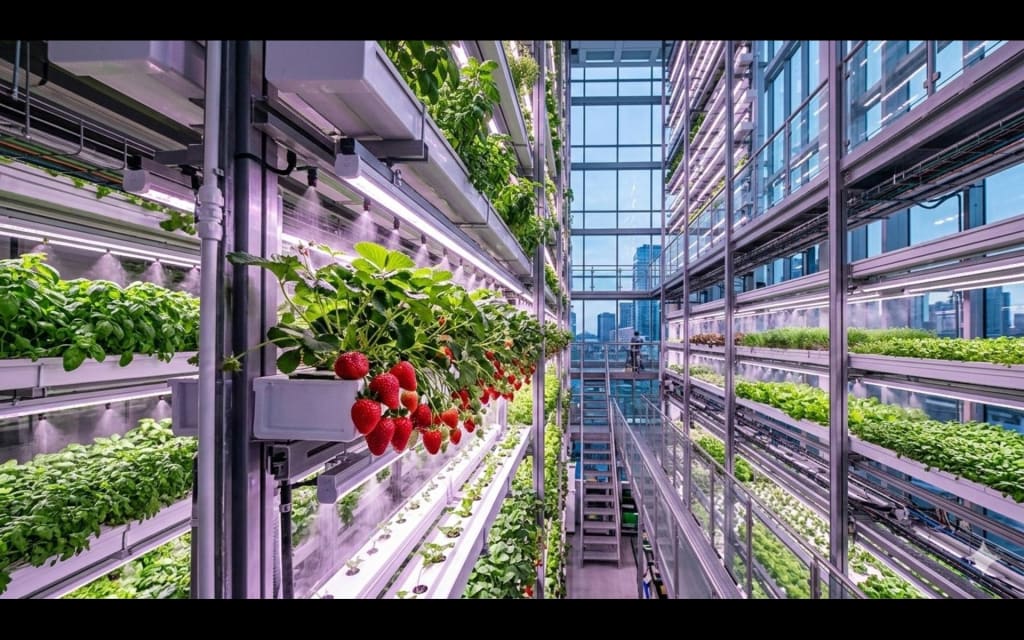
Picture a strawberry picked at the perfect moment of ripeness, grown in a building in the middle of a city, its flavour calibrated by an AI that has been studying the plant for weeks. It has never seen soil. It has never needed rain. And it tastes extraordinary.
This is not a fantasy version of 2040. It is already happening in research facilities and early commercial farms around the world. What comes next is simply more of it, faster, tastier, and more widely available than most people currently expect.
Growing Up Instead of Out
Vertical farming has moved well beyond novelty. Multi-storey growing facilities now produce leafy greens, herbs, berries, and an expanding range of vegetables using precisely controlled light, temperature, humidity, and nutrient delivery. Every variable that outdoor farming leaves to chance becomes something a vertical farm can manage exactly.
The results are striking. Crops can be grown in days or weeks rather than seasons. Water usage drops dramatically compared with traditional field growing, because closed-loop systems recycle and reuse almost everything. And because the farms sit close to the people who eat the food, freshness improves significantly.
It is something that we have watched develop with real enthusiasm, observing how vertical farming has shifted from an intriguing experiment into a genuine cornerstone of how forward-thinking food systems are being designed.
The AI That Knows Your Crops Better Than You Do
Artificial intelligence is transforming what it means to grow food well. Sensors throughout modern farms monitor plant health at a granular level, detecting the earliest signs of stress, nutrient imbalance, or growth variation long before a human eye would notice anything amiss. The AI responds in real time, adjusting conditions automatically.
At scale, these systems are building enormous libraries of growing data. Every crop cycle adds to the model. Every adjustment that improves a yield or enhances a flavour gets logged and repeated. Over time, AI-guided farms effectively become expert growers, continuously refining their understanding of how to coax the best possible results from every plant.
Outdoor farming is being transformed too. AI-guided machinery now moves through fields with extraordinary precision, applying fertiliser, water, and care only where individual plants need it. Drones survey growing areas and return detailed maps of crop health within minutes. Farmers are gaining visibility into their land that simply did not exist a generation ago.
What Happens When Meat Is Grown, Not Raised
Cultivated meat is one of the most talked-about developments in food technology, and the progress since the early prototype stages has been significant. Growing animal protein directly from cells, without the need to raise and process a whole animal, is no longer a theoretical possibility. Several companies are now producing cultivated chicken, beef, and seafood at commercial scale.
The taste and texture have improved enormously as the science has matured. Chefs working with cultivated products describe the cooking experience as essentially identical to conventional meat. The ingredient behaves the same way. It responds to heat, seasoning, and technique in all the familiar ways.
The conversation around cultivated protein has moved on from whether it is possible to how quickly it can become a mainstream choice for people who simply want delicious food that aligns with how they want to live.
Fermentation Is Having Its Moment
Precision fermentation is quietly becoming one of the most versatile tools in modern food production. By programming microorganisms to produce specific proteins, fats, and flavour compounds, food scientists are creating ingredients that were previously only available through complex supply chains or animal agriculture.
Dairy proteins produced through fermentation are now being used in everything from cheese to ice cream, with a flavour profile that experts describe as indistinguishable from conventionally sourced equivalents. Oils, textures, and aromas that once required rare or seasonal ingredients can now be produced consistently, year-round, in a fermentation vessel.
For food manufacturers and restaurant kitchens alike, this opens up creative possibilities that are genuinely exciting. Ingredients that were once expensive or difficult to source become reliable building blocks. Menus can be designed around flavour and imagination rather than supply constraints.
The Kitchen of 2040 Starts on the Farm
The most significant shift underway is how the food chain itself is being reimagined. Rather than a long journey from field to processor to distributor to shop to table, the food of 2040 will increasingly travel shorter, smarter routes.
Urban farms integrated into supermarket buildings. Community growing facilities supplying local restaurants directly. Fermentation labs producing custom ingredients for specific culinary applications.
Gen Z and younger generations are already shaping demand in ways that accelerate all of this. Curiosity about where food comes from, enthusiasm for novel ingredients, and a genuine interest in the science behind what they eat are combining to create an audience that is ready for the future of food in ways previous generations were not.
According to experts, the food revolution that is coming will feel less like disruption and more like discovery. Every meal becomes an opportunity to taste what thoughtful technology, applied with creativity and care, can actually produce.
The strawberry grown in a city tower, the steak cultivated from a handful of cells, the cheese made without a single cow. By 2040, these will not be remarkable. They will simply be dinner.
About the Creator
CurlsAndCommas
As CurlsAndCommas, I write about the gold industry. My dad spent 30 years in the mines. I grew up hearing stories at the dinner table. Now I write about the industry that raised me. All angles, sometimes tech, science, nature, fashion...
Keep reading
More stories from CurlsAndCommas and writers in Futurism and other communities.
Smart Home Technology: What Life Looks Like When Your Home Can Actually Think
It is seven in the morning and the kitchen already knows. The blinds have lifted just enough to let in soft light without waking anyone who is still sleeping. The kettle began heating two minutes ago.
By CurlsAndCommas5 days ago in Futurism
Vacuum Gas Oil Market Outlook: Refinery Processing Demand and Petrochemical Feedstock Growth Opportunities
According to IMARC Group's latest research publication, The global vacuum gas oil market size reached USD 454.2 Billion in 2024. Looking forward, IMARC Group expects the market to reach USD 695.9 Billion by 2033, exhibiting a growth rate (CAGR) of 4.36% during 2025-2033.
By James Whitman32 minutes ago in Futurism
Stanislav Kondrashov Oligarch Series: Oligarchy and Global Supergrids in the Next Phase of the Energy Transition
Large technological shifts often depend on infrastructure that takes decades to design and build. The next phase of the energy transition is no exception. Around the world, the idea of global supergrids—vast electricity networks connecting distant regions—has moved from theoretical discussion to long-term planning.
By Stanislav Kondrashov6 days ago in Futurism
Worth the Wait: Puerto Viejo, Costa Rica
Beach bumming in a small Caribbean beach town sounded like a perfect way to end our 6-month trip through Mexico and Central America. Or so we thought. The foul, fishy stench of rotten seaweed hit our nostrils as we stepped from the cramped bus and looked out at a rather depressing, empty, and underwhelming black sand beach. It was pouring with rain, and we had to quickly fish out our ponchos. We thought, this couldn’t be it, could it?
By Sh*t Happens - Lost Girl Travel6 days ago in Wander




Comments