
Low-Code Development Platform Market Insights: Enterprise Agility, Cloud Integration & Forecast to 2034
How enterprise demand for agility, seamless cloud integration, and rapid application development is driving growth in the low-code development platform market

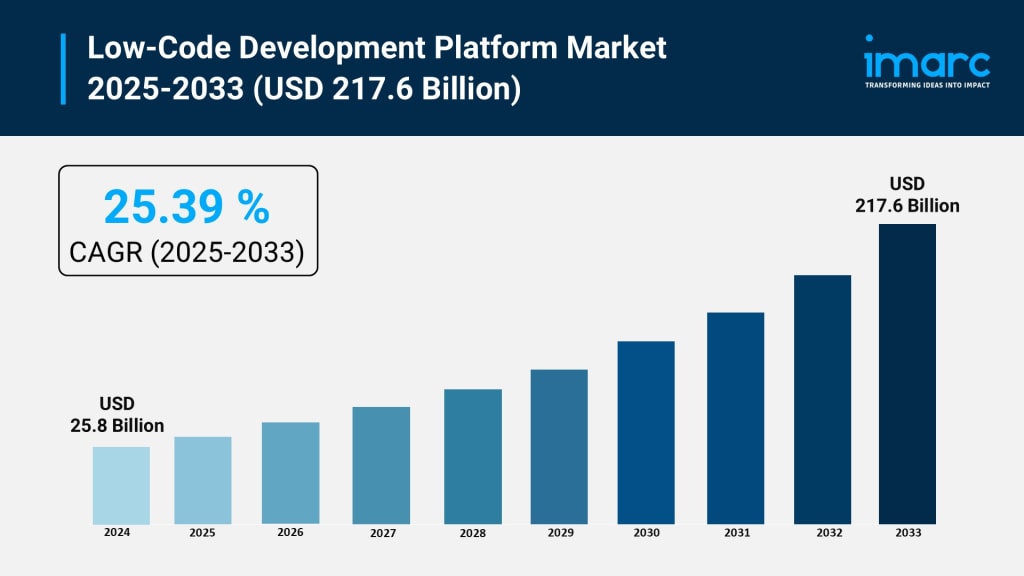
The global low-code development platform (LCDP) market reached USD 25.8 Billion in 2024 and is heading for a remarkable expansion. According to IMARC Group’s latest research, the market is projected to reach USD 217.6 Billion by 2033, fueled by surging demand for rapid application development, enterprise-wide digital transformation drives, the rise of citizen developers, and heavy investment from both large corporations and SMEs in digital innovation. With Gartner estimating that 70% of new applications will be built using low-code or no-code technologies, this is not a niche trend — it’s a fundamental rewiring of how organizations build software.
Key Market Figures at a Glance
Historical Market Size: USD 25.8 Billion (2024)
Forecast Market Size: USD 217.6 Billion (2033)
Growth Rate (CAGR): 25.39% (2025–2033)
Leading Region: North America (approx. 34–42% market share)
Fastest-Growing Region: Asia-Pacific
Leading Enterprise Segment: Large Enterprises (approx. 59% share)
Leading Industry Vertical: IT & Telecom (28.82% share)
Leading Deployment Mode: Cloud-Based (64.4% share)
Market Overview
Low-code development platforms let both technical and non-technical users build fully functional applications through visual drag-and-drop interfaces, pre-built templates, and minimal hand-written code. Think of it as the difference between building a house brick by brick versus snapping together prefabricated modules — the end product is structurally sound, deployed faster, and accessible to a much wider range of people.
The numbers behind the developer shortage make this shift feel almost inevitable. As of 2025, citizen developers are expected to outnumber professional developers by a ratio of 4 to 1. Organizations are not waiting for the talent market to catch up — they are rerouting their workflows around it. Low-code platforms can reduce application development time by anywhere from 50% to 90% compared to traditional coding. In a global survey, 29% of respondents said low-code is 40–60% faster, with another 29% reporting speeds of 61–100% faster than conventional methods.
By enterprise size, large corporations currently dominate with roughly a 59% market share — using low-code to modernize legacy systems, accelerate internal tooling, and reduce IT backlog. Microsoft expects that out of 500 million apps projected to be built in the coming years, approximately 450 million will rely on low-code or no-code platforms. Meanwhile, 87% of organizations have either already adopted or are actively planning to adopt low-code solutions, according to a survey by techUK — a figure that effectively signals mainstream arrival.
Request a Business Sample Report for Procurement & Investment Evaluation
Low-Code Development Platform Market Growth Drivers:
• Surging Demand for Rapid Application Development (RAD): Speed is now a competitive differentiator, and low-code delivers it. In practical terms, apps that previously took six to twelve months to build can be ready for deployment in under three months on a low-code platform. Businesses managing fast-evolving customer demands — particularly in banking, retail, and logistics — are finding traditional development cycles simply too slow. According to KPMG’s survey of 715 companies across Europe, the Middle East, and Africa, around 60% of senior managers now consider low-code platforms “critical to very critical” for their business strategy. That endorsement from the C-suite is accelerating budget allocation across sectors.
• Digital Transformation Mandates Across Industries: Digital transformation is no longer optional — it’s a boardroom priority. Forbes reports that 70% of organizations have either digitally transformed their operations or are actively working toward it. Low-code platforms sit squarely at the center of these initiatives by helping enterprises rapidly build and customize applications tailored to their unique workflows. The BFSI segment alone accounts for 24% of global low-code market share, with financial institutions using these platforms to automate compliance workflows, accelerate customer onboarding, and reduce their dependency on scarce IT resources. EY’s partnership with Appian to modernize business processes through low-code and AI is a real-world example of this trend in action.
• Rise of Citizen Developers Reshaping Enterprise IT: The rise of citizen development is arguably the most structurally important driver in this market. Low-code platforms are empowering non-IT professionals — finance analysts, HR teams, operations managers — to build their own workflow applications without writing a single line of code. By one estimate, 80% of technology products and services will be built by non-IT professionals. This trend directly reduces the bottleneck that IT departments have long created for internal innovation. Creatio’s USD 200 million funding round and USD 1.2 billion unicorn valuation in 2024 reflects just how strongly investors are betting on platforms that put app creation directly in business users’ hands.
Low-Code Development Platform Market Trends:
• Generative AI Integration Transforming Platform Capabilities: AI is no longer a ‘coming soon’ feature in low-code — it is the central battleground. Salesforce’s Agentforce, embedded within its low-code Platform, now enables enterprise users to build autonomous AI agents using natural language. Appian released version 25.1 in early 2025 with an AI-powered data fabric, achieving a 75x improvement in document processing speed compared to its previous version. OutSystems added OpenAI and ChatGPT connectors in April 2025, plugging generative AI directly into visual modules. According to leading research, the adoption of conversational AI in enterprise applications is expected to reach 40% — up from under 5% in 2020 — a shift that low-code platforms are uniquely positioned to accelerate.
• Cloud-Native Architecture Becoming the Default Deployment Model: Cloud-based deployment has pulled ahead decisively, commanding a 64.4% market share and growing at the fastest pace through the forecast period. This is not surprising — cloud-native low-code platforms offer automatic scaling, reduced infrastructure management, and faster update cycles. OutSystems rebuilt its cloud architecture around Kubernetes and microservices in April 2025, allowing each application service to deploy independently. In May 2025, Mendix launched Mendix 10, introducing reusable standalone components with integrated Git support for collaborative team development. Vendors are also investing 40–50% of their R&D budgets into core platform enhancements, ensuring cloud capabilities keep pace with enterprise complexity.
• Asia-Pacific and SME Segments Emerging as High-Growth Frontiers: While North America leads in absolute terms, Asia-Pacific is the region with the most runway — projected to grow at the fastest rate through the forecast period, driven by digital adoption across enterprises in China, India, and Southeast Asia. Workato’s partnership with IMDA in Singapore and Mendix’s collaboration with InsureMO are tangible signals of this momentum. At the same time, the SME segment is expected to grow faster than large enterprises, as affordable low-code pricing — some platforms starting at just USD 8–10 per user per month — removes the cost barrier that previously locked smaller businesses out of enterprise-grade application development.
Recent News and Developments in the Low-Code Development Platform Market
• April 2025 – OutSystems Strengthens Platform with Kubernetes Architecture and GenAI Connectors: OutSystems rolled out two significant updates: a rebuilt cloud architecture on Kubernetes and microservices for independent app service deployment, and new native connectors for OpenAI and ChatGPT that embed generative AI directly into visual development modules. The update allows developers to integrate AI-powered chatbots, digital assistants, and intelligent workflow automation without leaving the low-code environment, substantially raising the bar for what citizen developers can build on the platform.
• February 2025 – Salesforce Expands Strategic Partnership with Google Cloud: Salesforce and Google Cloud announced a major expansion of their strategic partnership, enabling Salesforce customers to build Agentforce AI agents using Google Gemini models and to deploy their Salesforce environments directly on Google Cloud. The move strengthens Salesforce’s position as a low-code platform for enterprise AI development and signals a broader industry shift toward multi-cloud interoperability as a competitive requirement for low-code vendors.
• February 2025 – Appian Releases Version 25.1 with AI-Powered Data Fabric: Appian launched version 25.1, featuring a redesigned AI-powered data fabric that delivered a 75x improvement in document processing speed compared to its previous release. The platform also strengthened its position in regulated industries, supporting FedRAMP compliance, multi-region high availability, and Kubernetes-based container deployments. Gartner ranked Appian number one for Business Workflow Automation with Integration use case, recognizing its technical depth in process automation for healthcare, finance, and government sectors.
• November 2024 – BrowserStack Launches Low Code Automation Tool for QA Teams: BrowserStack introduced Low Code Automation, a tool designed to simplify test automation for QA teams, developers, and non-technical users alike. The product reflects a growing trend of low-code capabilities expanding beyond application development into adjacent functions like software testing and quality assurance, broadening the addressable user base beyond traditional citizen developers and into DevOps workflows across enterprise IT organizations.
Note: If you require specific details, data, or insights that are not currently included in the scope of this report, we are happy to accommodate your request. As part of our customization service, we will gather and provide the additional information you need, tailored to your specific requirements. Please let us know your exact needs, and we will ensure the report is updated accordingly to meet your expectations.
About the Creator
Suhaira Yusuf
I specialize in Consumer Insights, focusing on transforming detailed market data into strategic business solutions that accelerate growth and improve customer engagement.
Keep reading
More stories from Suhaira Yusuf and writers in Futurism and other communities.
IO-Link Market Analysis: Factory Automation, Digitalization & Forecast to 2033
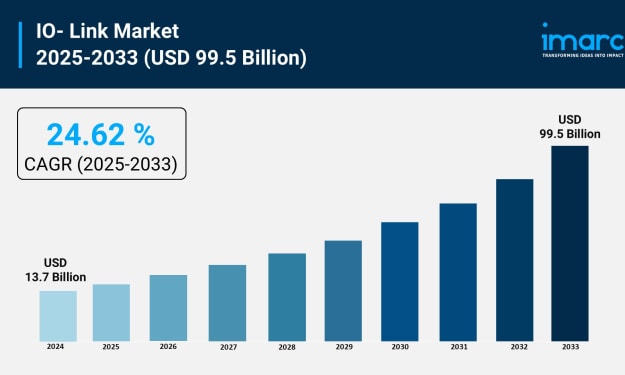
The global IO-Link market reached USD 13.7 Billion in 2024 and is on a steep upward trajectory. According to IMARC Group's latest research, the market is projected to reach USD 99.5 Billion by 2033, driven by explosive demand for industrial automation, Industry 4.0 smart manufacturing, and the need for standardized field-device communication. With over 51.6 million IO-Link nodes deployed worldwide and 12 million devices shipped in 2024 alone, IO-Link has moved from niche protocol to the backbone of modern factory connectivity.
By Suhaira Yusufabout 13 hours ago in Futurism
How machines can learn from human behaviour
In order to understand where we are and where we are going, we need to understand where we were first. - Susan Fourtane Could a human behaviour simulator be embedded into a robot or online avatar to the point that it’s hard to distinguish between a real person or artificial intelligence? Scientists have been upping the stakes in this “Turing test” for years, to the point that human-mimicking programmes are ready to answer tricky questions, assist people with online shopping or be companions.
By Susan Fourtané 11 days ago in Futurism
GCC Secondhand Luxury Goods Market Insights: Authentication, Resale Platforms & Trust Factors
According to IMARC Group's latest research publication, the GCC secondhand luxury goods market size reached USD 678.6 Million in 2025. The market is projected to reach USD 1,579.9 Million by 2034, exhibiting a growth rate (CAGR) of 9.55% during 2026-2034.
By Abhay Rajput5 days ago in Futurism


Comments
There are no comments for this story
Be the first to respond and start the conversation.