
Remade in their Image
Architecture of the Scythe: The Sovereign & the Subjugated

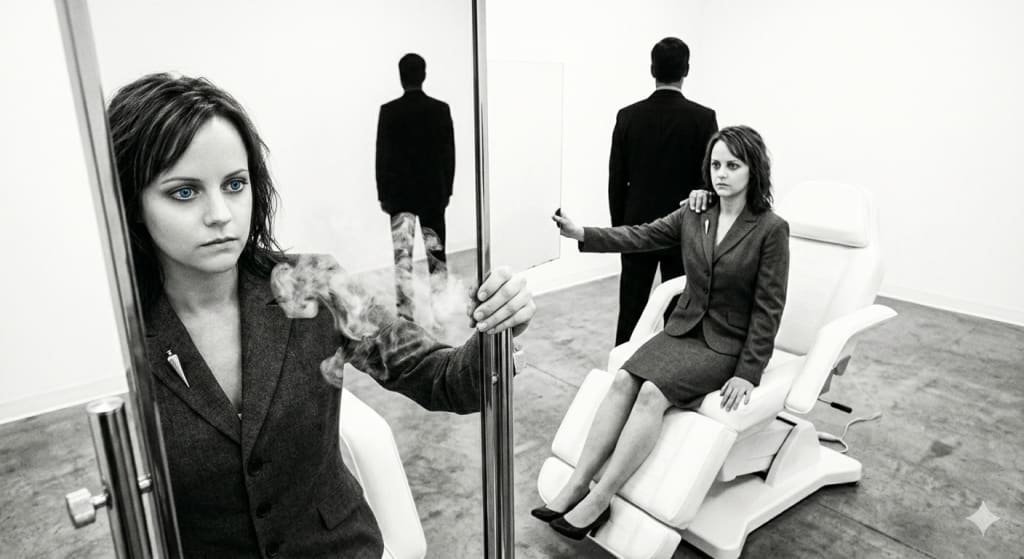
The warehouse was a cathedral of rot, a windowless box of corrugated steel tucked into the industrial gut of Tinseltown. A place where the city’s discarded ambitions went to be processed into low-grade celluloid. It sat on a dead-end street that smelled of brine and heavy-duty degreaser, a stone’s throw from the banks of the Bay of Laytah. On the heavy steel door, a piece of yellowed masking tape bore the name Velvet Nocturne Productions in fading marker—a shell company that existed to shuffle Cartel revenue through the books of a made-for-cable soft-core fantasy.
Inside, the air was a thick, stagnant soup of unwashed bodies, and the chemical tang of a cheap fog machine that hummed with a persistent, rhythmic discord. To anyone else, the noise was just the background hum of a low-budget set. To Trixie Fare, her stage name, it was Fog. It was a mist of deception, a thick miasma clouding her perception.
Trixie sat in a folding chair that lacked a rubber foot, causing her to tilt toward the shadows every time she shifted. She held a handheld makeup mirror with a jagged crack running through the center, bisecting her reflection into two unaligned halves. In the left half, her eye looked hopeful; in the right, it looked like a structural failure.
She was twenty-three, and for the last six months, she had been one of the thousands of aspiring actresses who poured off the Greyhounds. She had spent her last eight dollars on a tube of ‘Crimson Sin’ lipstick and a bus pass to this industrial wasteland, convinced that a named credit in a late-night Cinemax feature was the necessary tour de force before she could build her real career.
"Focus, Trixie," she whispered, her voice a fragile line of tension in the oppressive room. "It’s a SAG-eligible credit. It’s a foot in the door. It’s a start."
She applied the lipstick with a hand that she forced to be level. The waxy pigment felt like a seal. She tried to frame the room through the lens of artistry, pretending the grease-stained floor was "atmosphere" and the apathetic, cold stares of the crew were "professional distance." But the geometry of the place was wrong. The light from the flickering fluorescent tubes overhead wasn't illuminating the room—it was stripping it bare.
The Director sat ten feet away, hunched over a monitor that radiated a sickly, green glow. He was a man whose skin looked like yellowed parchment stretched tight over a skull, a human brand of a person who had long ago traded his soul for a steady supply of "The Grease." He didn't look at the script. He didn't look at Trixie. He looked at the waveform on his monitor, watching the Mist.
"Fare!" he barked. The sound was like a hammer striking a hollow pipe. "On the plywood. We’re burning daylight we don't have."
Trixie stood, her knees wobbling in heels that were a half-size too small, creating a localized "Shear" force in her ankles. She walked toward the center of the warehouse, where a makeshift bedroom set had been hammered together out of unhewn 2x4s and splintered pressboard. It was a Vacant Lot of a set, a facade of domesticity built on a foundation of exploitation.
As she stepped into the harsh, unforgiving glare of the floodlights, the Mist in her head reached a fever pitch. The lights were not warm; they were a surgical "Compression," pinning her against the backdrop. She could feel the gaze of the crew—thick-necked men in grease-stained tank tops who didn't see an actress, but a shipment of raw material to be processed. They were the Cartel’s "Goffers"; the mechanical components of a machine designed to turn human desperation into dreams.
"Positions," the Director droned. He finally looked up, his eyes two hollowed-out sockets of predatory calculation. He didn't see Trixie’s talent or her hope; he saw her "3% variance." He saw the fractures in her confidence that made her the perfect.
"The scene is simple, Trixie," he said, his voice dropping to a low, rhythmic drone that mimicked the metronome of a gavel. "You’re the ingenue. You’re lost. You’re looking for a way out of the storm, and you find yourself here. You’re supposed to be vulnerable. You’re supposed to want to be 'Honed'."
He didn't mean the character. He meant the girl.
Trixie took her place on the edge of the bed. The mattress was stained and smelled of stale cigarettes and a pungent, chemical cleaner that failed to mask the scent of previous "Clearances." She clutched a silk robe around her, the fabric feeling like a flimsy shroud.
"Wait," Trixie said, her voice cracking as she looked at the male co-star stepping out of the darkness.
He was a man built of pure tension—broad-shouldered, silent, and moving with a predatory grace that suggested he was more familiar with a back alley than a soundstage. He didn't look like an actor. He looked like a demolition tool. He didn't make eye contact; he simply took his place in the shadows just outside the light, his presence a weight that made the floorboards groan.
"Is there a rehearsal?" Trixie asked, her eyes searching the room for a single vertical line of truth.
The Director didn't answer. He just tapped a rhythm on the arm of his chair—a jagged, discordant beat.
"We don't rehearse 'truth', Trixie," he said. "We capture it. The camera is the only instrument in this room. If it says you're falling, you're falling."
He leaned back, his face disappearing into the green glow of his monitor. The red light on the camera began to blink—a rhythmic, bleeding eye opening in the dark.
"Action," he whispered.
The word hung in the air like a death sentence. Trixie felt the failure of her own plan. She came here to build something, but as the co-star stepped into the light and the Director’s dark smile widened, she realized she hadn't been invited to a movie set.
The Director, a man named Sterling, didn’t bother with the script. He didn’t have to. The "script" was merely a suggestion, a flimsy facade of dialogue designed to lure the victim into the warehouse. He sat in his tilting chair, tapping a jagged, discordant rhythm on his thigh.
"New blocking," Sterling rasped. His voice was a low-frequency vibration that seemed to bypass the ears and rattle the teeth. "The hallway sequence? It’s redundant. We’re moving the entire emotional arc to the mattress. It’s about vulnerability, Trixie. We need to see the failure of the character in real-time."
Trixie froze. The air in the warehouse suddenly felt ten pounds heavier, as if the atmospheric pressure had doubled within the span of a heartbeat. The "Mist" in the room—the whir of the industrial fans and the indifferent murmurs of the crew—coalesced into a nebulous wall of sound.
"The bed?" Trixie’s voice was a thin wire of Tension. "But the lines... the dialogue about the detective and the missing money... that’s the motive. That’s the story."
"The story is whatever the camera says it is," Sterling snapped. He finally looked at her, his eyes two hollowed-out sockets of predatory calculation. He didn't see an actress; he saw a 3% variance in a human soul that he could exploit. "The dialogue is just filler. We’re filming the reaction now. The raw, unscripted collapse. Get on the plywood, Trixie. Don't make me recalculate your value."
The male co-star, a man named Brock whose muscles looked like they had been forged in a shipyard and then left to rust, stepped out of the shadows. He didn't look like an actor. He looked like a demolition tool. He moved toward Trixie with a predatory grace, his shadow elongating across the unpainted pressboard like a dark geometry that threatened to swallow her whole. He didn't make eye contact; he simply occupied the space, his presence a localized compression that pinned her into the center of the frame.
"I’m not comfortable with this," Trixie said, her voice cracking as she looked toward the exit—a heavy steel door at the far end of the warehouse that now looked a mile away.
One of the crew members, a thick-necked Toadie in a grease-stained tank top, stepped in front of the door. He didn't say a word. He just crossed his arms, his massive bulk acting as a literal deadbolt against the vertical truth of the world. The exit was no longer a doorway.
"We’re rolling," Sterling said, his voice dropping to a rhythmic, hypnotic drone that mimicked the strike of a gavel. "Don't break character, Trixie. This is what you wanted, isn't it? To be seen? To be an Icon? Every Icon starts somewhere."
Brock reached out, his hand gripping Trixie’s upper arm. It wasn't a theatrical touch. It was a mechanical grip, calculating the exact breaking point of the bone. He didn't lead her to the bed; he steered her, his weight a force of nature that she had no hope of resisting. Trixie tried to pull back, but the geometry of the room had changed. The floor seemed to tilt, the walls leaned inward, and the harsh floodlights became an interrogation, stripping away her agency until she was nothing but raw material.
"Cut," she whispered, her eyes searching the apathetic, grey faces of the crew for a single Plumb Line—one person who would see the fraud and call it out. "Please, stop the camera. This isn't the movie."
The Director leaned back, a small, dark smile touching his parchment-like lips. He watched the monitor, captivated by the real-time demolition of the girl’s spirit.
"The camera stays on, Trixie. The camera is the only thing in this city that doesn't lie," Sterling said, his eyes reflecting the green, sickly glow of the Mist. "You're doing great. Action."
The co-star’s grip tightened, and as Trixie was forced down onto the stained, chemical-scented mattress, she realized what she had tried to maintain was a lie. In this room, under these lights, she was being subdued by a machine she didn't even understand. The warehouse was no longer a studio; it was an altar, and she was the sacrifice.
The red light of the camera didn't just blink; it throbbed with the rhythmic, heavy pulse of a hemorrhaging wound. To Trixie, pinned against the unyielding pressboard, it was the only “level” point left in a world that had tilted on a lethal axis. The warehouse around her dissolved into blurred shadows and hazy light, a space where the laws of human decency had been suspended in favor of the Cartel’s industrial-grade cruelty.
The co-star, the man named Brock who moved like a heavy demolition tool, didn’t speak. There were no more lines to recite, no more pretenses of a "dramatic feature." The controlled demolition of the scene was total. As his weight bore down on her, the flimsy plywood beneath Trixie’s back groaned—a dry, splintering sound that echoed the internal snapping of her own autonomy. The air suffocated her as did the crew’s indifference. They stood in the gloom like statues of salt, their silence a high-frequency vibration of voyeuristic entropy that made the very walls seem to sweat.
"Hold that expression, Trixie," Sterling’s voice drifted in from the darkness, sounding like a shovel scraping against cold stone. "That’s the stuff. That’s the real face of the city. Don't look at me—look at the lens. Give the camera your soul."
The assault was not an explosion; it was a compression. It was the slow, methodical crushing of a human spirit to see what kind of dust it produced for the market. Trixie tried to scream, to find a line of protest, but the sound was caught in her throat—a bridge support strained far past its load-bearing capacity, vibrating until it hummed with a terrifying, silent heat.
Then, the fracture occurred.
It wasn't a physical break, but a catastrophic slip of the mental keystone. In a sudden, nauseating lurch of perspective, Trixie "left" the bed. Her consciousness, unable to sustain the sheer force of the violation, retreated. She pulled back into the corrugated steel rafters of the warehouse, looking down at the girl on the plywood as if she were a distant, collapsing structure in a different zip code.
From this height, the geometry of her ruin was clear. She saw the girl—being ground into dirt by a machine. She saw the cameras, cold, glass eyes, capturing every edge of her agony, turning her trauma into a packaged product, encrypted, and sold for ten dollars a night.
The world was nothing but a series of predatory forces, and she was merely the unhewn stone being shattered to make way for a more profitable illusion.
She watched the Director lean forward, his face illuminated by the sickly green glow of the monitor, looking for the "3% variance"—that specific moment where her spirit broke.
When the red light finally extinguished, the silence that followed was heavier than the assault. It was the silence of a site that had been cleared. The demolition was finished.
The bathroom was structural neglect; a damp, tile-lined throat in the back of the warehouse that seemed designed to swallow a woman’s dignity. A single, naked fluorescent tube hummed overhead, flickering at a jagged frequency that synchronized with the nauseating throb behind Trixie’s eyes—the rhythmic, heavy pulse of the Mist. The walls were weeping, the yellowed tiles sweating a cold, industrial condensation that smelled of rust, bleach, and the metallic tang of old blood.
Trixie stood over the cracked porcelain sink, her hands shaking so violently she had to grip the edges of the basin to keep from collapsing into the rubble she had become. The porcelain was ice-cold, a dead weight against her palms that felt more solid than her own body. She felt unanchored, her internal Plumb Line snapped, her spirit drifting somewhere near the corrugated steel rafters while her physical form remained trapped in the wreckage.
She turned the tap. The pipes groaned—a dry, mechanical shriek of metal under tension before spitting out a stream of lukewarm water that tasted of copper and lime. She splashed it onto her face with a desperate, frantic intensity, as if she could wash away the last hour. She scrubbed at her mouth until the skin was raw, trying to erase the ‘Crimson Sin’ lipstick that had smeared across her chin like a ritualistic marking.
Slowly, she forced her head up. She had to see the damage.
The mirror was a spiderweb of fractures, held together by grime and the sheer inertia of the building’s decay. In the cracked, silvered glass, she didn't see the aspiring actress who had walked into the warehouse with a script and a dream. She didn't see the tough woman she had spent years trying to construct out of the debris of her past.
She saw a failure, a doup.
The reflection was a study in human entropy. Her eyes were hollowed out, the light in them extinguished by the sheer force she had endured. Her face looked wrong—unaligned, asymmetric, tilted on a lethal axis. The bruising hadn't even started to bloom yet, but she could see the variance in her own expression, the microscopic tremor in her jaw that signaled a total neurological collapse of her old identity. She was a pile of discarded material, the debris left behind after a demolition.
"I’m still here," she whispered, but the words had no weight. They were just more Mist in the room, a low-frequency vibration that failed to move the air.
She looked down at the sink, watching the pink-tinged water swirl around the drain. It looked like the Bay of Laytah—a small, swirling river of forgetfulness where she was supposed to drown her trauma for the sake of the work. The Cartel had taken the raw stone of her life and shattered it, leaving nothing but edges and dust. They had unhewn her, stripping away the polish until only the raw, vibrating agony remained.
The vibration of the warehouse—the distant, heavy thud of the industrial fans and the muffled laughter of the Toadies in the hall—felt like the heartbeat of a predator. Trixie realized then that there was no level ground left for her in Tinseltown. She was a building that had already fallen, a ruin sitting on a vacant lot, waiting for the city to come and pave over the remains.
She reached for a rough, brown paper towel to dry her face, but her fingers froze mid-air.
The door to the bathroom clicked. It was a small, mechanical sound, but in the absolute silence of her own ruin, it sounded like the strike of a gavel. A cold draft of air, smelling of nothingness and charcoal wool, swept into the room, cutting through the stench of the warehouse.
Trixie didn't turn around. She couldn't. She just stared into the broken mirror, her eyes fixed on the reflection of the door as it began to swing open, revealing a shadow that was perfectly terrifying. The intruder did not belong in the Den of Iniquity. He did not carry the scent of fog machine, cheap tobacco, or the acidic tang of industrial degreaser that defined the warehouse’s atmosphere. Instead, he occupied the doorway with a vacuum of presence—a silent, clinical void that was more terrifying than the physical violence Trixie had just escaped. He was dressed in a suit of ebony wool so fine it seemed to absorb the flickering fluorescent light, neutralizing the "Mist" of the room simply by standing in it. He walked with a rhythm that was unnervingly level his polished oxfords clicking against the damp tile with the precision of a metronome.
Trixie didn't turn. She watched him in the jagged, silvered shards of the broken mirror. He didn't look at her face; he didn't offer the pity of a human gaze. He looked at her as a surveyor looks at a plot of land after a hurricane. He was measuring her posture, the way her shoulders had buckled under the weight of the night, and her trembling hands.
"You’ve had a bad introduction to Tinseltown," the man said. His voice was a smooth, synthetic chord—a perfect frequency that bypassed the ears and resonated directly in the bone. It was devoid of empathy, yet rich with a terrifying, mathematical calculation. "But you’re high-grade. Rare to find such intensity and power in one so young."
He didn't offer a towel or a glass of water. To him, the assault wasn't a crime; it was an exercise in will that had successfully cleared the lot. Trixie was no longer a woman to him; she was unhewn, stripped of the pretenses of her former life, reduced to raw, vibrating rubble.
"Who are you?" Trixie rasped. Her voice sounded like grinding stone, the tension in her throat making every syllable a labor of shear force. "Are you with Sterling? Is the camera still on?"
"Sterling is a scavenger," the man said, stepping into the room. He occupied the space with an architectural authority that made the sweating walls feel even closer. "He deals in 'Mist' and 'Grease.' He breaks things because he lacks the creativity to build them. I represent Apex Synthesis. We don't scavenge, Trixie. We renovate. We take the wreckage of a life and we subject it to a higher order."
He reached into his breast pocket and pulled out a document. It wasn't paper; it was a thin, cool sheet of polished ivory-colored composite, unyielding. He laid it on the edge of the stained porcelain sink, right next to the pool of pink-tinged water.
"The Cartel will keep you in this warehouse until there is nothing left to break," he continued, his eyes fixed on her reflection, tracking her panic. "They will feed you to the 'Mist' until you are just another empty lot in the industrial district, a ghost in the Bay of Laytah. Or, you can sign with us."
Trixie looked down at the document. The text was microscopic, a dense web of litigious "Synthesis" that promised total protection in exchange for total "Clearance."
"We offer a new construction," the agent said. "We will take this... discord... and we will synthesize it into an impenetrable shield. We will give you a career that doesn't just make you famous; it makes you an Icon—a force so powerful that no one will ever be able to touch you again. You will be the head mistress of a kingdom of glass and light, provided you accept the terms.
He produced a pen—a heavy, brass instrument that looked like a miniature Plumb Line. Trixie’s hand shook as she reached for it. The state of her reality was menacing; the walls of the warehouse were closing in, and the "Mist" of her trauma was a roar she couldn't silence. She didn't look at the clauses. She didn't look at the fine print that defined her future. She only saw the exit from the nightmare.
As her signature hit the ivory sheet, the fluorescent light stopped flickering. The hum of the Mist faded into a low, predatory purr. The Architect of Illusion smiled—a movement of his face that was perfectly symmetrical, perfectly false.
"Welcome to Apex, Aria," he said, his voice a final Gavel strike. "The demolition is over. Let the work begin."
The transition was not a healing; it was a total structural overhaul, a cold, clinical demolition of the self to make way for a more profitable monument.
Within forty-eight hours of the ink drying on the Contract, the legal and social entity known as Trixie Fare was systematically erased. Apex’s machinery moved with the silent, terrifying efficiency of a wrecking crew, scouring her name from digital registries, shredding her failed contracts with Velvet Nocturne, and burying the "Mist" of the warehouse assault under a mountain of non-disclosure agreements and ironclad "Clearance" protocols. They didn't just hide the trauma; they treated it as a structural defect to be paved over.
Then came the physical Honing.
Trixie—though the name was already beginning to feel like a ghost in her mind—was moved to a private surgical wing of the Apex Synthesis headquarters. The suite was a cathedral of shadowless white, smelling of medical-grade ozone and a synthetic floral scent that felt like a chemical lie. There was no "Grease" here; there was only "Clearance."
A team of Synthesizers, dressed in the same charcoal-wool uniforms as the Agents, moved around her with the precision of stone-cutters. They didn't see a woman; they saw a rough stone that had been badly handled by amateurs. They saw a 3% variance in her symmetry that needed to be corrected to meet the market's demand for perfection.
They started with the "Neurological Alignment." A cocktail of proprietary neuro-suppressants flowed into her veins, designed to cauterize the edges of her memory. It didn't remove the horror of the warehouse; it simply detached the tension from the event. It turned the assault into a data point—a distant, vibrating frequency that could be ignored but never truly silenced. It was the pharmaceutical equivalent of a level smoothing out the peaks and valleys of her agony until she felt like a flat, grey horizon.
Then came the refacing. Under local anesthesia that left her mind drifting in the void while her body remained pinned by compression, they restructured the architecture of her face. They narrowed the bridge of her nose by a fraction of a millimeter to achieve a more royal profile. They injected synthetic fillers to lift the corners of her mouth into a perpetual, calibrated warmth. They chemically brightened the whites of her eyes, turning them into two polished glass marbles that reflected light but held no depth.
When the final bandages were unspooled, the Agent stood behind her, his reflection a dark, vertical anchor in the blinding white room. He placed his hands on her shoulders—a weight of absolute service that felt like a permanent gavel strike.
Trixie looked into the mirror. The rubble was gone. The fractures had been filled with expensive, high-gloss resins. The woman staring back was a masterpiece of "Mist Organization." She was luminous. She was perfect. She was the absolute "Synthesis" of every male fantasy in Tinseltown.
"Do you see the variance?" the Agent asked. His voice was a low-frequency hum that resonated in her new, delicate jawline.
Aria Darling—the name now sat in her mind like a heavy, golden crown—looked at her new face. Outwardly, she was a 50-foot icon ready to be projected onto the skyscrapers of the city. But deep behind the synthetic blue of her irises, in the dark vault where the warehouse still lived, the 3% variance remained. The trauma wasn't gone; it was trapped beneath the "Synthesis," a structural defect vibrating against the inside of her new, polished skull. The "Mist" was still there, a muffled scream beneath a layer of pristine marble.
"I don't see anything," Aria whispered. Her voice was beautiful, melodic, and entirely hollow—a "Clear-head" frequency that projected total compliance.
"Good," the Agent said, his smile a study in geometric perfection. "The world doesn't want to see the stone. They want the monument. Tinseltown is hungry, Aria. Let’s go serve."
As she walked out of the clinic, her gait was steady, her posture was plumb, and her soul was a closed system. Trixie Fare was a ghost haunting the Bay of Laytah, and Aria Darling was the new face of the Facade. The work had begun.
About the Creator
Nathan McAllister
I create content in the written form and musically as well. I like topics ranging from philosophy, music, cooking and travel. I hope to incorporate some of my music compositions into my writing compositions in this venue.
Cheers,
Nathan
Keep reading
More stories from Nathan McAllister and writers in Futurism and other communities.
The First Harvest
Chapter 4: The First Harvest The District of Rust smelled of wet iron and dying dreams, a sharp contrast to the sterile, pressurized air of the Vane Tower. I sat in the corner of a grease-slicked diner, my hands shaking—not from the cold, but from the low-frequency hum of the Static that had begun to chew at the edges of my vision. I needed a fix. Not the chemical stimulants of the Obsidian Room, but a different kind of grounding. I needed to see Elena Vane.
By Nathan McAllister15 days ago in Futurism
How machines can learn from human behaviour
In order to understand where we are and where we are going, we need to understand where we were first. - Susan Fourtane Could a human behaviour simulator be embedded into a robot or online avatar to the point that it’s hard to distinguish between a real person or artificial intelligence? Scientists have been upping the stakes in this “Turing test” for years, to the point that human-mimicking programmes are ready to answer tricky questions, assist people with online shopping or be companions.
By Susan Fourtané 12 days ago in Futurism
Fire Protection Materials Market Outlook: Safety Regulations and Infrastructure Growth Opportunities
According to IMARC Group's latest research publication,The global fire protection materials market size reached USD 7.4 Billion in 2024. Looking forward, IMARC Group expects the market to reach USD 13.2 Billion by 2033, exhibiting a growth rate (CAGR) of 6.24% during 2025-2033.
By Michael Richard7 days ago in Futurism




Comments
There are no comments for this story
Be the first to respond and start the conversation.