
TREK REVIEW: SFA 1-1 "Kids These Days"
Yeah, yeah, I know it's been cancelled

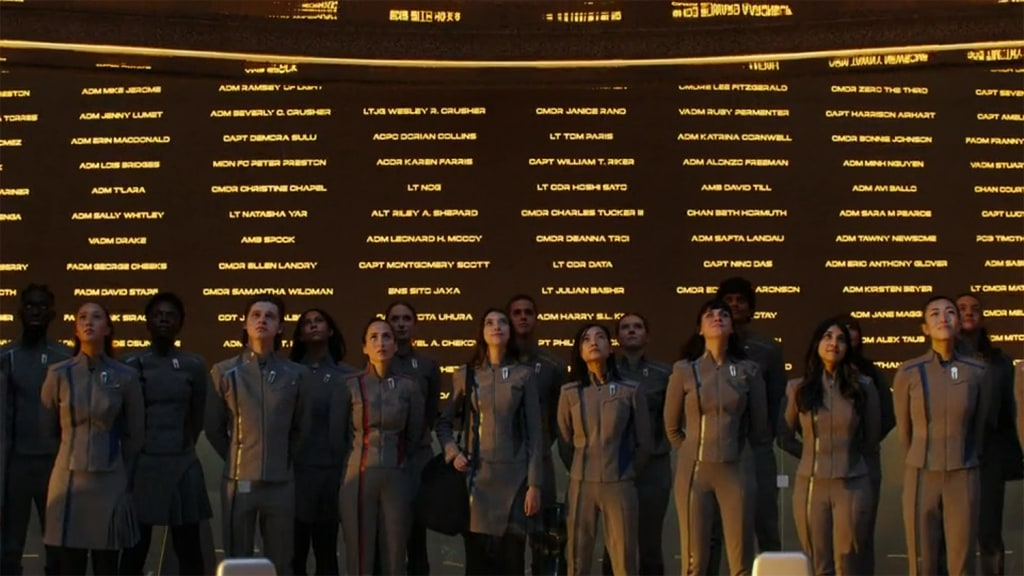
Typical, isn't it? I finally find time to sit down and review Starfleet Academy and what happens? Paramount cancels it. It's a huge shame, because this series, in spite of how some fans feel about it, was a real winner for many more. Still, it's understandable. While it's tempting to blame review bombing and negative press, at the end of the day, it's an extremely expensive show and not enough people were watching. (At least in the States; UK and European streaming figures have been very positive.) SFA has been hovering outside the Nielsen Top Ten, and for a high budget, flagship series, that's not going to cut it. Plus, with the studio being bought yet again, it was an easy first move to cut it.
Still, season two is already in the bag and will be streaming next year, assuming Paramount doesn't do something stupid like they did with Star Trek: Prodigy. In many ways, Starfleet Academy is a continuation of Prodigy. Not literally, of course; it's more of a continuation of Discovery, sitting at the far end of the 32nd century and the frontier of Trek's future history. But Prodigy was Star Trek aimed at younger viewers, focusing on a group of teens of various species as they made their first faltering steps into Starfleet. The Doctor was even there, offering his wisdom and acting as Chief Medical Officer. It's hard not to see SFA as the next step, a more adult series, of course, but still resolutely aimed at young people.
This is the problem a lot of fans have with it. It simply isn't aimed at them. Now, it's not aimed at me, either - at 42, I'm far too long-in-the-tooth for the target audience. I love the show, but I understand that's a rarity among died-in-the-wool Trekkies. But that's fine. This isn't a show for people who've been watching Star Trek for decades. It's a show for new, young viewers, and while it still needs to be Star Trek it doesn't need to be old school Star Trek. Now, I agree that there's a place for old school Trek and that nothing airing right now quite fulfils that remit (Strange New Worlds comes closest, but that's still an aggressively modern take on early Star Trek). But that's not what Starfleet Academy is trying to be.
Some fans have called it "CW Star Trek," and that's a pretty fair description of the show. Personally, I don't think CW Star Trek would have been a bad thing. If anything, it perhaps should have been more of a CW-style show, and turned out twenty-six episodes on a slimmer budget. That would have made an easier argument for keeping it around, without having to change the content much at all. As for people complaining that it's woke... yeah, it is. That's a good thing. As frustrating as it is to see people making the same complaints that they made about Voyager thirty-odd years ago (as Robert Picardo himself pointed out), being politically correct is, usually, a good thing. Infinite diversity, remember?
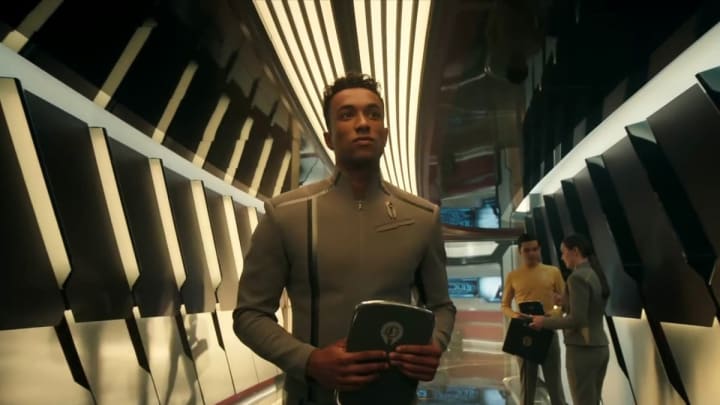
"Kids These Days" is a solid opener for the series, with a lot packed into its somewhat extended runtime. It introduces the new cast of characters, setting, and ongoing story arc with style and flare. The cast are uniformly excellent, even if not everyone gets a chance to really show their stuff in this opening instalment. Sandro Rosto is clearly pitched as the star as Caleb Mir, the cocky, genius runaway and criminal who gets to show he's a decent fella at heart. There's a bit of a trend for this kind of character in Trek recently: Jack Crusher, Dal Rel (his closest antecedent, really), even 2009 Jim Kirk (if you can call that recently). Still, with a full season of Academy-learning ahead of him, it's more realistic to imagine that he'll find his path and learn how to balance his cleverness and ingenuity with, well, not being a prick.
The second lead is, of course, Holly Hunter, bringing both Hollywood leading lady and weird little gremlin vibes. Captain Ake is getting a lot of hate and a lot of love from fan circles. Personally, I think she's great. It's always good to see an older woman in a lead role, especially on an action show, and this peculiar, 400-year-old officer, weighed down by the guilt of her poor decision years earlier but still an eccentric, chipper mentor character, really works.
Robert Picardo is the big draw for existing fans, excelling in his portrayal of an older, tireder, more melancholy Doctor. It's interesting to see how his character here contrasts with his 800-years-younger version in Prodigy, when he is in an ostensibly similar position. Gina Yashere is an inspired choice for Lura Thok, the intimidating Klingon-Jem'Hadar Cadet Master. Some fans are getting upset at a female Jem'Hadar, but I can't get over having a Cockney Jem'Hadar! She's a hoot in every scene she's in. The other main "grown-up" Starfleet character is Admiral Vance, with Oded Fehr giving his usual quietly classy turn.
Onto the rest of the kids. Karim Diane makes an immediate impression as Jay-Den Kraag (a Klingon called Jayden? Really?) Poised and respectful but full of Klingon energy, he's very much the new Worf. The remarkably deep voice he puts on is not his natural one, but feels exactly right for the character. I was intrigued by his make-up, which includes blue contacts and unusual whorls on his cheeks, and wondered if he, too, would be revealed as a hybrid. Seems like he's a full-blooded Klingon, though, and it's not like that species' appearance has ever been entirely consistent.
George Hawkins as Darem Reymi mostly just gets to alternate between being charming and dickish, although his species, the Khionians, is intriguing. Bella Shepherd doesn't get to do much either as the ludicrously named Genesis Lythe. She's from another new alien race, the Dar-Sha, but Shepherd mostly just gets to look beautiful and gets little character work here. Still, this is only the first episode, and they do both get their hero moment. There will be plenty more to see from them as the season goes on.
Kerrice Brooks is an immediate hit as SAM, the Series Acclimation Mil hologram from Kasq. Again, there's a lot more to learn about her later in the season, but her character is so instantly clear from both the dialogue and Brooks's performance. The high-powered student who's desperate to both make friends and achieve is a cliche, but the idea of someone programmed to be that student so she can learn about organic beings is a great twist. If there's a complaint to be made about the young characters, it's that they are fundamentally cliched archetypes for this kind of show, but mapping this to the distant future makes that future easily relatable.
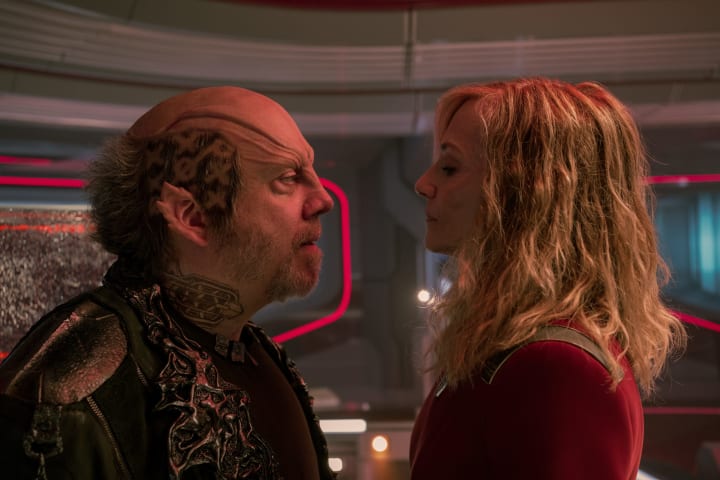
Finally, the anti-Starfleet side. Tatiana Maslany is a great actor but doesn't have a great deal of time to show that her. Fortunately, we'll be seeing more of her. Paul Giamatti is just fabulous as Nus Braka, our new Big Bad. Braka is a fully evil, over-the-top villain, and Giamatti plays him appropriately, hamming it up to the max. Half that enormous budget must have been spent replacing the scenery after he was finished chewing it. In spite his loudly villainous character, like the somewhat similar character of Harry Mudd (at least on Discovery), Braka has a point when he criticises Starfleet in general and Ake in particular. It's important that Starfleet, even being positioned as good for the Galaxy, isn't beyond reproach. Ake made a serious error in judgment in having Anisha Mir locked up and separated from her son, but she was just following orders, as they say. The seriousness of a powerful government sending uniformed troops out to arrest aliens and separate them from their children shouldn't take too much extrapolation to the modern day, even for the most cloth-headed viewers.
There are, admittedly, some massive plot holes in "Kids These Days." This is nothing new in Star Trek, but they still rankle when you notice them. Sure, Caleb Mir is a genius, but his escape from Starfleet Custody as a six-year-old srains belief a bit too far. Braka's plan to ensnare the Athena relies on a hell of a lot of luck. Ake could easily have decided just not to investigate the phenomenon when the ship already has a destination to get to. There are some oddities that are par for the course for a series like this: modern slang that will date quickly; actors well into their twenties playing teenagers. It's a little odd having that in Star Trek, but it's exactly what you'd expect from what is, at its heart, a teen drama series.
Importantly, though, it works as set-up for the series. In the post-Burn galaxy, we get why Starfleet Academy is a big deal and an altogether good thing. The galaxy is still in turmoil and things aren't fixed overnight. People are suffering out there and others are taking advantage of that. This, arguably, includes Starfleet, with Ake essentially blackmailing Caleb to join because she's decided it's the best path for him. But we also see that having structure and support around does help him, and that Starfleet is working to change how it interacts with the galaxy. For all the background about the resurgance of Starfleet, the threat of the Venari Ral pirates and all the other troubles in the galaxy, this is actually quite a small scale story, focusing on Caleb's choosing of his path.
The season as a whole follows up on all of this, albeit not entirely successfully, but as first episodes go, this is a strong opening to a fine, if very different, kind of Star Trek.
And if you don't like it - that's fine. But I rather loved it.
About the Creator
Daniel Tessier
I'm a terrible geek living in sunny Brighton on the Sussex coast in England. I enjoy writing about TV, comics, movies, LGBTQ issues and science.
Keep reading
More stories from Daniel Tessier and writers in Futurism and other communities.
REVIEW - Star Trek: Section 31
After what seems like forever since it was first announced as another new Star Trek series, Section 31 finally arrives as Trek’s first streaming TV movie. Indeed, it’s a first for the franchise in a number of ways: the first production not to focus on Starfleet characters; the first to be set in the “lost era” between the original cast movies and The Next Generation; and the first to be headed by an East Asian and non-Anglosphere lead.
By Daniel Tessierabout a year ago in Futurism
The Fears of AI And How Much Fun It Can Be
ChatGPT has come a long way, as has AI in general. There are those people who are scared of it, and for understandable reasons. People fear that as technologies advance, they’ll be replaced in the workforce. Then, there are the fears that AI could evolve into something that brings us to the brink of extinction.
By The Man Behind The Mask2 days ago in Futurism


Comments
There are no comments for this story
Be the first to respond and start the conversation.