
Update available - Humanity 2.0
The future of transhumanism

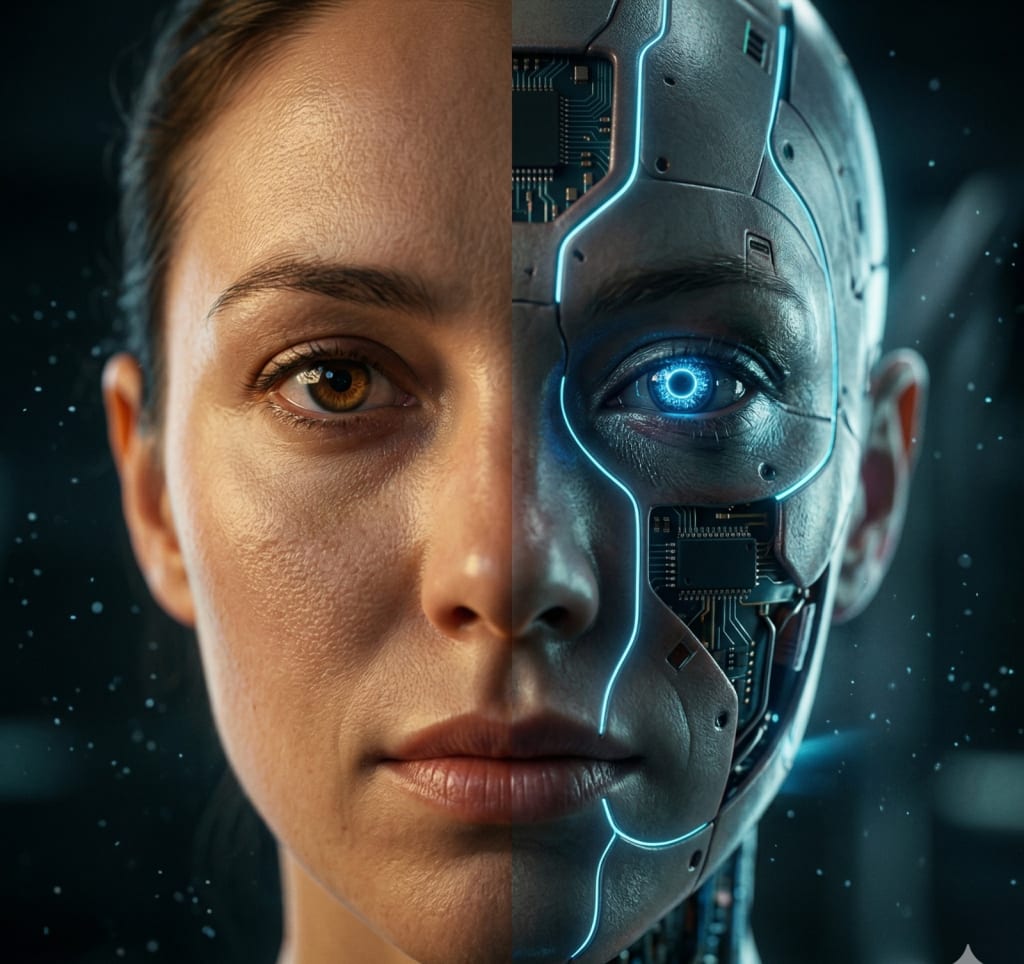
The year is 2050.
A girl wakes up in a silent white room. No heartbeat. No breathing. No blinking. Yet he is alive.
Her body is not made of flesh anymore. Her eyes glow faintly blue, her memory is perfect, and her brain is connected to a global network of knowledge. She can speak any language, solve complex equations in seconds, and never feel pain.
She is not human.
She is something new.
She is Humanity 2.0.
This idea may sound like science fiction, but it is already being discussed in laboratories, universities, and tech companies around the world. The movement behind it is called transhumanism, and its goal is simple but shocking:
To upgrade humans using technology and move beyond biological limits.
The idea began in 1957 when biologist Julian Huxley suggested that humans could guide their own evolution. Instead of waiting for nature to slowly change us, we could use science to become smarter, stronger, and healthier. At first, this sounded like a distant dream. But by the 1980s and 1990s, technology was advancing rapidly, and the dream started to feel possible.
Scientists, philosophers, and futurists began asking a bold question:
What if humans could improve themselves the same way we upgrade machines?
Soon, the vision became clearer.
Imagine living for hundreds of years. Imagine never getting sick. Imagine a brain connected directly to computers, allowing you to learn anything instantly.
Some transhumanists believe aging itself is a disease that can be cured. They argue that death is not natural, it is just a technical problem waiting for a solution.
Even today, researchers are studying animals like the bowhead whale, which can live for more than 200 years, to understand how extreme longevity works. The goal is not just to live longer, but to live indefinitely.
Not forever in a magical sense, but forever through science.
Then comes the most controversial idea of all:
uploading the human mind into a computer.
Futurist Ray Kurzweil predicts a moment called the Singularity, when machines become smarter than humans and begin improving themselves. After that point, humans may no longer need fragile biological bodies. Instead, consciousness could be stored digitally, living inside powerful computer systems or virtual worlds.
In simple words, your mind could live even after your body dies.
You could exist as pure intelligence.
This idea sounds terrifying, but it is not just theory. Billionaires and tech companies are already investing billions into transhumanist technologies. Companies are working on reversing aging, creating brain chips, and building artificial organs.
One real example is a brain chip implanted into a patient with ALS, allowing them to communicate using only their thoughts. No speech. No movement. Just thinking and the computer understands.
Another example is a filmmaker who replaced his missing eye with a camera. He calls himself Homo Excelsior, meaning an improved human. He says technology did not make him less human, it made him more capable.
Slowly, the line between human and machine is beginning to fade.
But not everyone is excited about this future.
Critics warn about a dangerous divide. If only rich people can afford these upgrades, society could split into two groups,
enhanced humans and normal humans.
The enhanced ones could be smarter, stronger, and live longer, while others remain limited by biology. This could create a new form of inequality, one not based on money or power, but on human design itself.Others worry about something deeper,
the loss of what makes us human.
Philosophers argue that struggle, pain, and even death give life meaning. If humans never suffer, never age, and never die, will life still feel valuable? Some believe that replacing natural growth with artificial upgrades could remove passion, emotion, and the beauty of imperfection.
Religious thinkers also question whether humans should try to eliminate death. Many believe life is meant to be a journey of learning, struggle, and spiritual growth. Trying to control life and death could be seen as humans attempting to play the role of a creator.
And history has shown that civilizations often fall when they try to control too much.
So the world stands at a crossroads.
The question is no longer whether transhumanism is possible. The real question is whether we should do it.
Because one day, humans may truly wake up in a silent white room, with glowing eyes and digital minds, no longer bound by flesh or time. And when that day comes, we may have to ask ourselves the most important question in history,
Are we still human…?
About the Creator
Sakuni Bandara
Just Another average girl !
Keep reading
More stories from Sakuni Bandara and writers in Futurism and other communities.
How machines can learn from human behaviour
In order to understand where we are and where we are going, we need to understand where we were first. - Susan Fourtane Could a human behaviour simulator be embedded into a robot or online avatar to the point that it’s hard to distinguish between a real person or artificial intelligence? Scientists have been upping the stakes in this “Turing test” for years, to the point that human-mimicking programmes are ready to answer tricky questions, assist people with online shopping or be companions.
By Susan Fourtané 3 days ago in Futurism
Automotive Adhesives Market Outlook: Lightweight Vehicle Manufacturing and Advanced Bonding Growth Opportunities
According to IMARC Group's latest research publication, The global automotive adhesives market size reached USD 6.4 Billion in 2024. Looking forward, the market is expected to reach USD 13.5 Billion by 2033, exhibiting a growth rate (CAGR) of 4.3% during 2025-2033.
By James Whitman7 days ago in Futurism


Comments
There are no comments for this story
Be the first to respond and start the conversation.