
Video Conferencing Market Trends: Remote Work Adoption, AI Features & Forecast to 2034
How the rapid adoption of remote work, integration of AI-powered meeting tools, and expansion of cloud collaboration platforms are accelerating growth in the global video conferencing market.

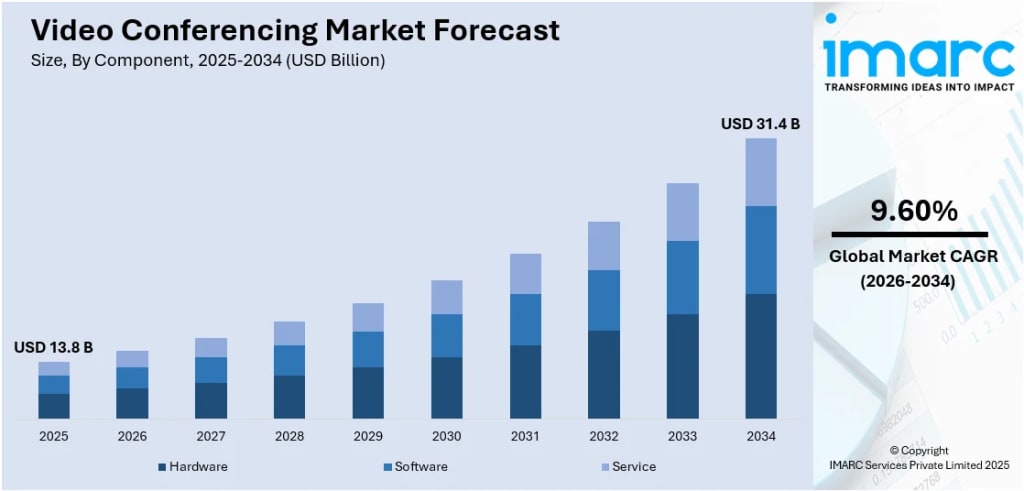
Growing demand for remote and hybrid work, the rapid spread of high-speed internet, and the push by organizations to cut travel costs are fueling strong momentum in the video conferencing space. According to IMARC Group's latest data, the global video conferencing market size was valued at USD 13.8 Billion in 2025. Looking forward, IMARC Group estimates the market to reach USD 31.4 Billion by 2034, exhibiting a CAGR of 9.60% from 2026-2034. North America currently dominates the market, holding a market share of over 39.8% in 2025.
Video conferencing has moved well beyond replacing in-person meetings — it now enables entirely new ways of working. Platforms powered by AI deliver real-time transcription, intelligent noise suppression, and automated meeting summaries, making virtual collaboration genuinely more productive. With 96% of US adults online and GSMA reporting over 90% global access to 4G or higher mobile networks, the infrastructure for seamless video communication is firmly in place. Hardware adoption is accelerating too — meeting room cameras grew 8% in value over the past year, with all-in-one video bars becoming the go-to solution for hybrid offices managing tight budgets.
Video Conferencing Market Growth Drivers:
Rise of Remote and Hybrid Work Models
Hybrid work isn't a pandemic-era experiment anymore — it's the new baseline. About half of remote-capable employees were working in a hybrid arrangement in 2025, and Cisco's Hybrid Work Index found that 98% of all meetings now include at least one remote participant. Businesses across finance, legal, and tech sectors have reorganized their entire communications infrastructure around video-first collaboration. This structural shift is what's driving sustained investment in video conferencing — not just software licenses, but full room systems, hardware upgrades, and enterprise-wide deployments that weren't on the table three years ago.
Cost Reduction and Travel Efficiency
One of the most compelling arguments for video conferencing is straightforward economics. Organizations replacing even a portion of business travel with virtual meetings report roughly 30% reductions in travel-related expenses — covering flights, hotels, per diems, and venue costs. For large multinationals managing thousands of employees across regions, those savings add up to tens of millions annually. Beyond the balance sheet, fewer business trips also mean measurable drops in corporate carbon emissions, which matters to companies with active ESG commitments and increasingly scrutinized sustainability reporting obligations.
Expanding Use Across Healthcare and Education
Healthcare and education have shifted from peripheral use cases to genuine growth engines for this market. Telehealth consultations are now routine for millions of patients worldwide. In China, the Ministry of Industry and Information Technology reported that over 95% of schools had access to video learning tools in 2024. Japan's government committed JPY 3.1 trillion under its digital transformation fund to support communication technologies including video platforms. Brazil's Ministry of Communications has also ramped up funding for internet projects in underserved regions specifically to support video-based services. These are infrastructure investments, not experiments.
Video Conferencing Market Trends:
AI Integration is Reshaping the User Experience
The most significant change happening inside video conferencing platforms today is the embedding of AI across the entire meeting lifecycle. Cisco's Webex introduced next-generation AI agents in 2025 that go beyond note-taking — they automate follow-ups, connect data across workflows, and break down information silos. Microsoft Teams launched real-time language translation in nine languages, removing one of the most persistent barriers in global collaboration. Zoom's AI Companion now generates live summaries and drafts chat responses. These aren't cosmetic upgrades — they're fundamentally changing how distributed teams operate and communicate day to day.
Immersive and Spatial Meeting Environments
The next frontier in video conferencing is presence — making remote participation genuinely feel equivalent to being in the room. Google Beam, the successor to Project Starline, uses AI volumetric video and depth displays to render participants as life-size 3D representations, with a deliberate focus on preserving eye contact and natural expression. AR and VR spatial meeting environments are also moving from pilot programs toward early commercial deployment, with tools like Meta's Hyperspace enabling teams to create and inhabit shared digital spaces. In high-stakes fields like surgical training, aviation simulation, and disaster management, these immersive formats are already in active pilot use.
Security and Compliance Taking Center Stage
As video conferencing embeds itself into sensitive business, medical, and government workflows, data security has become a baseline requirement rather than a premium add-on. In March 2025, the European Union approved new Data Protection Regulations specifically targeting video conferencing platforms, establishing standards for data handling across the bloc. Google Meet introduced end-to-end encryption for enterprise calls in late 2024. On-premises deployment currently holds 58.7% market share — a number largely driven by organizations in finance and healthcare that need complete control over their data infrastructure. That preference isn't changing anytime soon, especially as compliance requirements continue to tighten globally.
Recent News and Developments in the Video Conferencing Market
• August 2025: Zoom Video Communications announced a strategic partnership with a leading AI firm to integrate advanced machine learning capabilities into its platform, targeting smarter meeting automation, real-time intelligence, and enhanced productivity tools for enterprise customers.
• Q1 2025: Pexip and Logitech announced a partnership to deliver integrated video conferencing solutions, combining Pexip's enterprise software with Logitech's hardware ecosystem to give organizations a seamlessly bundled room system that simplifies procurement and deployment at scale.
• April 2025: Tencent upgraded its Meeting platform with enhanced AI-based translation and voice recognition capabilities, strengthening multilingual support for its user base exceeding 300 million and deepening its competitive position across Asia Pacific enterprise markets.
• Q4 2024: Google rolled out end-to-end encryption for Google Meet enterprise video calls, responding to growing demand for stronger data protection guarantees from corporate clients in regulated industries across North America and Europe.
Note: If you require specific details, data, or insights that are not currently included in the scope of this report, we are happy to accommodate your request. As part of our customization service, we will gather and provide the additional information you need, tailored to your specific requirements. Please let us know your exact needs, and we will ensure the report is updated accordingly to meet your expectations.
About the Creator
Suhaira Yusuf
I specialize in Consumer Insights, focusing on transforming detailed market data into strategic business solutions that accelerate growth and improve customer engagement.
Keep reading
More stories from Suhaira Yusuf and writers in Futurism and other communities.
Crowdfunding Market Trends: Fintech Innovation, Online Investment & Forecast to 2034
Rising entrepreneurship, rapid digitalization, and a global shift away from traditional banking are powering the expansion of the crowdfunding market. Backed by supportive regulations and growing social media reach, crowdfunding has gone from a niche alternative to a mainstream financing engine. According to IMARC Group’s latest data, the global crowdfunding market size reached USD 20.4 Billion in 2025. Looking forward, IMARC Group expects the market to reach USD 52.3 Billion by 2034, exhibiting a growth rate (CAGR) of 10.47% during 2026–2034. North America currently leads the market, supported by deep internet penetration, established platform ecosystems, and investor-friendly regulatory frameworks.
By Suhaira Yusuf2 days ago in Futurism
Australia Pro AV Market: Hybrid Work Demand, Digital Signage & Smart AV Technologies
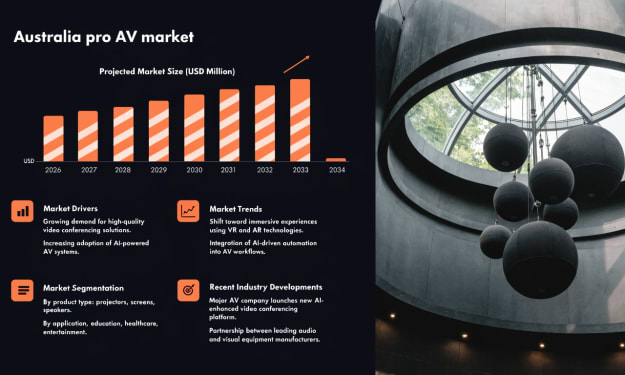
According to IMARC Group, the Australia pro AV market reached a value of USD 93.9 Million in 2025 and is projected to reach USD 133.6 Million by 2034, growing at a compound annual growth rate (CAGR) of 3.88% during 2026–2034. The market is expanding as organizations increasingly adopt advanced audiovisual solutions to support communication, collaboration and digital engagement. Hybrid work environments are encouraging businesses to invest in video conferencing systems, smart displays and integrated collaboration platforms that connect remote and in-office teams. At the same time, industries such as retail, hospitality and tourism are investing in digital signage to improve customer engagement and brand communication. As companies focus on creating interactive and technology-driven environments, professional AV solutions are becoming essential tools for modern workplaces, entertainment venues and commercial spaces across Australia.
By Kevin Cooper4 days ago in Futurism
WhatsApp Business API: A Complete Guide to Business Messaging in 2026
Over the past decade, the way businesses communicate with customers has changed dramatically. Traditional channels such as email and phone support are still widely used, but instant messaging has become one of the most preferred ways for people to interact with brands. Customers increasingly expect quick responses, convenient updates, and support that feels personal rather than formal.
By Olivia Cartera day ago in Futurism
Why Didn't Anyone Tell Us
Men, move along. This is not for you. This is for the women. I was forty-five when I began menopause. It is pretty young for that to be going on in a woman’s life, but I had undiagnosed PCOS, my entire life. Thank you to all the gynecologists I had seen my entire life. That in itself should encourage women to keep seeking second opinions, especially when you are not getting correct answers or any at all.
By Alexandra Grant3 days ago in Humans


Comments
There are no comments for this story
Be the first to respond and start the conversation.