
Your Website is a Ghost Town (and That’s Okay)
Why I’m abandoning my standalone blog to move where the attention actually flows.

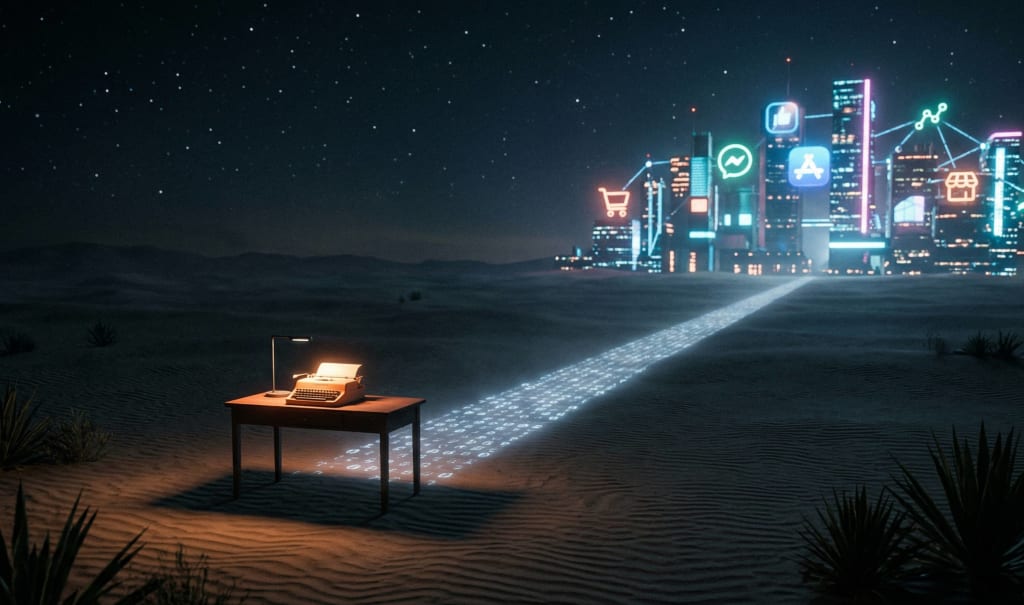
I finally did it. I followed the "expert" advice. I bought the domain, obsessed over a minimalist WordPress theme, and told myself that if I posted twice a week, the audience would eventually find me. I treated my blog like a Field of Dreams: if I built it, they would come.
Then I looked at my traffic.
If you count "Russian bot pings" and "spam comments about crypto," then sure, I had traffic. But in terms of actual human beings reading my words? Total silence. I was standing on my gorgeous, polished little island, shouting into a megaphone, and realized something embarrassing:
Nobody is coming to my island. Not when the continent is bustling just a few miles away.
We’ve been romanticizing the "Open Web" like it’s still 2008. We tell ourselves that owning our own platform is the only way to be free. But the reality is much harsher. The mall is dead. The independent boutique on a quiet side street is boarded up. Everyone is at Costco now. And online, "Costco" is wherever the attention already flows like a 6 a.m. Starbucks line.
If you’re building anything that deserves to be seen, you have to stop fighting gravity. Here is why your website is a ghost town and where you should actually be putting your energy.
The "Discovery" Problem: Google Isn't Your Friend Anymore
Ten years ago, SEO was the great equalizer. You wrote a good post, tagged it correctly, and Google would eventually hand you some foot traffic. Today? Google is a graveyard of AI-generated SEO filler and "sponsored" results. The chance of a random human stumbling onto your blog via a search engine is nearing zero.
People don't "browse" the open web anymore. They browse shelves. Think about how you use the internet. When you want a tool to track your fitness, do you search the open web for a random .com? No. You go to the App Store. When you want to buy a custom Muslim marriage certificate (Nikah Nama), do you hope to find a standalone shop? No. You go to Etsy. These platforms are the new front doors of the internet. They aren't just tools; they are discovery engines.
1. The App Store is the new search engine.
If you are creating anything that "does" something—whether it’s a productivity tool, a finance tracker, or a recipe aggregator—your biggest mistake is hosting it on a private URL.
App stores (Apple and Google) are the default search engines for utility. People go there specifically because they have a problem they want to solve right now. When you ship as an app, you aren't just providing a tool; you’re letting Apple and Google hand you foot traffic like a 90s shopping mall. They do the marketing for you because they want people to stay within their ecosystem.
2. Marketplaces Have Built-in Gravity
A standalone site selling a product is a lemonade stand on a quiet suburban street. A listing on Amazon or Etsy is a booth inside the biggest Costco on Earth.
The difference in exposure is staggering. I’ve seen writers spend months building a "shop" on their own site, only to sell three copies to their cousins. Meanwhile, the person who puts a simple PDF guide on Gumroad or a design on Etsy sees sales from people in countries they couldn't find on a map.
Why? Because those platforms have built-in trust. People already have their credit cards saved there. They trust the return policy. They trust the reviews. You aren't just fighting for attention on your own site; you’re fighting for trust—and that’s a much harder battle to win alone.
3. Social Media is the Last Public Square
I’ve had a love-hate relationship with social media for years. It’s noisy, it’s toxic, and the algorithms are fickle. But it is the only place where the "accidental discovery" still happens.
People scroll social media without thinking. They "bump" into creators. They stumble onto ideas they weren't even looking for. On your own website, you have to beg people to visit. You have to send emails, run ads, and plead for clicks. On LinkedIn, X, or TikTok, you just have to be interesting. You drop your work where the crowd is already standing and let the gravity of the platform do the heavy lifting.
The Freedom of Admitting Defeat
I’m basically giving up on my blog.
That sounds like a failure, but it actually feels incredibly freeing. I’m not giving up on writing; I’m giving up on the "long route" to an audience. There is no prize for taking the hardest path possible. There is no virtue in obscurity.
If the crowd is browsing Amazon reviews at midnight, or scrolling LinkedIn during their lunch break, or searching the App Store for a new way to manage their trading on Exness, then that is where I need to be.
We romanticize "owning our platform" because we’re afraid of being "rented" by an algorithm. But I’d rather rent a booth at a busy trade show than own a mansion in the middle of a desert where nobody can see me.
Attention has gravity. You can either fight it and stay lonely, or you can go where it pulls. I like practical solutions. And practically speaking? The open web is for archives; platforms are for growth.
About the Creator
abualyaanart
I write thoughtful, experience-driven stories about technology, digital life, and how modern tools quietly shape the way we think, work, and live.
I believe good technology should support life
Abualyaanart
Keep reading
More stories from abualyaanart and writers in Futurism and other communities.
How machines can learn from human behaviour
In order to understand where we are and where we are going, we need to understand where we were first. - Susan Fourtane Could a human behaviour simulator be embedded into a robot or online avatar to the point that it’s hard to distinguish between a real person or artificial intelligence? Scientists have been upping the stakes in this “Turing test” for years, to the point that human-mimicking programmes are ready to answer tricky questions, assist people with online shopping or be companions.
By Susan Fourtané 7 days ago in Futurism
Insurances
When I was asked to move from the big city of Philly halfway across the country to the small town of Centerville, OK, I was excited for the new start and the new job. My insurance company offered me a promotion to move because I'm young and unattached. I was to be one of two agents in the branch.
By Julie Lacksonen6 days ago in Fiction




Comments
There are no comments for this story
Be the first to respond and start the conversation.