
Evony TKR Review: A Closer Look at Evolving Live Events
Analyzing the LiveOps Strategy of Evony: The King’s Return

As the global mobile gaming landscape transitions into a mature, high-saturation market, the industry is witnessing a fundamental paradigm shift.
With User Acquisition Costs (UAC) at an all-time high, the focus for top-tier developers has migrated from mere content deployment to long-term ecosystem sustainability.
Deep-layered gameplay mechanics, hyper-personalized user journeys, and data-informed behavioral loops now form the bedrock of modern game design.
In this context, LiveOps events are no longer peripheral additions; they are sophisticated, engineered systems designed to synchronize new user onboarding with the revitalization of veteran player communities.
Against this backdrop, we evaluate one of the strategy genre’s most enduring titans—Evony: The King’s Return—through the lens of its latest high-stakes in-game events.
Event I: The Historic City of Pasargadae — A Study in Strategic Friction
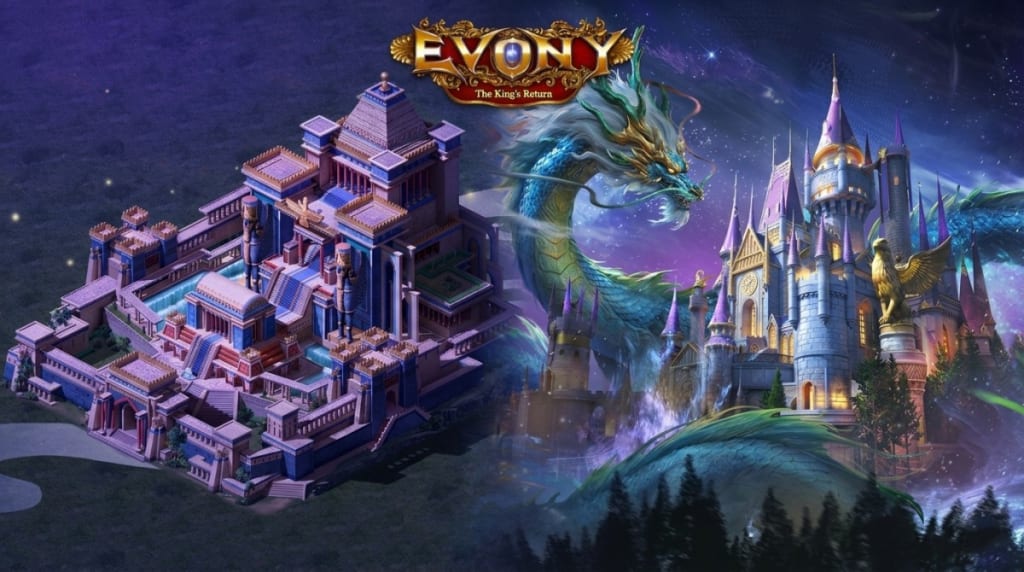
The latest cycle of the Historic City Event introduces Pasargadae, a Persian-inspired stronghold that represents more than a cosmetic update—it is a calculated disruption of the current tactical meta.
The Strategic Edge: Beyond the Numbers
Pasargadae offers a suite of buffs specifically engineered to empower Mounted Troop compositions and Rally-based warfare:
- Base Specialization: Mounted Troop Attack, Defense, and HP $+15%$
- Offensive Peak: Attacking Mounted Troop Attack $+50%$
- Coalition Resilience: In-Rally Mounted Troop Defense and HP $+50%$
- Counter-Meta Utility: $-20%$ Attack reduction for enemy Ranged and Siege units when defending
Design Insight: By segmenting the competition across six continents, the developers foster a sense of localized rivalry. The daily reset of rankings creates "productive urgency," while the exclusivity constraint—limiting players to one city of the same type—introduces strategic friction, forcing players to commit to a specific progression path rather than accumulating mindless power.
Event II: Season 17 All-Star — The Competitive Apex
While the Historic City event focuses on resource mastery, the Season 17 All-Star tournament serves as the game’s "proving ground." This is where the game’s competitive layer sharpens into a true meritocracy.
Tiered Meritocracy: Balanced Competition
The event utilizes a sophisticated bracket system to ensure engagement across the entire power spectrum:
- All-Star Battlefield (Top 400): The elite echelon of global strategists
- All-Star Elite (401–800): The competitive mid-tier
- All-Star Junior (801–1200): A pipeline for emerging talent
This structure guarantees that players compete within balanced brackets, maintaining the "flow state" essential for high-level retention.
Reward Hierarchy: Status vs. Utility
The rewards in Season 17 are designed to be transformative, not just incremental:
- The Elder Dragon (Mengzhang): A symbol of absolute dominance and a massive leap in tactical capability
- The Arcanum Athenaeum (Champion Castle): This is a masterclass in progression-based rewards. As the castle evolves, it unlocks scalable debuffs against enemy defenses and boosts offensive output, rewarding players who view the game as a multi-year investment
- The Legendary Dragon Egg: This introduces a high-level trade-off decision. Players must choose between immediate liquidity (exchanging for high-value materials) or long-term power (unlocking rare dragons), adding a layer of risk management to the experience
Cross-Validation of User Feedback and Behavioral Data
In emphasizing user feedback and the creation of high-quality games, the Evony team states that it conducts continuous, systematic testing across regions and diverse player cohorts. This process is not only used to gather players’ subjective feedback, but also to cross-validate it with detailed behavioral data. In other words, what players say and what players actually do are placed side by side within the same analytical framework.
In practice, the team observes how players engage during the early onboarding phase—whether they complete tutorials smoothly, where they encounter friction, how they convert into active users, and where they drop off. At the same time, the usage lifecycle of new features, player retention duration, and the key factors that drive players to return are all continuously tracked.
As a result, qualitative feedback is no longer treated as an isolated, subjective judgment, but rather as a reference point calibrated against objective behavioral data. This approach enables the team to distinguish “noise” from “signal,” avoiding decisions based solely on surface-level feedback, and instead making more informed, data-driven decisions grounded in real player behavior.
Behind the Vision: Top Games, Inc.
The architect of this ecosystem is Top Games, Inc., a studio that has mastered the art of hybridizing genres.
Since 2015, their philosophy has centered on the "Player-First" model, integrating RPG depth, Match-3 accessibility, and deep social strategy.
About the Creator
Cool Gamer
With 5+ years in mobile gaming, I see it as more than fun—it enriches life. Here to share trends, insights, and joy. Let's have some fun!
Keep reading
More stories from Cool Gamer and writers in Gamers and other communities.
Strategic Depth: The Evolution of uCool’s Heroes Charge in 2025
The independent gaming sector is undergoing a period of significant expansion, with market valuations estimated at $4.85 billion in 2025 and projections suggesting a near-doubling by the end of the decade. While premium, "pay-once" models still command approximately 61% of indie revenue, the industry is increasingly defined by hybrid monetization—blending base purchases with sophisticated live-ops, cosmetic enhancements, and non-intrusive subscriptions. Within this shifting landscape, uCool stands as a prominent example of an independent studio that has successfully navigated these complexities, primarily through its enduring RPG hit, Heroes Charge.
By Cool Gamer3 months ago in Gamers
Butcher Season Is Here: The Ultimate S12 Paladin Leveling Guide for Diablo IV
The launch of Season 12 has fundamentally shifted the leveling meta for Paladins in Diablo IV. While traditional builds relied on static defensive setups, this season—aptly nicknamed the "Butcher Season"—revolves around high-speed mobility and a devastating new transformation loop. If you want to hit Paragon 150 within your first few sessions, you need to abandon the old "Immovable Book" defensive playstyle and embrace the carnage.
By hasan zidan5 days ago in Gamers
Chronic Ache in the Soul of a Single Parent
There is a chronic ache in the soul of a single parent. It lingers, feeling endless. This ache feels so difficult, especially when you look at other families. They seem so… whole. They seem so joyful and complete. There is a husband and a wife and children in a stroller. Thinking about your single state, you realize how awkward you feel, how out of place at various functions and gatherings. They are all happily together and you’re miserably alone. Disappointment with the current life circumstances just settles in to stay, or so it feels. How could these layers of disappointment be broken up anyhow?
By Rowan Finley 6 days ago in Humans


Comments
There are no comments for this story
Be the first to respond and start the conversation.