

I used to think the hardest thing about growing up was getting everything right.
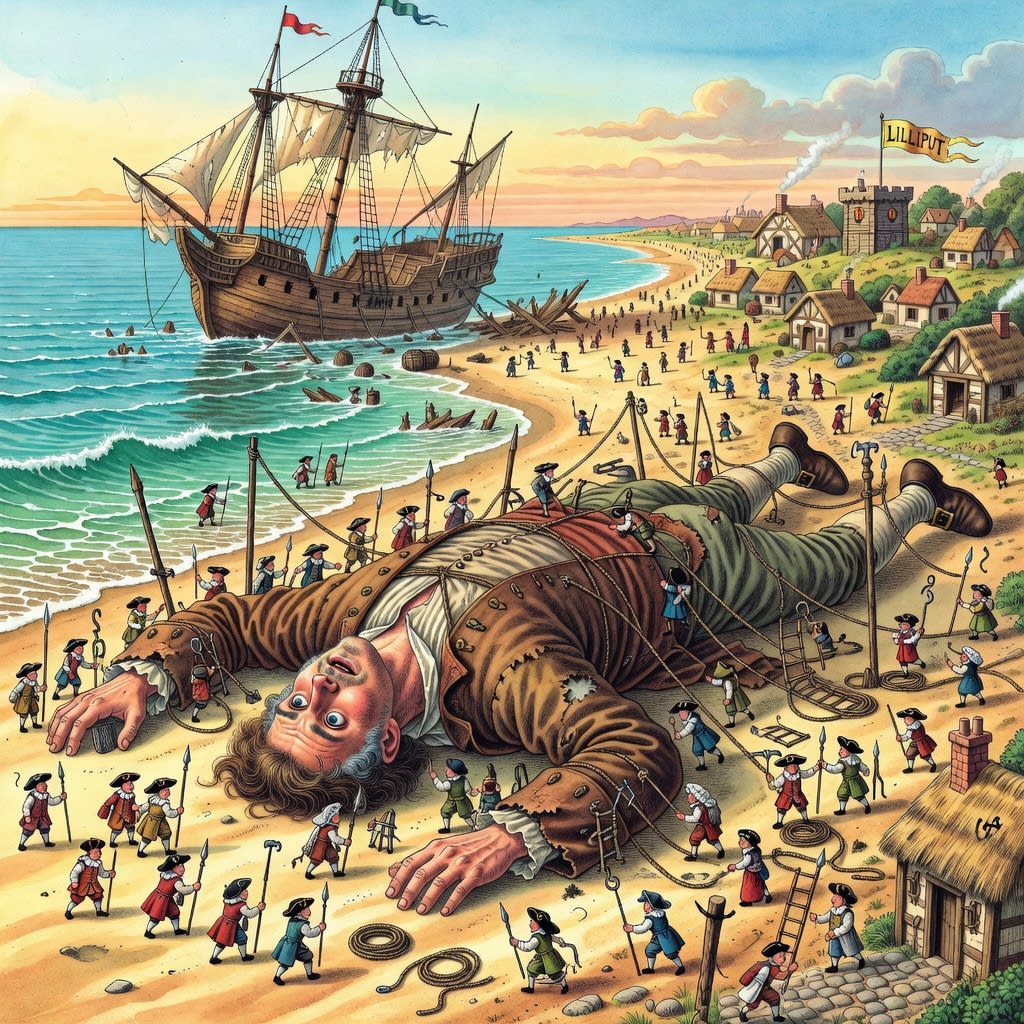
But then I read Gulliver’s Travels, and suddenly I felt… small.
Not in a cute way. In a “what am I doing with my life?” way.
It started on a random night when I couldn’t sleep. My brain was doing its usual sprint—overthinking old conversations, replaying mistakes, building imaginary disasters like it was my full-time job. I picked up Gulliver’s Travels because I wanted something “classic,” something that sounded safe. Instead, it opened a door I didn’t realize was locked inside me.
I was halfway through the first part—where Gulliver keeps ending up in worlds that don’t match his expectations—when I felt this strange sting in my chest. How many times have I walked into a situation thinking I would be the same person there, only to discover the place changes you? How many times have I tried to hold my identity like it’s a steady object, when really it’s more like a balloon—floating until the air runs out?
The thing about Gulliver is that he’s not just traveling. He’s constantly being measured by other people’s rules. One world makes him a giant. Another makes him tiny. And every time, he has to decide what to do with his pride.
I’ve been learning that lesson the hard way.
There was a season when I switched jobs and told everyone—mostly to convince myself—that I was fine. I smiled a lot. I nodded in meetings. I pretended I knew what I was doing. But inside, I felt like Gulliver in a room full of people who could suddenly see the size of my confidence. Like they knew exactly where I was bluffing.
Every mistake felt bigger than it should’ve. Every “quick question” from someone more experienced felt like a spotlight. I’d leave work exhausted, not because I did anything terrible, but because I was constantly translating myself. Not just my ideas—me.

And here’s the uncomfortable truth: the first reflective moment hit me when I realized I wasn’t comparing my work to other people’s work. I was comparing my worth to their certainty. I was acting like their comfort was proof that they were better, even though they were just further along in their story.
Isn’t it wild how quickly we turn our feelings into facts?
When I kept reading, Gulliver’s journeys felt less like fantasy and more like a mirror. He arrives in each place with an expectation, and the world answers him in its own language. Sometimes he’s treated with wonder. Sometimes with suspicion. Sometimes with cruelty.
But the part that got under my skin was how often he tries to win people over by explaining himself. He wants to be understood. He wants his explanation to fix the mismatch. He wants the world to agree that he’s reasonable.
I recognized that urge.
I’ve done that in relationships too. I’ve tried to “make sense” of my feelings so someone would stop judging them. I’ve written long messages in my head. I’ve rehearsed my tone. I’ve tried to be so clear that nobody could misunderstand me.
And yet—people still do.
That second reflective moment came while I was reading about Gulliver trying to navigate social power in unfamiliar places. It made me think about the way I used to chase approval like it was oxygen. I’d rather be exhausted from trying to fit in than risk being seen as awkward, wrong, or simply different.
So I did something small, almost laughably small, but it mattered. The next time I felt myself spiraling into “perform mode,” I stopped. I didn’t give a perfect explanation. I didn’t over-justify. I just said the truest thing I could manage in that moment: “I’m not totally sure, but I’m learning.”
It felt like stepping onto a tightrope with no safety net. I expected judgment to hit me like a wave.
Instead, something softer happened. The pressure eased. I wasn’t suddenly perfect, but I wasn’t alone in the room with my fear anymore. I could breathe.
I kept reading, and Gulliver kept colliding with people who had different standards. The satire—how he’s both amazed and disgusted, both impressed and humbled—kept pulling me forward. I started noticing how each world exposes a different part of human behavior. Not just the behavior of the “other” people, but the behavior I carried into every situation.
Because that’s the real conflict, isn’t it? Gulliver isn’t only fighting new environments. He’s fighting his own need to be the main character.
And I know that need. I’ve had it dressed up as ambition. I’ve had it disguised as independence. Sometimes it shows up as humor, like I’m brave enough to laugh while I’m secretly terrified.
There were days after work when I’d sit on my couch and scroll until my mind felt numb. I’d tell myself it was rest, but it was really me avoiding the harder work of facing my doubts. Reading Gulliver’s Travels became a kind of interrupt button. Every time I wanted to numb out, I’d open the book and suddenly my thoughts had somewhere to go besides my own chest.
It’s strange—there’s something comforting about watching a character stumble through unfamiliar worlds. It reminds you that confusion isn’t failure. It’s proof you’re still in the middle of becoming.
So when I think about Gulliver now, I don’t just think about giants or tiny people. I think about the moments in my own life when I felt too much or not enough. When I walked into a new room and instantly started shrinking myself to fit someone else’s idea of “normal.”
And then—slowly—I started getting curious instead of scared.
What would it look like to enter new situations like I’m learning, not auditioning? What if I stopped using my discomfort as evidence that I don’t belong?
I don’t have a dramatic transformation story. I didn’t wake up one morning with confidence glowing out of my pores. Growth, for me, has been more like a series of small choices I make when nobody’s watching. A sentence I choose not to say. A boundary I finally honor. A fear I don’t feed with an explanation that won’t change anything.
The book didn’t fix me. It just gave my messy feelings a shape.
And maybe that’s what great stories do when you let them. They don’t hand you a lesson like a receipt. They let you feel your own life in a stranger’s words until you recognize yourself—and then, if you’re lucky, you become a slightly kinder version of who you were before you opened the page.
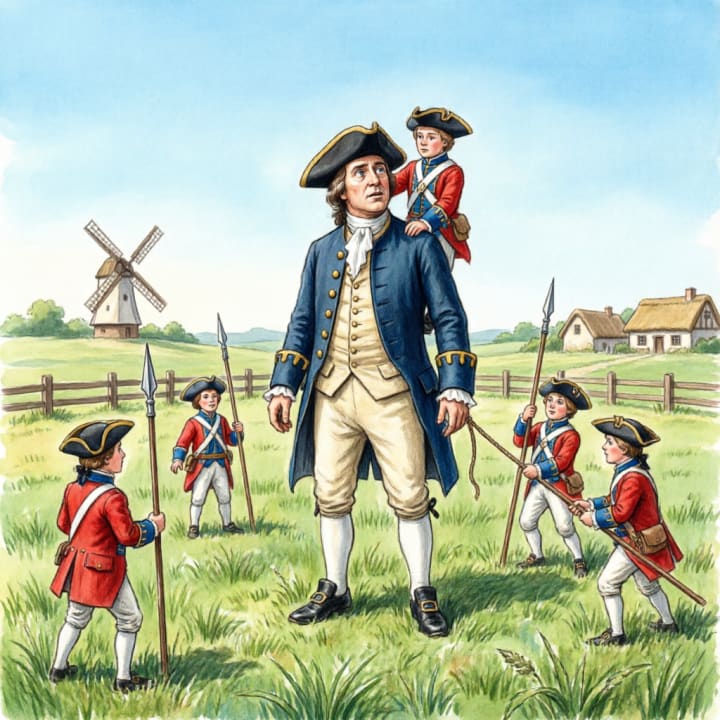
When I finished Gulliver’s Travels, I sat quietly for a while. Not because it was perfect. Because it was honest. Gulliver’s journeys show how easy it is to judge from the outside, and how hard it is to admit you’re also making assumptions with every step you take.
And I realized something that still makes me emotional, even now: I don’t have to be the biggest person in the room. I just have to keep traveling toward the truth, even when my reflection changes depending on where I stand.
So tell me—where are you feeling “too small” or “too much” lately? And what would happen if, for one day, you stopped arguing with the world and started learning its language?
About the Creator
John Smith
Man is mortal.
Keep reading
More stories from John Smith and writers in Geeks and other communities.
Congratulations!
That’s what the email said. One word. An exclamation mark. And suddenly, my chest felt tight instead of light. I had been waiting for that message for months. Refreshing my inbox like it owed me something. Imagining the moment it would finally arrive—the rush, the relief, the feeling that everything I’d been working toward had finally paid off.
By John Smithabout 23 hours ago in Geeks
The Politics of Playing Dress-Up
Well, to start off I'd like to say a happy world book day to all who celebrate. I know I haven't really posted anything on my socials about it but I'm not a jubilant kind of person. I lay low most of the time. Let's start off with a popular anecdote from the vaults...
By Annie Kapur20 days ago in Geeks




Comments
There are no comments for this story
Be the first to respond and start the conversation.