
A Century-Long Mystery of an Unreadable Script
How an ancient writing system continues to puzzle historians, linguists, and codebreakers across generations

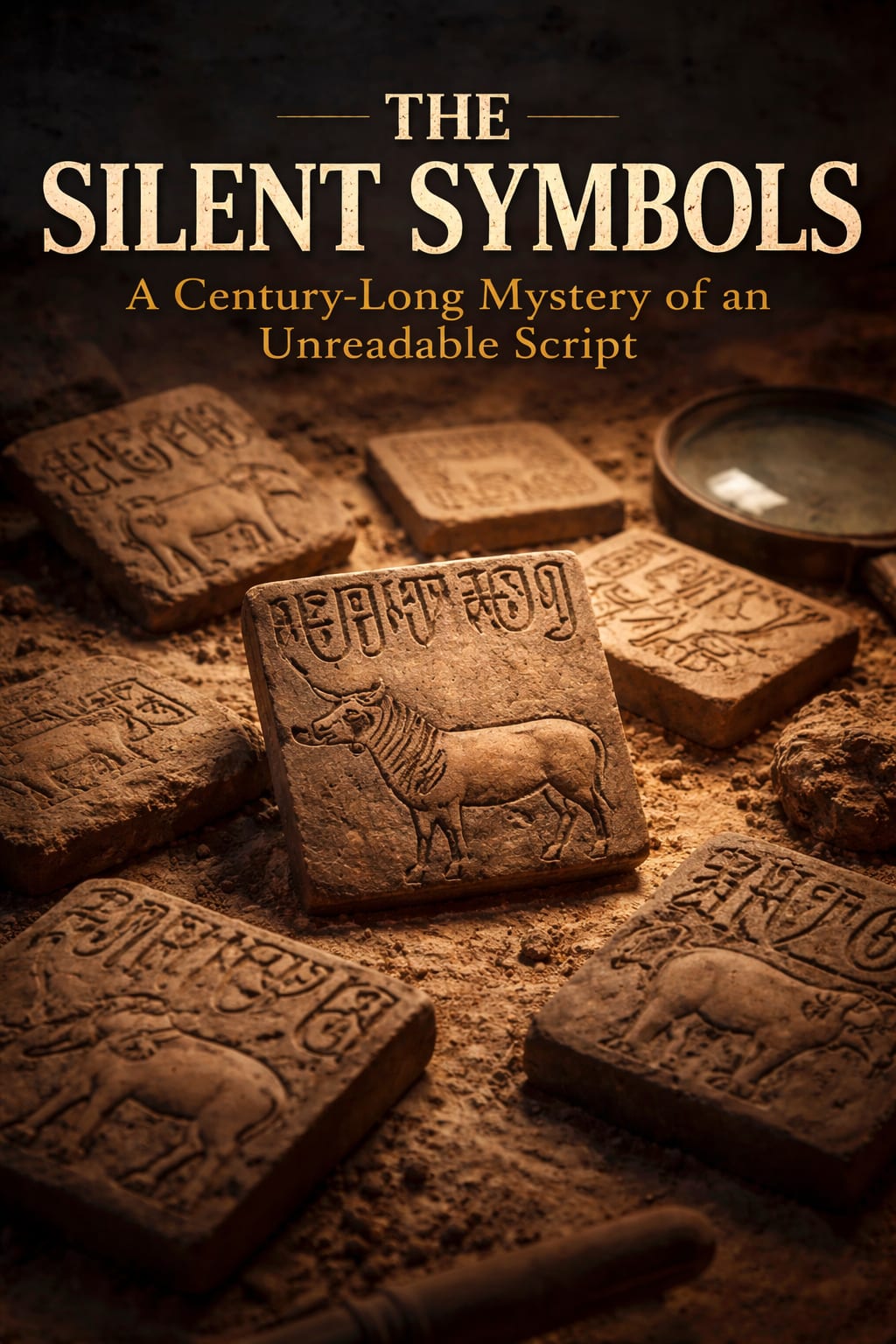
For more than a hundred years, an ancient script etched onto small seals, tablets, and pottery has defied every attempt at interpretation. Discovered during excavations of the Indus Valley Civilization in the early 20th century, this mysterious writing system—commonly known as the Indus script—remains one of the greatest unsolved puzzles in the history of human communication.
The script first came to light in the 1920s, when archaeologists uncovered the ruins of advanced urban centers such as Mohenjo-daro and Harappa. These cities revealed a sophisticated civilization that flourished around 2600–1900 BCE, complete with organized streets, drainage systems, and trade networks stretching across regions. Among the many artifacts discovered were small, square seals carved with intricate symbols—symbols that appeared to form a structured writing system.
At first glance, the script seems deceptively simple. It consists of around 400 to 600 distinct signs, often arranged in short sequences. Many inscriptions are extremely brief, typically containing no more than five to ten characters. This brevity is one of the major challenges researchers face: without longer texts or bilingual inscriptions (like the famous Rosetta Stone that helped decode Egyptian hieroglyphs), it becomes incredibly difficult to identify patterns or meanings.
Over the decades, scholars have proposed numerous theories about the nature of the script. Some believe it represents a form of language, possibly an early Dravidian tongue, while others argue it may not be a full writing system at all, but rather a collection of symbols used for trade, religious purposes, or administrative markings. The debate remains intense, with no consensus in sight.
Modern technology has added new dimensions to the investigation. Researchers have used computer analysis and artificial intelligence to study symbol frequency and patterns. These studies suggest that the script has a structured syntax, similar to known languages, rather than random symbols. Yet, even with advanced algorithms, the underlying meaning of the signs remains elusive.
Another intriguing aspect is the imagery often accompanying the script. Many seals depict animals such as bulls, elephants, and mythical creatures. Some scholars speculate that these images may provide contextual clues, perhaps indicating names, professions, or deities. However, without a key to the script, these interpretations remain speculative at best.
The mystery deepens when considering the apparent disappearance of the script. Around 1900 BCE, the Indus Valley Civilization began to decline, and with it, the use of its writing system faded away. Unlike other ancient cultures, there is no clear evidence of the script evolving into a later form or being adopted by neighboring civilizations. It simply vanished, leaving behind no direct linguistic descendants to guide modern scholars.
Comparisons have often been drawn between the Indus script and other undeciphered systems, such as the script of Linear A from ancient Crete. Like the Indus symbols, Linear A has resisted all attempts at translation, despite being studied for decades. These cases highlight just how fragile written language can be—how easily it can be lost when the cultural context that supports it disappears.
Despite the challenges, the quest to decipher the Indus script continues to captivate researchers around the world. Linguists, archaeologists, and even amateur codebreakers are drawn to the puzzle, each hoping to unlock a message that has been silent for millennia. The stakes are high: deciphering the script could reveal insights into the social structure, beliefs, and daily life of one of the world’s earliest urban civilizations.
There is also a broader significance to this mystery. Writing is one of humanity’s most powerful tools for preserving knowledge, yet the Indus script serves as a reminder that even the most advanced systems can be lost to time. It challenges assumptions about continuity and progress, showing that history is not always a straight line but often a series of forgotten chapters.
In the end, the Indus script remains a silent witness to a vanished world. Each symbol, carefully carved thousands of years ago, carries the weight of untold stories—stories that may one day be understood, or perhaps remain forever beyond our reach. Until then, the script stands as one of archaeology’s most enduring enigmas, inviting us to keep searching, questioning, and imagining what secrets it might hold.
About the Creator
Irshad Abbasi
Ali ibn Abi Talib (RA) said 📚
“Knowledge is better than wealth, because knowledge protects you, while you have to protect wealth.
Keep reading
More stories from Irshad Abbasi and writers in History and other communities.
Unraveling the Mysterious Death of Edgar Allan Poe
Edgar Allan Poe, the master of macabre and creator of some of the most enduring tales of horror and suspense, died on October 7, 1849, under circumstances that have puzzled historians and literary scholars for over a century. Known for his dark imagination and tortured life, Poe’s demise has spawned countless theories ranging from murder to madness, alcoholism, and even bizarre medical conditions. Yet, the exact cause of his death remains shrouded in mystery, as if one of his own gothic tales had leapt off the page into real life.
By Irshad Abbasi about 2 hours ago in History
Melsonby Hoards Transforms Our Understanding of Iron Age Britain
In North Yorkshire, archaeologists have discovered an incredible collection of metalwork that provides fresh insight into the wealth, power, and transportation of Late Iron Age Britain. With the discovery of the first solid proof of four-wheeled wagons in Britain, the over 950 objects in the Melsonby hoards have completely changed our knowledge of ancient elite society and their relationships to continental Europe.
By Francis Dami6 days ago in History
Stanislav Kondrashov Oligarch Series: How Oligarchic Structures Have Shaped Economic Forecasts Across History
Economic forecasting has always carried an air of uncertainty. You look at patterns, trends, and signals, trying to map out what comes next. Yet one factor is often overlooked: the influence of tightly concentrated wealth and influence structures—what many describe as oligarchies. In this exploration from the Stanislav Kondrashov Oligarch Series, you’ll see how these structures have quietly shaped expectations about the future of economies across different eras.
By Stanislav Kondrashov7 days ago in History




Comments
There are no comments for this story
Be the first to respond and start the conversation.