
“Alone in the Death Zone”
“Alone in the Death Zone — Where every breath is a negotiation with death, and silence answers back louder than the wind.”

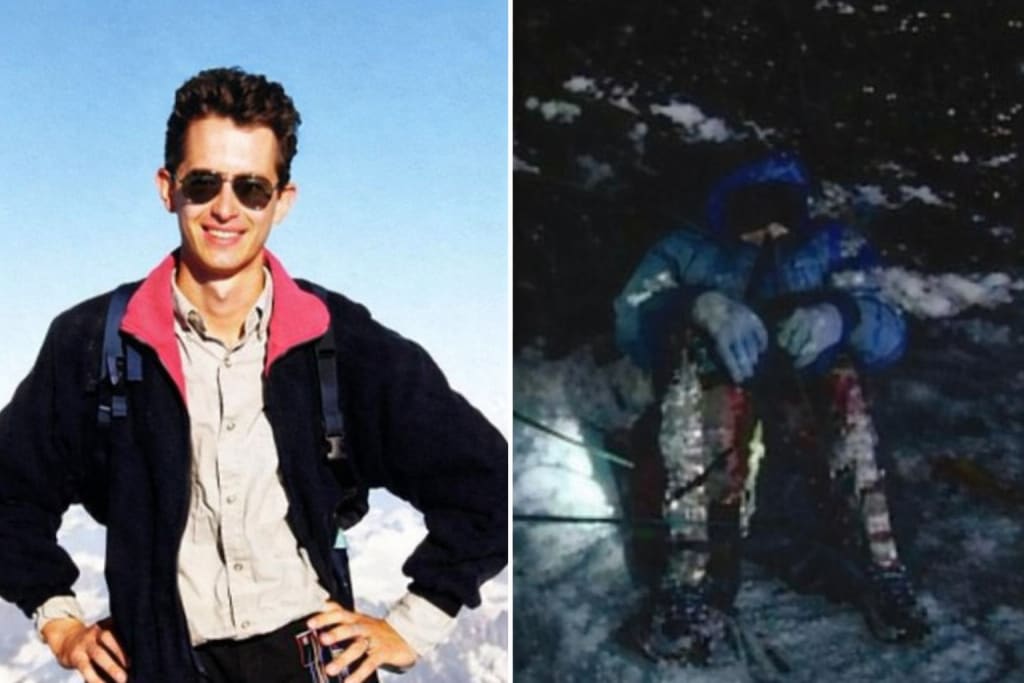
The silent tragedy of David Sharp on the slopes of Mount Everest
High above the world, where the air becomes too thin to breathe and the sky turns a darker shade of silence, lies a place climbers fear most—the Death Zone. It begins above 8,000 meters on Mount Everest, where even the strongest bodies start to shut down, and every step feels like a negotiation with fate.
This is the story of one man who reached that line alone—and never came back.
His name was David Sharp.
David Sharp was not a famous mountaineer chasing headlines or glory. He was a quiet, determined climber with a simple dream: to stand on the highest point on Earth. For him, Everest was not about competition—it was about personal achievement, about proving to himself that he could do something extraordinary in a world that often felt ordinary.
In 2006, he made his attempt.
He joined an expedition to climb Everest without the support systems that elite climbers often rely on. It was not an easy path. Everest demands respect, preparation, and perfect timing. Every decision on the mountain can become a matter of life and death. And at those extreme altitudes, even small mistakes are magnified into irreversible consequences.
As Sharp climbed higher, the mountain began to strip away everything—strength, clarity, warmth, and time itself. The higher he went, the more the world below felt like a distant memory.
Above 8,000 meters, the air holds only a third of the oxygen available at sea level. This is the Death Zone, where the human body is no longer designed to survive for long. Climbers describe it as walking inside a dream that slowly turns against you. Thinking becomes slower. Movements become heavier. Every breath feels borrowed.
On his descent—or what should have been his descent—David Sharp collapsed inside a narrow rocky shelter known among climbers as “Green Boots Cave,” a name given after a long-deceased climber who had died there years earlier. It was a place already marked by silence, and now it would witness another.
Other climbers passed him.
Some were exhausted, some were focused on survival, and some believed he was already beyond help. In the Death Zone, every second is a decision between helping someone else or saving yourself. The line between compassion and survival becomes painfully thin.
Sharp sat there, alone, as the wind carved invisible edges into the mountain. His oxygen was gone. His body was weakening rapidly. Around him, the world kept moving upward and downward, but for him, time had almost stopped.
A few climbers reported seeing him alive, moving slightly, his presence unmistakable in that frozen corridor of rock and ice. But the altitude does something cruel to the mind—it blurs urgency, dulls reaction, and convinces even the strongest that there may be no time left to intervene.
And so the mountain kept him.
Hours passed. Then more.
The Death Zone does not rush. It waits.
David Sharp eventually died where he sat, alone, in one of the most unforgiving environments on Earth. No dramatic final words. No rescue helicopter. Just silence, wind, and the endless white horizon of Everest stretching beyond human judgment.
His death later sparked global debate. People questioned responsibility, ethics, and what climbers owe each other at extreme altitude. Should someone risk their life to save another when survival margins are already so thin? Or does the mountain erase those obligations entirely?
There are no simple answers.
What remains is a haunting truth: Everest is not just a mountain of stone and snow. It is a place where human limits are tested until they break—and sometimes, where humanity itself is tested too.
David Sharp’s story is not only about death. It is about isolation at the edge of existence, where even surrounded by climbers, a person can still be completely alone.
And in the Death Zone, being alone is often the most dangerous thing of all.
About the Creator
Keep reading
More stories from imtiazalam and writers in History and other communities.
Giants of the Ancient Jungle: Dinosaurs’ Reign and Extinction
Imagine stepping into a misty prehistoric jungle where the ground trembles beneath your feet. Towering conifers and giant ferns stretch toward the sky, forming a dense green canopy under a warm, humid climate. Strange sounds echo through the forest—deep roars, snapping branches, and the distant thunder of massive footsteps. In this ancient world, survival is a constant struggle.
By imtiazalam16 days ago in History
Satwa Dubai: A Brief Overview
Satwa Dubai is one of the most unique areas in the city, where the past and present exist side by side in a very natural and visible way. While Dubai is known for luxury buildings and modern development, Satwa represents a simpler and more grounded lifestyle that continues to thrive.
By Backlinks Cart4 days ago in History
You Should Stop Trying to Be a Better Person
A year ago, I spent two days in the Colombian mountains drinking ayahuasca as part of a spiritual ceremony. An experience that pulled apart every detail of my being and rearranged me in a new sequence. I wish that life became easier after the feat. It didn’t.
By Annaise Michelle5 days ago in Humans


Comments
There are no comments for this story
Be the first to respond and start the conversation.