
Harry Houdini’s Unlikely Last Act
How the world’s greatest escape artist devoted his final years to exposing spiritualist frauds and defending truth

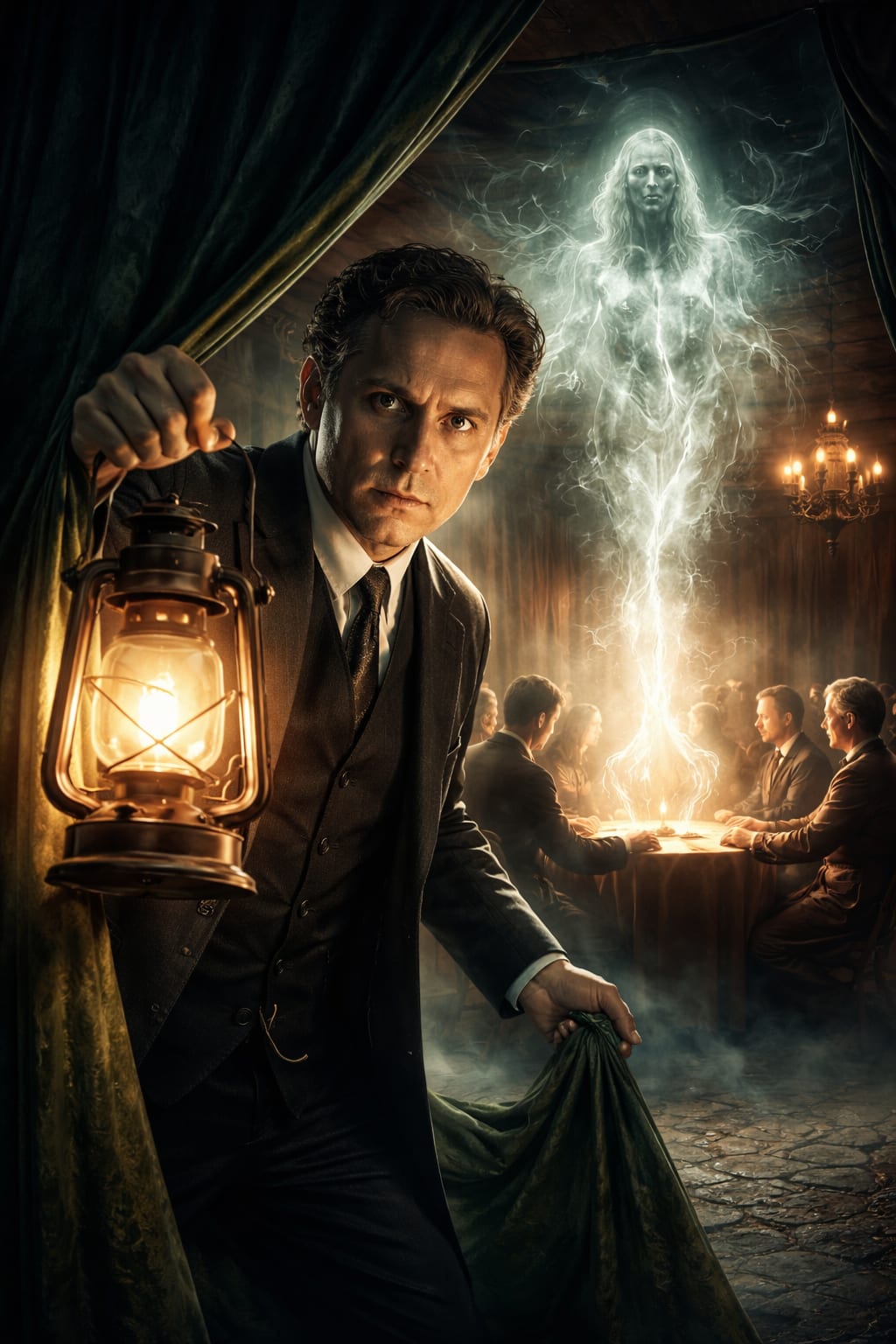
In the public imagination, Harry Houdini remains the ultimate master of illusion—an entertainer who could slip chains, vanish from locked boxes, and defy death itself. Yet, in the final chapter of his life, Houdini turned his talents in a surprising direction. Rather than dazzling audiences with tricks, he set out to dismantle deception. His target was not rival magicians, but the booming spiritualist movement that claimed to bridge the gap between the living and the dead.
The early 20th century was a fertile period for spiritualism. In the aftermath of World War I, grief-stricken families longed for contact with lost loved ones. Mediums and séances became increasingly popular, offering messages from beyond the grave—often for a price. To many, these practices offered comfort. To Houdini, they represented exploitation.
Houdini’s skepticism was rooted in both personal and professional experience. Having mastered illusion himself, he understood how easily audiences could be misled. Tricks involving hidden compartments, sleight of hand, and psychological manipulation were his bread and butter. When he attended séances, he recognized similar techniques being used—not for entertainment, but under the guise of supernatural power.
His crusade became deeply personal after the death of his beloved mother, Cecilia. Devastated, Houdini briefly hoped that spiritualism might offer genuine contact. But repeated encounters with fraudulent mediums hardened his stance. Instead of finding solace, he found what he believed to be deception. From that point on, he committed himself to exposing the truth.
Houdini began attending séances in disguise, carefully observing mediums at work. He would later reveal their methods in lectures, books, and demonstrations. One of his key arguments was simple: if a medium could truly communicate with the dead, their abilities should withstand scientific scrutiny. Yet time and again, he demonstrated that their feats could be replicated through ordinary means.
His campaign brought him into direct conflict with prominent figures, including Arthur Conan Doyle, the creator of Sherlock Holmes. Doyle was a passionate believer in spiritualism and saw Houdini’s abilities as proof of supernatural forces, rather than skill. Their friendship deteriorated as Houdini publicly debunked claims that Doyle held dear. The clash highlighted a broader cultural divide between belief and skepticism in an era grappling with loss and uncertainty.
Houdini did not limit his efforts to public performances. He collaborated with organizations such as Scientific American, which offered a monetary prize to anyone who could demonstrate genuine psychic ability under controlled conditions. Despite numerous attempts, no medium succeeded. Houdini’s involvement lent credibility to the investigation and reinforced his argument that spiritualist phenomena were the result of trickery rather than the supernatural.
Ironically, Houdini’s fame as a magician sometimes worked against him. Believers argued that his debunking efforts were themselves part of a grand illusion or that he possessed powers he refused to acknowledge. This paradox underscored the challenge he faced: convincing people to abandon comforting beliefs in favor of uncomfortable truths.
As his campaign intensified, Houdini’s public image began to shift. No longer just an entertainer, he became a defender of rational thinking. His lectures often blended showmanship with education, demonstrating how easily the human mind could be fooled. He emphasized critical thinking, urging audiences to question extraordinary claims.
Houdini’s final years were marked by relentless travel and advocacy. Despite declining health, he continued to perform and speak out against fraud. His dedication came at a cost, both physically and emotionally. Yet he remained unwavering in his mission to protect vulnerable individuals from exploitation.
When Houdini died in 1926, his legacy was already firmly established—not only as a pioneer of magic, but as a fierce critic of deception. In a poignant twist, he left behind a secret code with his wife, Bess, promising that if communication from the afterlife were possible, he would use it. For ten years after his death, Bess held séances on the anniversary of his passing. No message ever came.
Houdini’s unlikely last act was not an escape from chains or water tanks, but a confrontation with belief itself. By turning his skills toward exposing fraud, he challenged a society eager for miracles. In doing so, he left behind a legacy that extended beyond entertainment—a reminder that even in times of grief, truth deserves its own spotlight.
About the Creator
Irshad Abbasi
Ali ibn Abi Talib (RA) said 📚
“Knowledge is better than wealth, because knowledge protects you, while you have to protect wealth.
Keep reading
More stories from Irshad Abbasi and writers in History and other communities.
Cracking the Silence — A New Approach to Solving History’s Greatest Cold Case
For decades, it has stood as one of history’s most haunting mysteries—a cold case that resisted every attempt at resolution. Investigators came and went, theories flourished and faded, and yet the truth remained elusive, buried beneath time, lost evidence, and fading memories. Now, in an era defined by technological breakthroughs and renewed investigative strategies, experts believe the case may finally be solvable.
By Irshad Abbasi about 16 hours ago in History
The World’s BIGGEST Airplane & Its Crazy Transport Network
The Giant's Journey: How Airbus Transports the World's Largest Planes Airbus is a European powerhouse, producing nearly three aircraft every single day. But there is a massive catch: the parts for these planes are manufactured in different countries—wings in the UK, tails in Germany and Spain, and fuselage sections in France. Bringing them all to the final assembly line in Toulouse, France, is one of the most complex transport puzzles in the world.
By Imran Ali Shah3 days ago in History
The Irony of Flying While We Bomb the "World's Greatest Terror Regime"
Ah, the irony of flying at this moment in time as the United States is simultaneously bombing Iran - the nation officials have insisted for decades is "The World's Greatest Terror Regime" - while the TSA is on a go-slow, courtesy of a funding squeeze that's left its officers unpaid, quitting in droves, and turning checkpoints into something like slow-moving bread lines.
By Scott Christenson🌴8 days ago in Humor



Comments
There are no comments for this story
Be the first to respond and start the conversation.