
Making Sense of the Pyramids’ Enduring Mysteries
Unraveling the secrets behind ancient Egypt’s most iconic structures and the questions that still puzzle historians

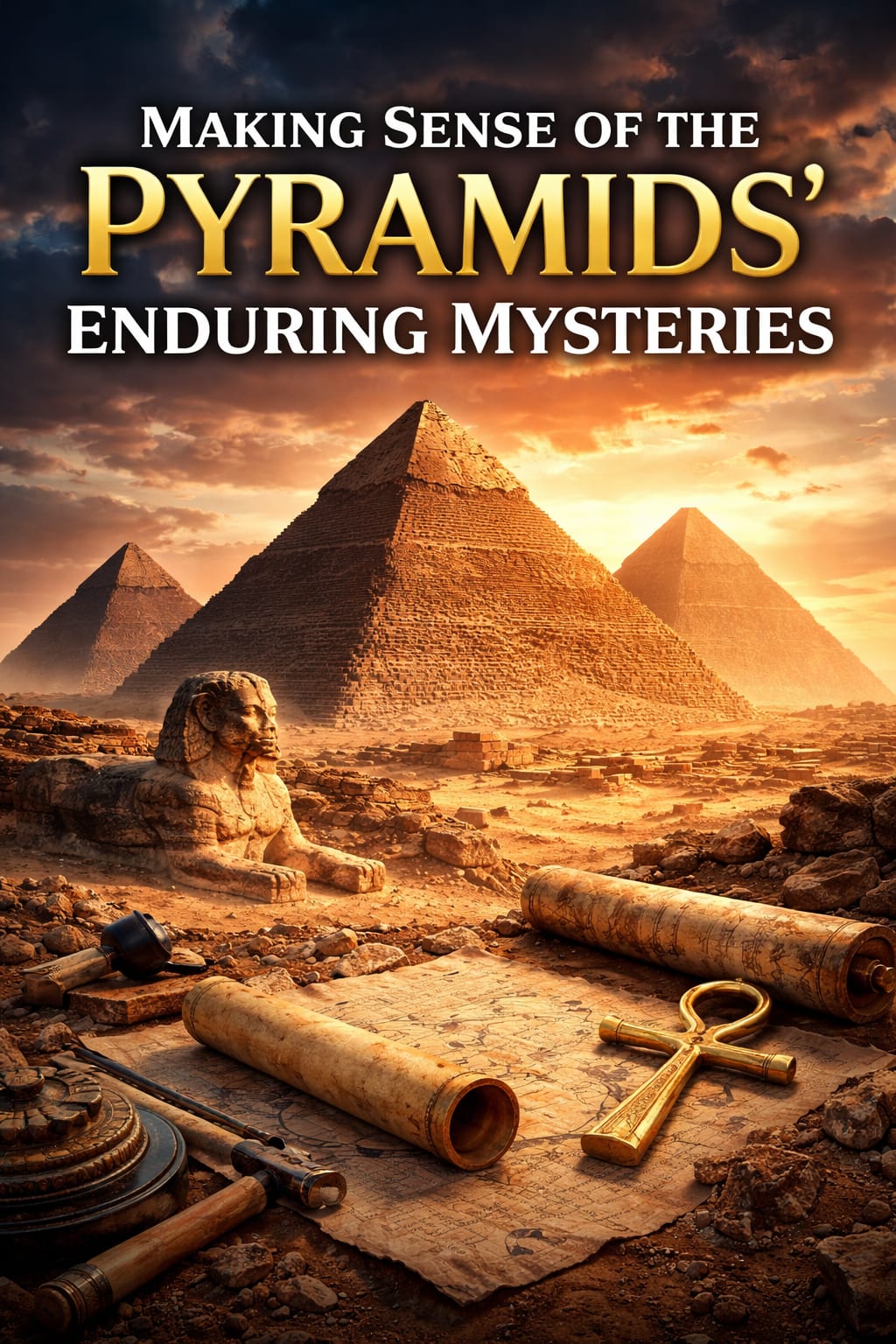
Few structures in human history inspire as much awe and curiosity as the pyramids of ancient Egypt. Towering above the desert sands for thousands of years, these monumental creations—especially the Great Pyramid of Giza—have become symbols of both human ingenuity and enduring mystery. Despite centuries of study, many aspects of their construction, purpose, and meaning continue to spark debate among historians, archaeologists, and enthusiasts alike.
The most widely accepted explanation is that the pyramids served as tombs for Egypt’s pharaohs. Built during the Old Kingdom period, particularly under rulers like Khufu, Khafre, and Menkaure, these structures were intended to ensure a safe passage into the afterlife. Ancient Egyptian beliefs centered on immortality, and the pyramid was seen as a stairway to the heavens. The burial chambers, often hidden deep within the structures, were filled with treasures, inscriptions, and items meant to assist the deceased ruler in the next world.
Yet, even with this understanding, questions remain. One of the most persistent mysteries concerns how these massive structures were built with such precision. The Great Pyramid alone consists of approximately 2.3 million stone blocks, some weighing several tons. Without modern machinery, how did ancient workers manage to transport and position these stones so accurately?
Traditional theories suggest the use of ramps, sledges, and a highly organized labor force. Evidence indicates that thousands of skilled workers—not slaves, as once believed—labored in teams, supported by a sophisticated system of logistics and planning. Recent archaeological discoveries, including worker villages and tools, have shed light on the daily lives of those who built the pyramids. However, the exact methods used to achieve such precise alignment and structural stability are still debated.
Another fascinating aspect is the pyramids’ alignment with celestial bodies. The sides of the Great Pyramid are almost perfectly aligned with the cardinal directions—north, south, east, and west. Some researchers argue that this reflects the ancient Egyptians’ advanced understanding of astronomy. The positioning of certain internal shafts has also been linked to specific stars, suggesting a spiritual or symbolic connection between the pharaoh and the cosmos.
This cosmic alignment has led to more speculative theories over time. Some have proposed that the pyramids were designed as energy generators or even built with the assistance of extraterrestrial beings. While such ideas capture the imagination, they lack credible evidence and are not supported by mainstream scholarship. Instead, most experts emphasize the remarkable capabilities of ancient Egyptian civilization, which combined engineering skill, religious devotion, and centralized authority to achieve these feats.
The purpose of the pyramids also continues to evolve in scholarly interpretation. While they are primarily understood as tombs, their role as symbols of political power and cultural identity is equally significant. Constructing a pyramid was not just about honoring a ruler in death; it was also a demonstration of the pharaoh’s divine status and the الدولة’s organizational strength. These structures served as lasting monuments to the ruler’s legacy, visible for miles across the landscape.
Modern technology has opened new doors in the study of the pyramids. Techniques such as ground-penetrating radar and muon tomography have revealed hidden voids and previously unknown internal spaces within the Great Pyramid. These discoveries hint that there may still be secrets waiting to be uncovered, challenging long-held assumptions and inviting further exploration.
Despite all that has been learned, the pyramids continue to captivate us because they represent both what we know and what we have yet to understand. They are a testament to human ambition and creativity, standing as a bridge between the ancient and modern worlds. Each new discovery adds another piece to the puzzle, but also raises new questions.
In the end, the enduring mystery of the pyramids is part of their allure. They remind us that even in an age of advanced technology and information, the past still holds secrets that resist easy explanation. As researchers continue to investigate, one thing remains certain: the pyramids of Egypt will continue to inspire wonder for generations to come.
About the Creator
Irshad Abbasi
Ali ibn Abi Talib (RA) said 📚
“Knowledge is better than wealth, because knowledge protects you, while you have to protect wealth.
Keep reading
More stories from Irshad Abbasi and writers in History and other communities.
The Vikings Who Vanished
The Vikings are often remembered as fierce warriors, fearless explorers, and skilled seafarers who left their mark across Europe and beyond. From raiding monasteries in England to establishing settlements in Iceland and even reaching North America centuries before Columbus, their legacy is both vast and remarkable. Yet among their many stories, one mystery continues to puzzle historians: the sudden disappearance of the Norse settlements in Greenland.
By Irshad Abbasi 5 days ago in History
The Prophet's (PBUH) Hajj: A Detailed Account
The Prophet's (PBUH) Hajj: A Detailed Account The Prophet (PBUH) performed Umrah four times and Hajj once. A complete and meticulous account of his Hajj has reached us through his companions, with every minor detail captured in the following Hadith.
By Amir Husena day ago in History
Corinne Griffith (1894-1979)
By Brian D’Ambrosio Corinne Griffith, born November 21, 1894, in Waco, Texas, became one of the most admired figures of the silent film era, celebrated for her elegance, poise, and expressive subtlety on screen. Known as “The Orchid Lady of the Screen,” Griffith cultivated an image of refinement and emotional restraint that set her apart from her contemporaries. Beneath the Hollywood persona lay a Texas childhood shaped by her Italian ancestry and the civic prominence of her maternal family, whose accomplishments left a lasting impression on her sense of artistry, ambition, and cultural awareness.
By Brian D'Ambrosio 3 days ago in History



Comments
There are no comments for this story
Be the first to respond and start the conversation.