
Muhammad Shah “Rangila”: The Colorful Emperor of a Fading Empire
How the Mughal ruler earned the nickname “Rangila” and what his vibrant lifestyle meant for the declining Mughal Empire.

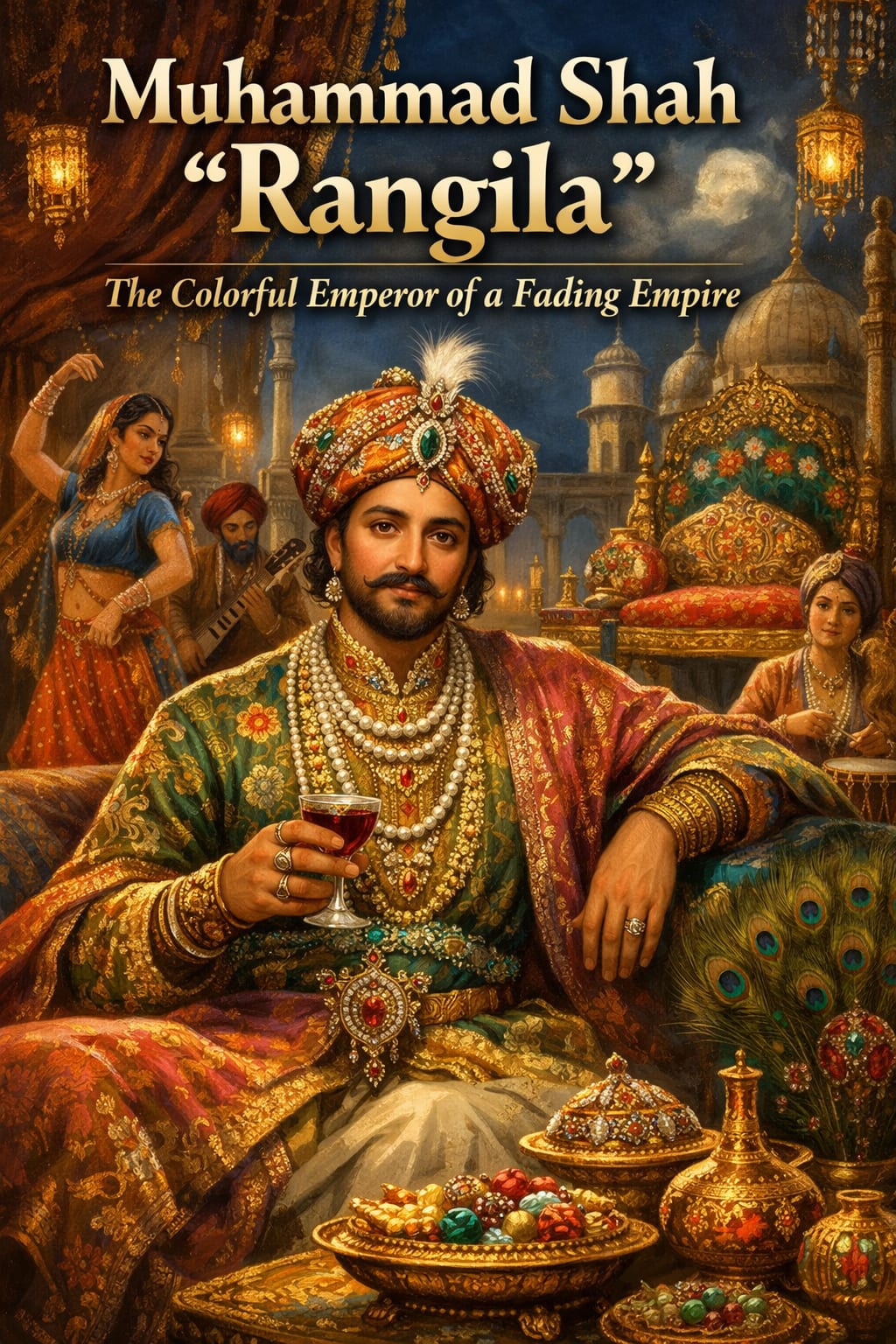
Among the later rulers of the Mughal Empire, Muhammad Shah Rangila stands out as one of the most colorful and controversial figures in South Asian history. Known for his love of music, dance, art, and luxury, he earned the nickname “Rangila,” meaning “the colorful” or “the pleasure-loving.” While his reign brought a cultural revival in some ways, it also coincided with a period of serious political decline in the Mughal Empire.
Muhammad Shah was born in 1702 and ascended the Mughal throne in 1719 at a young age. He was the son of Bahadur Shah I, and his rule came during a time when the Mughal Empire was already weakening. Powerful nobles, regional governors, and court factions were competing for influence. Early in his reign, Muhammad Shah was largely controlled by influential kingmakers known as the Sayyid Brothers, who dominated imperial politics.
However, after several years, Muhammad Shah managed to free himself from their control. In 1720, the Sayyid Brothers were defeated with the help of loyal nobles and military leaders. This allowed the emperor to exercise greater authority, but instead of focusing primarily on administrative reforms or military strengthening, Muhammad Shah became increasingly devoted to courtly pleasures and cultural pursuits.
The emperor’s court became famous for its vibrant artistic life. Muhammad Shah loved music, poetry, dance, and fine clothing. He was known to attend musical gatherings and dance performances regularly. Under his patronage, classical Indian music flourished, and many musicians and artists found support in the Mughal court. The emperor himself was said to appreciate and understand musical compositions deeply.
During his reign, the Mughal court in Delhi regained some of its cultural brilliance. Painters, poets, and performers thrived, and new styles of art and music developed. Some historians credit Muhammad Shah’s court with helping shape later traditions of North Indian classical music. His fondness for colorful garments, jewelry, and elaborate celebrations contributed to his nickname “Rangila.”
However, this glamorous lifestyle also earned him criticism from historians and contemporaries. Many believed that Muhammad Shah neglected the administrative and military responsibilities required to maintain such a vast empire. While the court enjoyed music and entertainment, the empire itself was fragmenting.
During his reign, several powerful regional states emerged. Leaders such as Nizam-ul-Mulk Asaf Jah I in the Deccan and the Maratha Confederacy increasingly asserted independence from Mughal authority. The central government in Delhi struggled to maintain control over distant provinces.
The most devastating event of Muhammad Shah’s reign occurred in 1739 when the Persian ruler Nader Shah invaded India. The Mughal army was defeated at the Battle of Karnal, exposing the weakness of the empire’s military leadership. Soon after, Nader Shah entered Delhi and carried out a brutal massacre and massive looting of the city.
This invasion was catastrophic for the Mughal Empire. The Persians seized enormous treasures, including the famous Peacock Throne and the legendary Koh-i-Noor diamond. The humiliation and financial loss greatly weakened Mughal prestige and power.
Despite these political disasters, Muhammad Shah continued to rule until his death in 1748. By the time he died, the Mughal Empire had lost much of its authority over India, although it still existed symbolically. His successor inherited a weakened state that would continue to decline in the following decades.
Historians often debate Muhammad Shah’s legacy. Some portray him as an irresponsible ruler who prioritized entertainment over governance, accelerating the fall of the Mughal Empire. Others argue that the empire’s decline had already begun long before his reign and that he simply ruled during a period when powerful regional forces were rising.
What cannot be denied is that Muhammad Shah left a lasting cultural imprint. His court helped preserve and promote artistic traditions that continue to influence South Asian music, dance, and aesthetics today. The nickname “Rangila” reflects both admiration for his artistic spirit and criticism of his indulgent lifestyle.
In the end, Muhammad Shah Rangila represents a fascinating contradiction: a ruler whose reign sparkled with cultural brilliance while the empire around him slowly crumbled. His story illustrates how luxury and art can flourish even in times of political decline, making him one of the most intriguing figures in the final chapter of the Mughal era.
About the Creator
Irshad Abbasi
Ali ibn Abi Talib (RA) said 📚
“Knowledge is better than wealth, because knowledge protects you, while you have to protect wealth.
Keep reading
More stories from Irshad Abbasi and writers in History and other communities.
When the British Challenged Aurangzeb Alamgir
The reign of Aurangzeb Alamgir (1658–1707) marked the last great expansion of the Mughal Empire, but it was also a period when new foreign powers were quietly testing the strength of the empire. Among these rising forces was the British East India Company, a commercial organization that had arrived in India with the intention of trade but gradually began to challenge the authority of the Mughal state.
By Irshad Abbasi about 20 hours ago in History


Comments
There are no comments for this story
Be the first to respond and start the conversation.