
Mystery of the Egyptian Pyramids: Has the Most Complex Puzzle Finally Been Solved?
New research and advanced technology offer fresh insights into how ancient builders constructed the massive pyramids thousands of years ago.

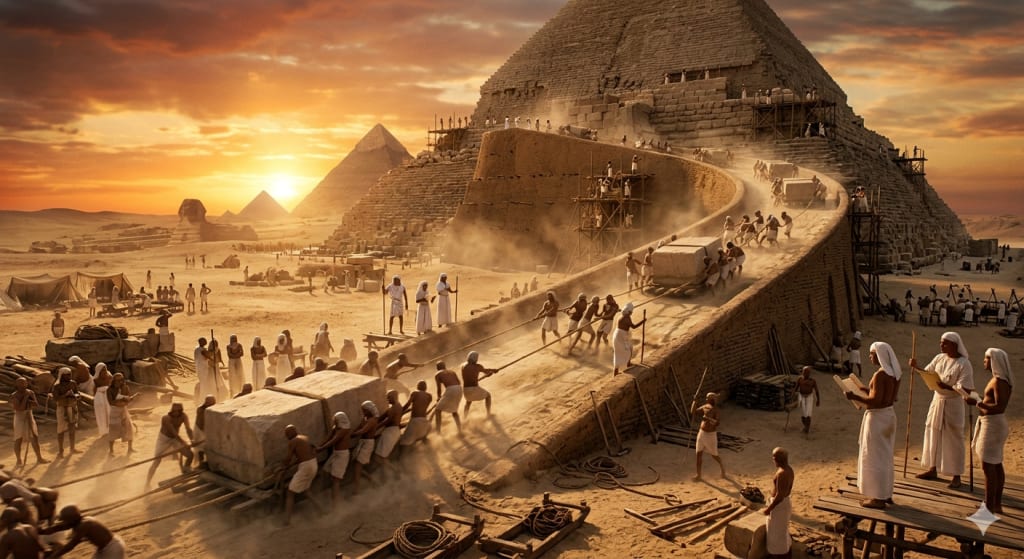
For centuries, the construction of the great pyramids of Egypt has been one of the world’s most fascinating historical mysteries. Towering above the desert sands near the ancient city of Giza, these monumental structures have puzzled historians, engineers, and archaeologists alike. How could a civilization that existed more than 4,500 years ago build such massive and precisely aligned structures without modern machinery?
Today, new discoveries and scientific research are bringing us closer than ever to understanding the secrets behind the construction of the pyramids—especially the most famous one, the Great Pyramid of Giza.
The Great Pyramid was built during the reign of the Egyptian pharaoh Khufu around 2560 BCE. It originally stood about 146 meters (481 feet) tall and was constructed using more than two million massive stone blocks, each weighing between 2 and 15 tons. For centuries, scholars debated how ancient workers managed to transport, lift, and place these enormous stones with such remarkable accuracy.
One of the most widely accepted theories today suggests that the pyramids were built using a complex system of ramps. These ramps allowed workers to drag heavy stone blocks from quarries to the construction site and gradually lift them as the pyramid grew taller. However, the exact design of these ramps remained uncertain for a long time.
Recent archaeological discoveries have strengthened the ramp theory. In 2018, researchers studying an ancient quarry at Hatnub Quarry discovered an innovative ramp system used by ancient Egyptian workers. The system included a central ramp flanked by staircases and post holes where wooden poles were placed. Workers likely used ropes wrapped around the poles to pull heavy stone blocks upward more efficiently.
This discovery provided the first clear evidence of how Egyptians could move massive stones up steep slopes. Experts believe similar techniques may have been used during the construction of the pyramids.
Another breakthrough came from a project known as ScanPyramids. Using advanced technologies such as thermal scanning, 3D imaging, and cosmic-ray muon detection, scientists examined the internal structure of the Great Pyramid without damaging it.
In 2017, the ScanPyramids team announced the discovery of a large hidden void inside the Great Pyramid. The space, often referred to as the “Big Void,” lies above the Grand Gallery and is believed to be at least 30 meters long. While researchers are still debating its exact purpose, some experts suggest it may have been designed to reduce structural pressure within the pyramid or could potentially lead to undiscovered chambers.
The discovery demonstrated that even after thousands of years of study, the pyramids still hold secrets waiting to be uncovered.
Another factor that helped explain pyramid construction is the discovery of ancient papyri belonging to an Egyptian official named Merer. These documents, known as the “Diary of Merer,” were discovered near the Red Sea in 2013. They describe how teams of workers transported limestone blocks by boat along the Nile River to the pyramid construction site.
According to these records, a large network of canals and waterways connected the Nile to the building site near Giza. Boats loaded with stone blocks were sailed through these channels, allowing builders to move heavy materials far more easily than transporting them entirely over land.
These discoveries together suggest that pyramid construction was not based on mysterious or supernatural methods, as some conspiracy theories claim. Instead, it was the result of remarkable organization, skilled labor, and ingenious engineering techniques developed by the ancient Egyptians.
Historians now believe that tens of thousands of workers—many of them skilled craftsmen and seasonal laborers rather than slaves—participated in the construction projects. Workers lived in organized communities near the construction site, where they received food, medical care, and housing while contributing to what was considered a sacred national project.
The pyramids were not only tombs for pharaohs but also symbols of divine power and national unity. Their construction reflected the Egyptians’ deep belief in the afterlife and their desire to ensure that their rulers could successfully journey into eternity.
Although many details of pyramid construction remain under investigation, modern archaeology and technology are steadily unraveling one of history’s greatest engineering mysteries. Each new discovery adds another piece to the puzzle, revealing the extraordinary capabilities of an ancient civilization that continues to inspire the modern world.
Even after thousands of years, the pyramids remain a powerful reminder that human ingenuity, determination, and cooperation can achieve wonders that stand the test of time.
About the Creator
Irshad Abbasi
Ali ibn Abi Talib (RA) said 📚
“Knowledge is better than wealth, because knowledge protects you, while you have to protect wealth.
Keep reading
More stories from Irshad Abbasi and writers in History and other communities.
Ancient Mummy from Luxor Tomb Put on Public Display in Egypt
Archaeologists in Egypt have unveiled a remarkable discovery from the historic region of Luxor—a well-preserved mummified body found inside an ancient tomb. The mummy, believed to be thousands of years old, has now been placed on public display, giving historians, scientists, and visitors a rare opportunity to observe an authentic relic of ancient Egyptian civilization.
By Irshad Abbasi 3 days ago in History
Who’s Secretly Behind Israel’s Power?
On 27 September 2024, in New York, during the United Nations General Assembly, when it was the turn of Israeli Prime Minister Benjamin Netanyahu to give his speech, more than half of the diplomats protested by turning their backs on him and walking out of the assembly. The message was very clear: they were protesting Israel’s bombing in Gaza and Lebanon.
By Imran Ali Shah4 days ago in History




Comments
There are no comments for this story
Be the first to respond and start the conversation.