
The Assassination of Lord Mountbatten: When India’s First Governor-General Was Killed by a Boat Bomb
The dramatic 1979 attack that ended the life of the last Viceroy of British India and shocked Britain and Ireland during the height of the IRA conflict.

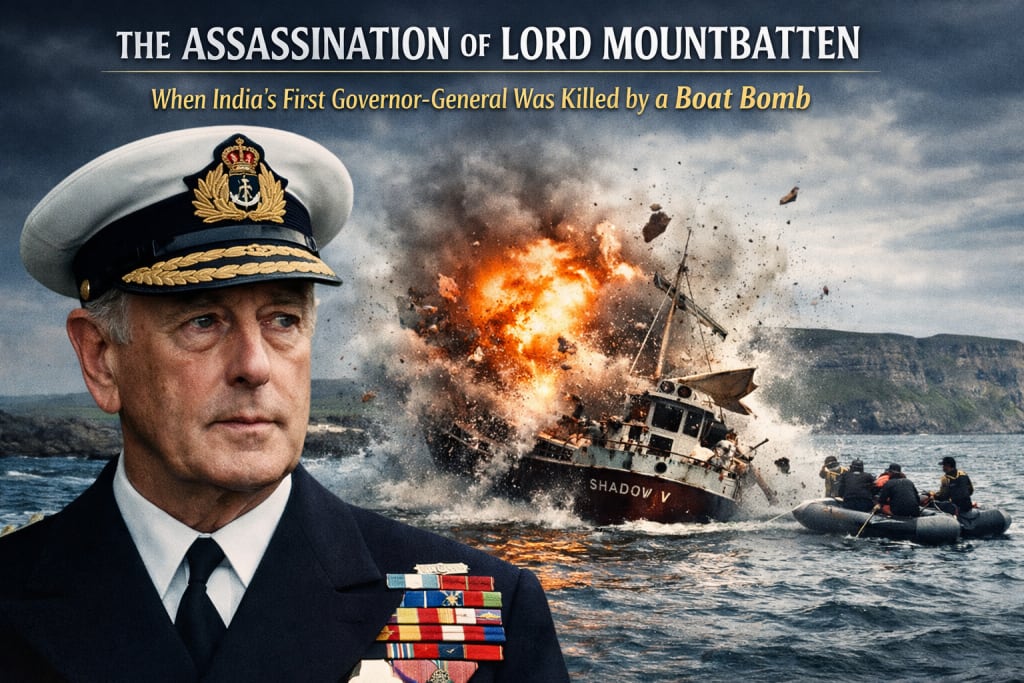
The assassination of Louis Mountbatten in 1979 was one of the most shocking acts of political violence in modern British history. A decorated naval officer, royal family member, and the last Viceroy of British India, Mountbatten had played a key role in overseeing the partition and independence of the Indian subcontinent in 1947. More than three decades later, his life ended in a violent attack when a bomb planted on his fishing boat exploded off the coast of Ireland.
The killing not only stunned the British royal family but also highlighted the intensity of the conflict known as The Troubles in Northern Ireland.
### A Royal Figure With Global Influence
Born in 1900, Louis Mountbatten was closely connected to the British royal family. He was the uncle of Prince Philip, the husband of Queen Elizabeth II, and a mentor to the young Prince Charles. Throughout his life, Mountbatten held important positions in the British military and government.
During World War II, he served as Supreme Allied Commander of the Southeast Asia Command, overseeing Allied operations against Japan. His leadership and influence made him one of Britain’s most prominent military figures.
In 1947, he was appointed the last Viceroy of British India. His mission was to manage the transition of power as Britain ended nearly two centuries of colonial rule. Mountbatten supervised the complex and controversial process that led to the creation of two independent states: India and Pakistan. After independence, he briefly served as the first Governor-General of independent India.
Although his role in the partition remains debated by historians, Mountbatten remained an influential figure in British public life long after leaving India.
### A Summer Holiday in Ireland
By the late 1970s, Mountbatten had retired from most public duties and spent summers at his holiday home in the small coastal village of Mullaghmore in County Sligo, Ireland.
On the morning of August 27, 1979, the 79-year-old aristocrat went out to sea on his fishing boat, the *Shadow V*. Accompanying him were several family members and local helpers, including his grandson and others enjoying the pleasant summer weather.
Unbeknownst to them, members of the Provisional Irish Republican Army (IRA) had secretly planted a powerful remote-controlled bomb on the boat during the night while it was docked in the harbor.
Shortly after the vessel left the shore and moved into open water, the bomb was detonated remotely from land.
### The Explosion That Shook Britain
The explosion was devastating. The blast ripped apart the small wooden fishing boat, throwing passengers into the water and scattering debris across the sea.
Mountbatten was severely injured and later died from his wounds. The attack also killed 14-year-old Nicholas Knatchbull, Mountbatten’s grandson, as well as Paul Maxwell, a local teenage crew member. Another elderly passenger, Lady Brabourne, later died from injuries sustained in the explosion.
The assassination sent shockwaves across the United Kingdom and beyond. Mountbatten was one of the most prominent figures ever targeted by the IRA, and his royal connections made the attack especially symbolic.
The killing happened on the same day the IRA carried out another deadly attack against British soldiers in Northern Ireland, further escalating tensions in the region.
### Why the IRA Targeted Mountbatten
The IRA claimed responsibility for the bombing shortly afterward. The organization was engaged in an armed campaign against British rule in Northern Ireland and sought to unite Ireland as a single independent state.
In a statement, the IRA described the assassination as an “execution” and argued that Mountbatten was a legitimate target because of his role in the British establishment and his past military leadership.
For the IRA, the killing served both a strategic and symbolic purpose. Mountbatten represented the British aristocracy, military authority, and imperial history—everything the organization opposed.
However, many observers condemned the attack as a brutal act of terrorism that killed innocent civilians.
### A Global Reaction
Leaders around the world reacted with shock and condemnation. Margaret Thatcher, the British Prime Minister at the time, described the attack as “a cowardly act of terrorism.” Members of the royal family were deeply affected, particularly Prince Charles, who had shared a close personal bond with Mountbatten.
Funeral ceremonies were held with full military honors, reflecting Mountbatten’s long service to the British armed forces. His death was mourned not only in Britain but also in many parts of the Commonwealth.
### A Symbol of a Violent Era
The assassination of Lord Mountbatten remains one of the most dramatic events associated with the conflict in Northern Ireland. It illustrated how far militant groups were willing to go in targeting symbols of British authority.
Although the conflict eventually moved toward peace with the Good Friday Agreement in 1998, the killing of Mountbatten remains a powerful reminder of the violence and political tensions that defined the era.
More than four decades later, the attack is still remembered as one of the most audacious assassinations of the 20th century—an event in which a royal statesman, once responsible for shaping the destiny of nations, lost his life to a bomb hidden aboard a quiet fishing boat.
About the Creator
Irshad Abbasi
Ali ibn Abi Talib (RA) said 📚
“Knowledge is better than wealth, because knowledge protects you, while you have to protect wealth.
Keep reading
More stories from Irshad Abbasi and writers in History and other communities.
Pakistani Man Accused of Plotting to Kill Donald Trump Appears in Court
A Pakistani citizen accused of plotting to assassinate former United States President Donald Trump appeared in a U.S. federal court this week, where prosecutors outlined details of what they described as a serious and potentially dangerous plan. During the hearing, the suspect reportedly told the court that he believed he “had no other option,” a statement that immediately drew attention as authorities continue to investigate the motives and possible connections behind the alleged plot.
By Irshad Abbasi 7 days ago in History
How Can the World Prevent Another Global War?
How Can the World Prevent Another Global War? In times of rising global tensions, many people ask an important question: How can the world prevent another major war? History has shown that global conflicts cause enormous human suffering, economic destruction, and long-lasting political instability. Preventing a large-scale war—especially one that could involve nuclear weapons—is one of the most important challenges facing world leaders today.
By Wings of Time 4 days ago in History



Comments
There are no comments for this story
Be the first to respond and start the conversation.