
The Economic Cost of Empire: How British Rule Drained India’s Wealth
An exploration of the financial losses India suffered under British colonial rule and the long-term impact on its economy.

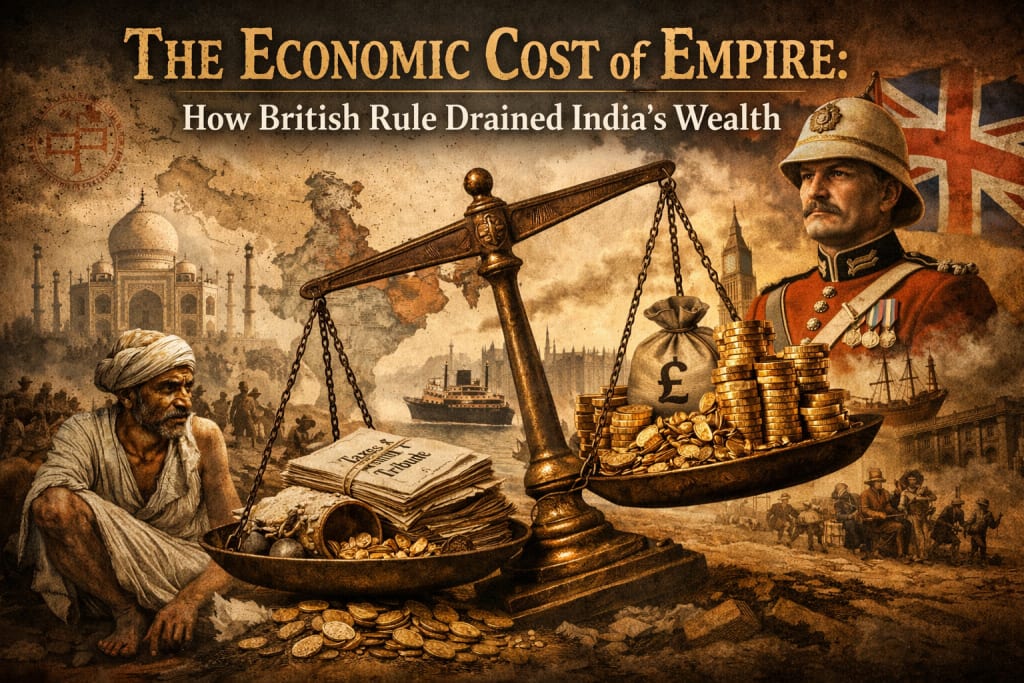
For nearly two centuries, the Indian subcontinent remained under British colonial rule. From the mid-18th century until 1947, British policies reshaped India’s political, social, and economic systems. While the British administration introduced railways, legal systems, and modern institutions, historians and economists widely argue that colonial rule resulted in a massive transfer of wealth from India to Britain. This economic extraction has often been described as the “drain of wealth,” a concept that attempts to estimate how much financial loss India experienced during colonial rule.
One of the most influential modern studies on this subject was conducted by economic historian Utsa Patnaik, who estimated that between 1765 and 1938 Britain extracted approximately $45 trillion (in today’s value) from India. Her calculation is based on trade records, taxation policies, and financial transfers that benefited the British Empire while impoverishing local economies. This figure has sparked global debate but highlights the immense scale of economic exploitation that occurred during colonial rule.
The “drain of wealth” theory was originally proposed in the 19th century by Indian nationalist thinker Dadabhai Naoroji. He argued that Britain systematically transferred India’s resources without fair compensation. According to Naoroji, taxes collected in India were often spent in Britain rather than reinvested locally. Salaries of British officials, military expenditures, and payments for imported British goods all contributed to this financial outflow. As a result, wealth generated in India rarely stayed within the country to support local development.
One of the key mechanisms of economic extraction was taxation. British colonial authorities imposed heavy land taxes on farmers, sometimes demanding up to half of agricultural produce as revenue. Many farmers were forced into debt, and during periods of crop failure they had little support from the colonial administration. These policies contributed to devastating famines during the 18th and 19th centuries, which killed millions of people. Critics argue that colonial economic priorities often focused more on revenue collection than on protecting the well-being of local populations.
Another major factor was trade policy. Before British dominance, India was one of the world’s leading manufacturing economies, particularly in textiles such as cotton and silk. Indian fabrics were highly valued in global markets. However, British industrialization changed this dynamic. Colonial policies encouraged the export of raw materials like cotton from India to Britain, where they were processed in British factories and then sold back to Indian consumers. At the same time, tariffs and restrictions weakened Indian manufacturing industries, leading to widespread deindustrialization.
Infrastructure development under British rule—such as railways, ports, and telegraph networks—was often presented as evidence of colonial investment in India. While these projects did contribute to modernization, historians note that they primarily served imperial interests. Railways helped transport raw materials from the interior to ports for export to Britain, and they facilitated the movement of British troops across the colony. Much of the financing for these projects came from Indian taxpayers, while British investors received guaranteed profits.
The economic consequences of colonial rule were significant. At the beginning of the 18th century, India accounted for roughly 23–25 percent of the world’s GDP, according to historical estimates by economist Angus Maddison. By the time of independence in 1947, India’s share of global GDP had fallen to around 3–4 percent. While many factors influenced this decline, scholars argue that colonial economic structures played a central role in weakening India’s industrial and financial capacity.
Beyond the immediate financial losses, the legacy of colonialism also affected long-term development. When India gained independence, it faced widespread poverty, limited industrial infrastructure, and an economy heavily dependent on agriculture. Rebuilding economic strength required decades of reform and investment. Many historians believe that the structural changes imposed during colonial rule slowed India’s economic growth for generations.
However, it is important to recognize that estimating the total economic loss from colonialism is complex. Different scholars use different methods and reach different conclusions. Some historians emphasize that certain administrative and infrastructural systems introduced during British rule later contributed to modern governance and economic integration. Nevertheless, the dominant view among many economists and historians is that the financial extraction from India was enormous and had lasting consequences.
In summary, British colonial rule significantly reshaped India’s economy and led to a large transfer of wealth to Britain. Whether measured in trillions of dollars or understood through the decline of local industries and rising poverty, the economic impact of colonialism remains a central topic in discussions about India’s historical development. Understanding this history provides insight into how colonial policies influenced global economic inequalities that still resonate today.
About the Creator
Irshad Abbasi
Ali ibn Abi Talib (RA) said 📚
“Knowledge is better than wealth, because knowledge protects you, while you have to protect wealth.
Keep reading
More stories from Irshad Abbasi and writers in History and other communities.
When the Portuguese Turned the Tide of Indian History
The arrival of the Portuguese in India at the end of the 15th century marked a turning point in the history of the Indian Ocean and the Indian subcontinent. What began as an ambitious maritime expedition soon transformed into a powerful political and economic presence that reshaped trade routes, introduced new cultural influences, and altered the balance of power in the region.
By Irshad Abbasi about 5 hours ago in History
The Handwriting is on the Wall origin
The handwriting on the wall Perhaps you or someone you know has used the phrase "The handwriting is on the wall," which indicates that something is coming to an end. This is often said about businesses before they go under.
By Cheryl E Preston3 days ago in History
My First Time Skiing and I Got Lost, Alone, in the French Alps
Looking back, I can trace some of my life’s biggest adventures to a simple action from my sister. She’d introduced me to Tommy (a very long time ago), a colleague of hers, who had overshared his penchant for Italian-looking women, and I ticked that box.
By Chantal Christie Weissabout an hour ago in Humans




Comments
There are no comments for this story
Be the first to respond and start the conversation.