
The Enigmatic Death of Jane Austen
Two centuries after her passing, the true cause of the beloved novelist’s death remains a subject of debate, intrigue, and speculation

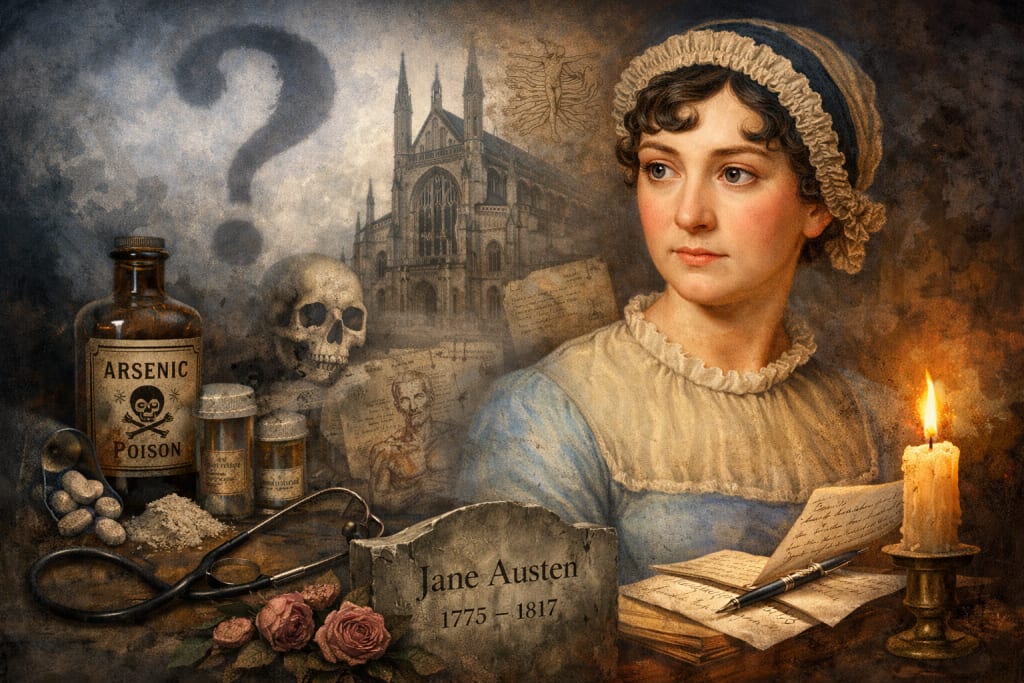
The death of Jane Austen, one of the most cherished authors in English literature, continues to puzzle historians and medical experts more than two hundred years later. Best known for her timeless works such as Pride and Prejudice and Sense and Sensibility, Austen left behind not only a literary legacy but also a lingering mystery surrounding her untimely death at the age of 41.
In early 1816, Austen began experiencing a decline in her health. Letters written to her family and friends provide valuable, though incomplete, insights into her symptoms. She described feelings of unusual fatigue, weakness, and recurring bouts of illness. At times, she mentioned pain in her back, irregular skin discoloration, and a general sense of discomfort that seemed to worsen over the months. Despite these troubling signs, Austen maintained her wit and continued writing, even as her strength faded.
By 1817, her condition had deteriorated significantly. Hoping for better medical care, she moved to the city of Winchester, where she sought treatment from local physicians. Unfortunately, the medical knowledge of the early 19th century was limited, and doctors could offer little more than speculation and rudimentary care. Austen died on July 18, 1817, leaving her family—and the world—without a clear explanation for her illness.
Over the years, several theories have emerged regarding the cause of Austen’s death. One of the most widely accepted hypotheses is Addison’s disease, a rare disorder involving the adrenal glands. This theory gained traction because some of Austen’s recorded symptoms, such as fatigue, skin discoloration, and digestive issues, align with what modern medicine recognizes as signs of the condition. However, critics argue that not all of her symptoms fit neatly into this diagnosis, leaving room for doubt.
Another possibility is Hodgkin’s lymphoma, a type of cancer that affects the lymphatic system. Some researchers believe that Austen’s progressive weakness and decline over time could be consistent with this illness. Yet again, the absence of precise medical records makes it impossible to confirm this theory with certainty.
In recent years, a more controversial idea has surfaced: arsenic poisoning. This theory was partly inspired by the discovery that Austen’s spectacles showed signs of arsenic exposure. Arsenic was sometimes used in medicines during her lifetime, and chronic exposure could lead to symptoms similar to those she described. While this explanation adds an element of intrigue, there is no conclusive evidence that Austen was intentionally poisoned or even that arsenic played a significant role in her death.
The lack of a definitive diagnosis is not surprising given the era in which Austen lived. Medical science in the early 1800s lacked the tools and knowledge necessary to accurately identify many diseases that are well understood today. Autopsies were not commonly performed, and detailed medical documentation was rare. As a result, much of what we know about Austen’s final days comes from personal correspondence rather than clinical observation.
Despite the uncertainty surrounding her death, Austen’s legacy has only grown stronger over time. Her novels continue to captivate readers with their sharp social commentary, memorable characters, and enduring themes of love and morality. Scholars and fans alike remain fascinated not only by her work but also by the mystery that surrounds her final years.
In many ways, the ambiguity of Austen’s death adds to her enduring allure. It serves as a reminder of the limitations of historical knowledge and the ways in which even the most well-documented lives can contain unanswered questions. The mystery invites each generation to revisit her story, not just as readers of her novels, but as investigators seeking to understand the life behind the literature.
More than two centuries later, the question remains unresolved: what truly caused Jane Austen’s death? While modern theories offer plausible explanations, none can be proven beyond doubt. Perhaps that uncertainty is fitting for a writer whose works often explored the complexities and uncertainties of human life.
In the end, Jane Austen’s story does not conclude with a clear answer, but rather with an enduring mystery—one that continues to inspire curiosity, debate, and admiration around the world.
About the Creator
Irshad Abbasi
Ali ibn Abi Talib (RA) said 📚
“Knowledge is better than wealth, because knowledge protects you, while you have to protect wealth.
Keep reading
More stories from Irshad Abbasi and writers in History and other communities.
The Master of Escape
Few names in history are as synonymous with magic and mystery as Harry Houdini. Known as the “King of Escape,” Houdini transformed stage illusion into a thrilling spectacle of danger, skill, and suspense. His life was as dramatic as his performances—and his death, which occurred on Halloween, only deepened the legend surrounding him.
By Irshad Abbasi about 13 hours ago in History
Musashi Miyamoto: The Samurai Who Fought His Last Duel in His Mind
1. The Undefeated Monster and the Zero Point Ask anyone around the world to name a famous Japanese samurai, and the first name to surface will almost certainly be Miyamoto Musashi. We know the core myth: the undefeated duelist who won sixty-one life-and-death encounters, the eccentric giant who carved his own wooden sword to defeat his greatest rival, Sasaki Kojiro.
By Takashi Nagaya6 days ago in History
Napoleon's Frozen Army
Napoleon Bonaparte invaded Russia in June 1812 with the largest army Europe had ever assembled, over 600,000 soldiers from across his empire, and six months later fewer than 100,000 staggered back across the border as broken remnants of the greatest military force in history, destroyed not primarily by Russian armies but by the Russian winter, starvation, disease, and the deliberate strategy of scorched earth that left the invaders with nothing to eat in a landscape stripped bare by the retreating Russians who burned their own cities and farms rather than allow Napoleon to use them.
By The Curious Writerabout 15 hours ago in History



Comments
There are no comments for this story
Be the first to respond and start the conversation.