
The Forgotten Voices of Whitechapel
Restoring the Lives Overshadowed by the Legend of Jack the Ripper

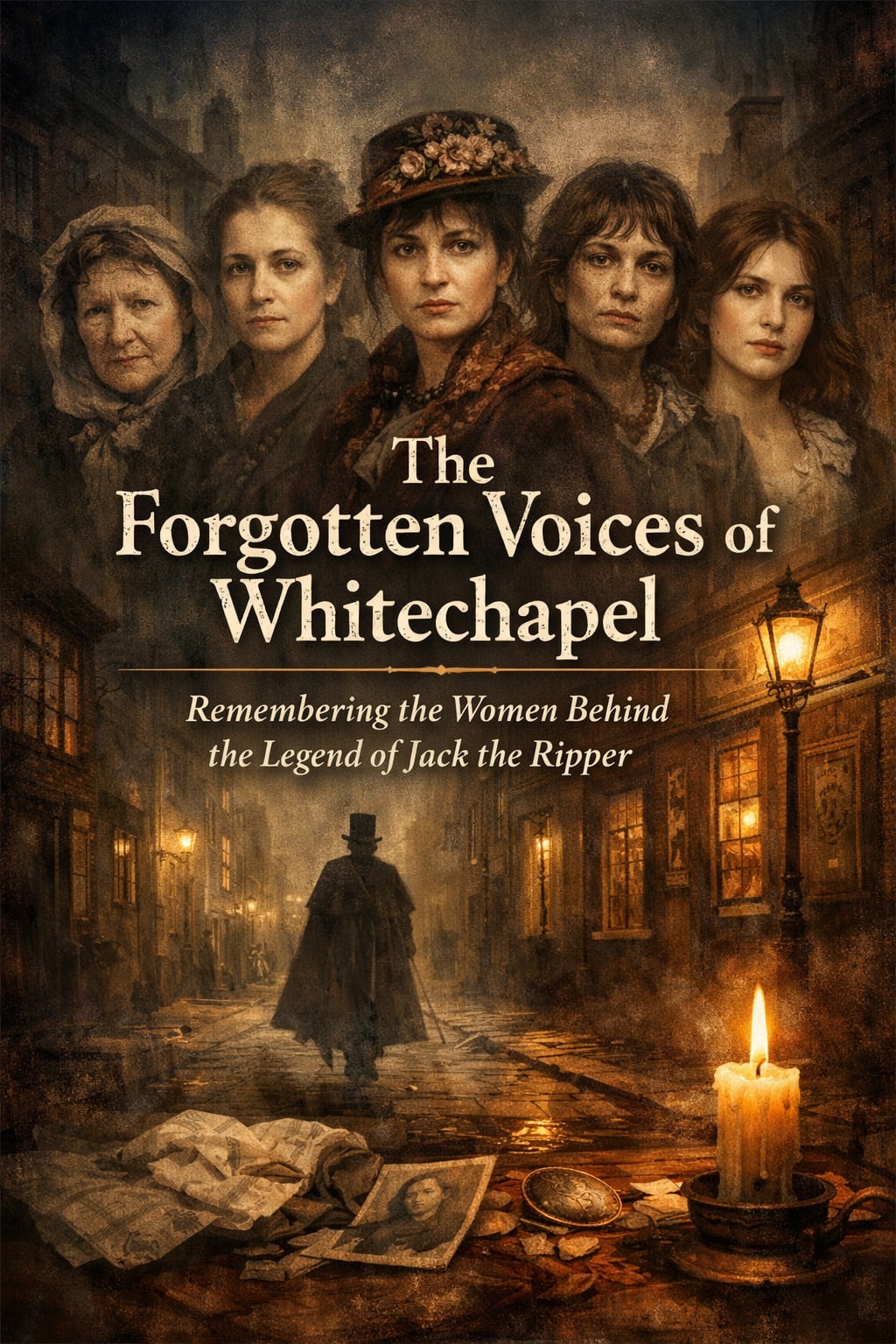
Everyone knows the name Jack the Ripper. It has echoed through history as a symbol of mystery, fear, and fascination. Books, films, and theories have kept the legend alive for generations. Yet, in the shadow of this infamous figure are the women whose lives were brutally cut short—women too often reduced to footnotes in a story that should have been theirs.
Mary Ann Nichols, Annie Chapman, Elizabeth Stride, Catherine Eddowes, and Mary Jane Kelly lived in the harsh realities of Victorian London. Their world was one of overcrowded streets, poverty, and limited opportunity. Many struggled to find steady work, faced unstable housing, and endured the daily challenges of survival. Some were mothers separated from their children, others battled illness or hardship, but all shared a common thread of resilience.
Too often, these women are remembered only for the way they died rather than how they lived. But before they became victims, they were individuals with identities, relationships, and stories worth telling. Mary Ann Nichols was known to friends as “Polly,” a woman who once worked as a domestic servant. Annie Chapman had a talent for crochet and maintained connections with family despite her struggles. Elizabeth Stride, originally from Sweden, spoke multiple languages and sought a better life in England. Catherine Eddowes was described as intelligent and lively, with a sharp sense of humor. Mary Jane Kelly, the youngest, was said to have a warm personality and dreams beyond her difficult circumstances.
Their lives were shaped by a society that offered few safety nets for vulnerable women. Economic hardship often forced them into precarious situations, where survival required difficult choices. The streets of Whitechapel were not just the backdrop of a crime—they were the setting of everyday life for thousands facing similar struggles. In understanding this context, we begin to see these women not as isolated victims, but as part of a broader social reality.
The enduring fascination with Jack the Ripper has often overshadowed this human perspective. The focus on the killer—his identity, motives, and methods—has turned real tragedy into a kind of dark mythology. This fixation risks stripping the victims of their dignity, reducing them to elements of a mystery rather than acknowledging their humanity. It is easier, perhaps, to focus on the unknown figure than to confront the harsh truths of poverty, inequality, and neglect that defined their lives.
Reclaiming their stories is not about diminishing the historical significance of the case, but about restoring balance. It is about shifting the narrative from one of sensationalism to one of remembrance. These women deserve to be seen as more than victims; they deserve to be remembered as people who lived, struggled, and mattered.
Today, there is a growing effort to tell their stories with empathy and respect. Historians and writers are working to piece together their lives, drawing from records, testimonies, and historical context. This renewed focus helps to humanize them, offering a fuller picture that goes beyond the headlines of the past. It reminds us that history is not only shaped by notorious figures, but also by the lives of ordinary people.
Remembering these women also invites reflection on issues that persist today. Poverty, inequality, and vulnerability continue to affect countless individuals around the world. By looking back at their lives, we are reminded of the importance of compassion, social support, and dignity for all.
In the end, the story of Jack the Ripper is not just a tale of mystery—it is a story of lives interrupted and voices silenced. By choosing to remember Mary Ann Nichols, Annie Chapman, Elizabeth Stride, Catherine Eddowes, and Mary Jane Kelly for who they were, we honor their humanity. We move beyond the shadow of the legend and bring light to the lives that truly matter.
Their voices may have been lost in time, but they need not be forgotten.
About the Creator
Irshad Abbasi
Ali ibn Abi Talib (RA) said 📚
“Knowledge is better than wealth, because knowledge protects you, while you have to protect wealth.
Keep reading
More stories from Irshad Abbasi and writers in History and other communities.
The Spiritualist Craze That Captivated the World a Century Ago
In the early decades of the 20th century, a strange and compelling belief swept across continents: the idea that the living could speak with the dead. Séances became social events, mediums rose to celebrity status, and ordinary people found themselves drawn into dimly lit rooms, hoping to hear whispers from the beyond. What began as a fringe curiosity evolved into a worldwide cultural phenomenon—one driven as much by emotion as by mystery.
By Irshad Abbasi about 12 hours ago in History
The Crusades
On July 15, 1099, after five weeks of siege, Christian Crusaders breached the walls of Jerusalem and embarked on a massacre so extreme that eyewitnesses reported riding horses through streets where blood reached the stirrups, slaughtering every Muslim and Jewish resident they could find regardless of age or gender, and one chronicler recorded that the killers then washed the blood from their hands and walked barefoot to the Church of the Holy Sepulchre to pray and give thanks to God for their victory, seeing no contradiction between worship and genocide.
By The Curious Writer2 days ago in History




Comments
There are no comments for this story
Be the first to respond and start the conversation.