
The Lost Glory of Muslim Spain
A brief yet brilliant chapter in history when Córdoba became one of the world’s greatest centers of knowledge, culture, and power

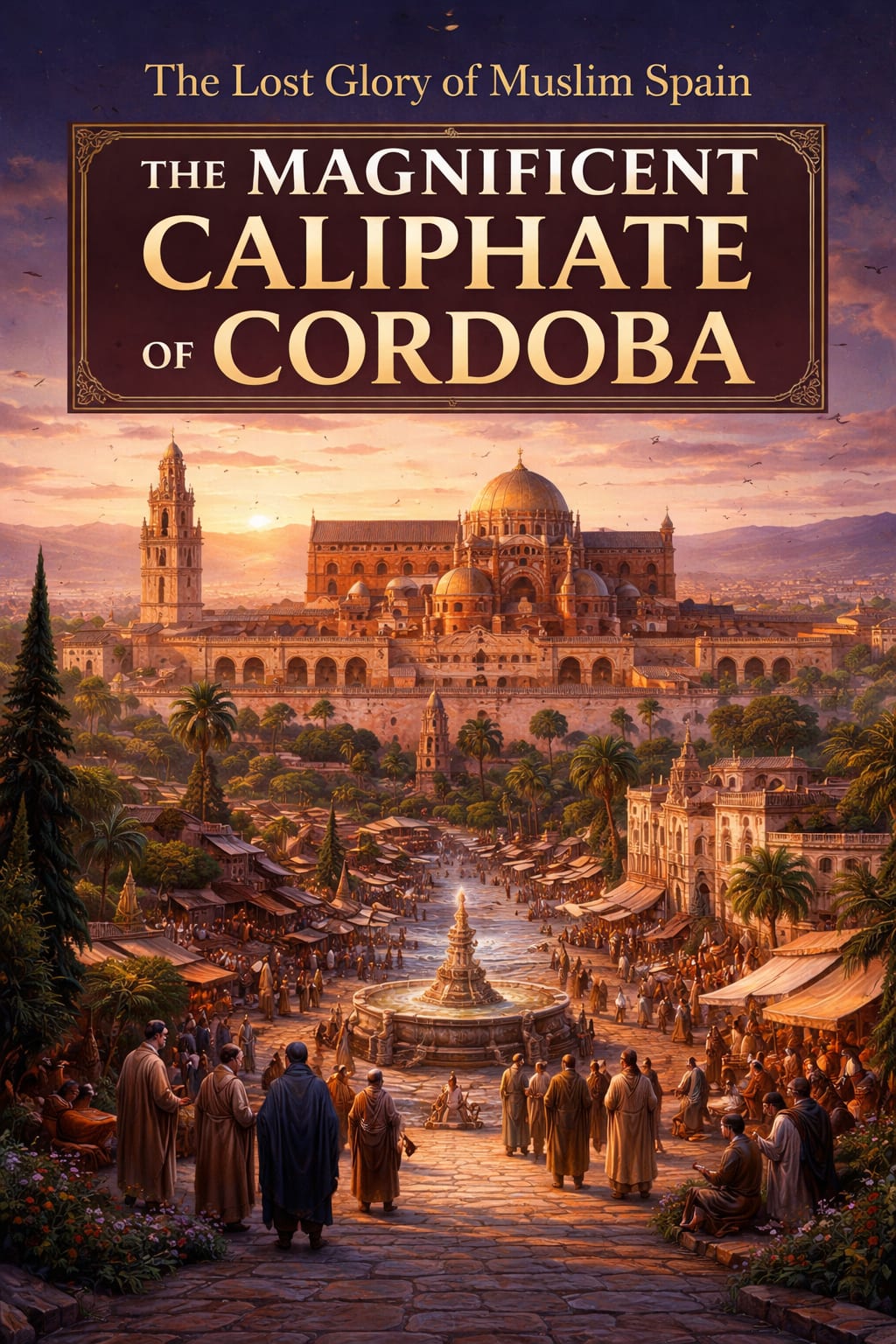
In the rich tapestry of Islamic history, few cities shine as brightly as Córdoba during the time of the Caliphate of Córdoba. Though the caliphate itself lasted for only about seventy years (929–1031 CE), its legacy left a lasting imprint on Europe and the Muslim world alike. It was a period marked by intellectual brilliance, architectural grandeur, and remarkable coexistence.
The foundation of this golden era was laid by Abd al-Rahman III, who declared himself Caliph in 929 CE. By doing so, he established the Umayyad Caliphate of Córdoba, separate from both the Abbasid Caliphate in Baghdad and the Fatimid Caliphate in North Africa. This bold move was not merely political—it symbolized the rise of Muslim Spain, or Al-Andalus, as a powerful and independent center of civilization.
Under Abd al-Rahman III and his successors, especially Al-Hakam II, Córdoba transformed into one of the most advanced cities in the world. At a time when much of Europe was emerging from the early medieval period, Córdoba boasted paved streets, street lighting, public baths, and an advanced water supply system. It is said that the city had hundreds of mosques, libraries, and schools, making it a hub of education and learning.
One of the most iconic landmarks of this era is the Great Mosque of Córdoba. With its striking red-and-white arches and vast prayer hall, it stood as a symbol of Islamic architectural excellence. The mosque was not only a place of worship but also a center for teaching and intellectual exchange.
Perhaps the most remarkable aspect of the Caliphate of Córdoba was its commitment to knowledge. Scholars from across the Muslim world and beyond traveled to the city to study subjects such as medicine, astronomy, philosophy, and mathematics. The caliphs actively supported the translation of Greek and Roman texts into Arabic, preserving ancient knowledge that might otherwise have been lost. This intellectual movement later played a crucial role in shaping the European Renaissance.
The libraries of Córdoba were legendary. Al-Hakam II is said to have owned a library containing hundreds of thousands of books—a staggering number for that time. In comparison, many European cities had only a few dozen manuscripts. Education was not limited to the elite; literacy rates in Córdoba were significantly higher than in other parts of Europe.
Another defining feature of this golden age was relative religious tolerance. Muslims, Christians, and Jews lived together in a system often referred to as convivencia. While not perfect, this coexistence allowed different cultures and religions to interact, exchange ideas, and contribute to a shared civilization. Jewish scholars, in particular, thrived during this period, making significant contributions to science and philosophy.
However, despite its achievements, the Caliphate of Córdoba was not destined to last. Internal divisions, political rivalries, and weakening central authority began to erode its stability. After the death of strong rulers, power struggles emerged among nobles and military leaders. By 1031 CE, the caliphate officially collapsed, fragmenting into smaller independent kingdoms known as Taifa states.
The fall of the caliphate marked the end of a unified Muslim rule in Spain, but its cultural and intellectual legacy endured. The knowledge preserved and developed in Córdoba would eventually spread to other parts of Europe, influencing fields such as medicine, science, and philosophy.
Today, the remnants of that glorious era still stand in Córdoba, reminding the world of a time when knowledge was celebrated, diversity was embraced, and civilization reached extraordinary heights. The story of the Caliphate of Córdoba is not just about a city or a dynasty—it is a testament to what humanity can achieve when learning, tolerance, and vision come together.
Though it lasted only seventy years as a caliphate, its impact continues to echo through history, making it one of the most remarkable chapters in the story of Muslim civilization.
About the Creator
Irshad Abbasi
Ali ibn Abi Talib (RA) said 📚
“Knowledge is better than wealth, because knowledge protects you, while you have to protect wealth.
Keep reading
More stories from Irshad Abbasi and writers in History and other communities.
Saudi Arabia’s Timeless Desert Treasure
Nestled in the northwestern region of Saudi Arabia, AlUla stands as one of the most fascinating and historically rich destinations in the world. This ancient town, surrounded by dramatic sandstone mountains and vast desert landscapes, offers a rare glimpse into civilizations that flourished thousands of years ago. Today, AlUla is not only a symbol of heritage but also a centerpiece of Saudi Arabia’s ambitious cultural and tourism transformation.
By Irshad Abbasi 8 days ago in History
The Crusades
On July 15, 1099, after five weeks of siege, Christian Crusaders breached the walls of Jerusalem and embarked on a massacre so extreme that eyewitnesses reported riding horses through streets where blood reached the stirrups, slaughtering every Muslim and Jewish resident they could find regardless of age or gender, and one chronicler recorded that the killers then washed the blood from their hands and walked barefoot to the Church of the Holy Sepulchre to pray and give thanks to God for their victory, seeing no contradiction between worship and genocide.
By The Curious Writera day ago in History
Side Quest Goal Achieved: Placing an Alien Claim
This is a post that has me quite ecstatic. It's funny, I thought it was going to be one of my usual, "Hey, I achieved another one of my goals and checked it off" type deals. And it sort of is. But it sort of isn't. And it's also one of my greatest writing accomplishments of late.
By Stephen Kramer Avitabile4 days ago in Writers



Comments
There are no comments for this story
Be the first to respond and start the conversation.