
The Mughal Princess Who Changed the Image of the Imperial Harem
Daughter of Babur and sister of Humayun, Gulbadan Begum transformed the perception of the Mughal harem through her intellect, scholarship, and historic writings.

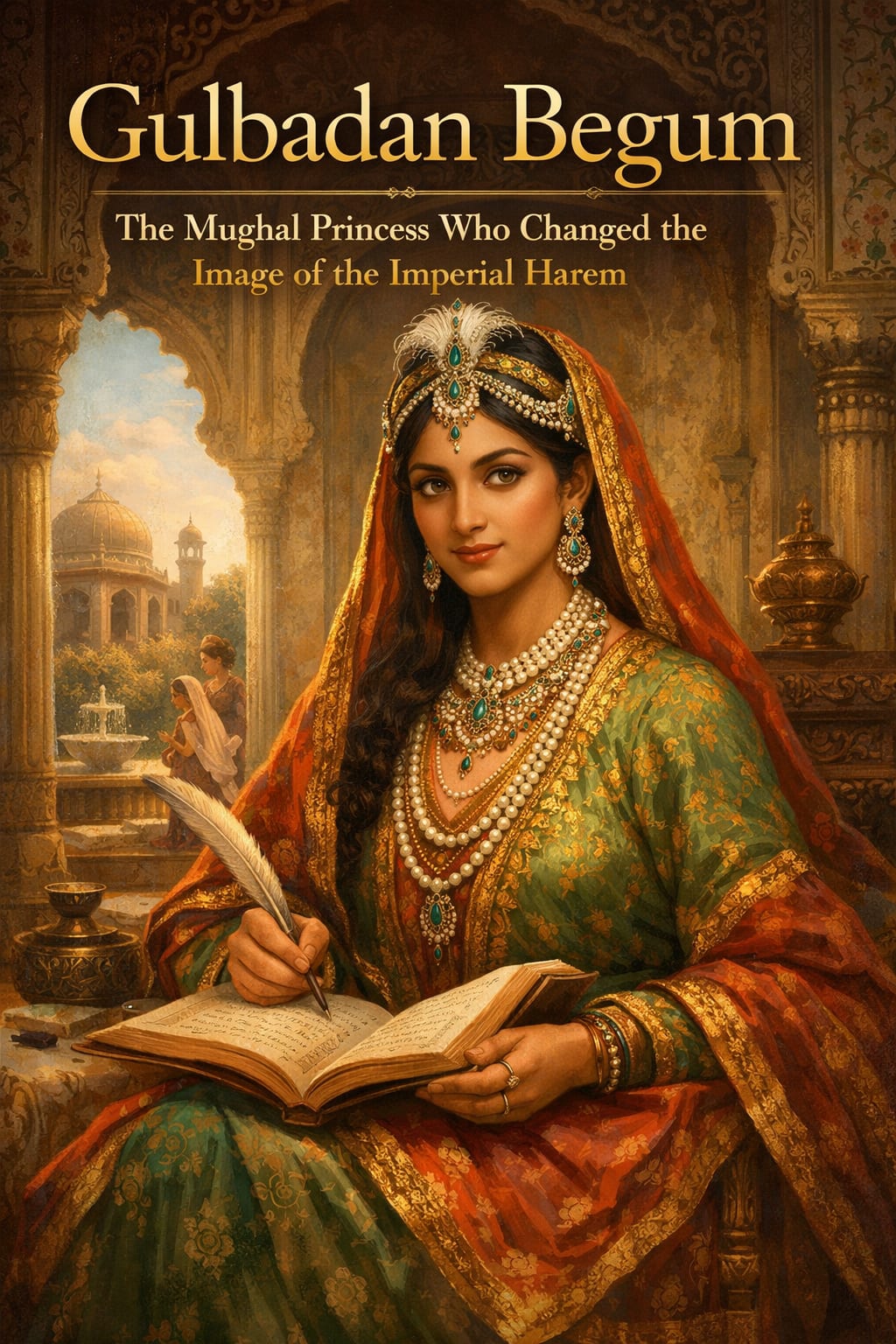
When people imagine royal harems in medieval empires, they often picture places of luxury, secrecy, and endless indulgence. The Mughal Empire is no exception. For centuries, the Mughal harem has been portrayed as a secluded world of wealth and pleasure where royal women lived hidden lives behind palace walls. However, one remarkable woman challenged this narrow view: Gulbadan Begum, a Mughal princess whose life and writings revealed a very different reality.
Gulbadan Begum was born in 1523 in Kabul to the first Mughal emperor, Babur, the founder of the Mughal Empire in India. She grew up during a time of dramatic political change. Babur had conquered large parts of northern India and established a powerful new dynasty. Yet his empire was still fragile, and the Mughal royal family frequently faced exile, conflict, and uncertainty.
As Babur’s daughter and the sister of Humayun, the second Mughal emperor, Gulbadan spent much of her early life traveling with the royal court. Unlike the peaceful and luxurious image often associated with royal women, her childhood was shaped by wars, political struggles, and migrations across Central Asia and the Indian subcontinent.
These experiences gave Gulbadan Begum a unique perspective on life inside the Mughal royal family.
After Babur’s death in 1530, Humayun ascended the throne, but his rule soon faced major challenges. Rival rulers and internal conflicts forced him into exile for several years. During these difficult times, Gulbadan Begum remained closely connected with her brother and the royal household, witnessing the hardships and resilience of the Mughal family.
Eventually, Humayun regained his throne in India in 1555, but his reign was short-lived. After his death in 1556, his son Akbar became emperor and went on to establish one of the most powerful and culturally vibrant periods in Mughal history.
It was during Akbar’s reign that Gulbadan Begum made her most significant contribution to history.
Akbar, who valued knowledge and historical record, encouraged members of the royal family to document the past. He asked Gulbadan Begum to write about the life of her father Babur and the early years of the Mughal dynasty. The result was a remarkable work known as the Humayun-nama, a historical memoir written in Persian.
This book is extraordinary for several reasons.
First, it is one of the very few historical works of the Mughal period written by a woman. Second, it provides a deeply personal and human account of the Mughal royal family. Instead of glorifying rulers with exaggerated praise, Gulbadan Begum described real events, family relationships, and everyday experiences.
Through her writing, readers gain insight into the emotions, struggles, and personalities of figures such as Babur and Humayun.
Her narrative also reveals that the Mughal harem was not simply a place of entertainment and luxury. It was an important center of political discussion, cultural activity, education, and family decision-making. Women in the royal household often played crucial roles in diplomacy, charity, and administration.
Gulbadan Begum herself was well educated and deeply respected in the imperial court. Her life showed that Mughal princesses could be scholars, travelers, and historians.
One of the most remarkable episodes of her life occurred later during Akbar’s reign when she joined a group of royal women on a pilgrimage to Mecca. The journey was long and dangerous, lasting several years. The caravan traveled by sea and land, demonstrating both the wealth and the determination of the Mughal royal household.
This pilgrimage further illustrates how active and influential royal women could be, contradicting the stereotype of isolation often associated with harems.
Gulbadan Begum eventually returned to India after completing the pilgrimage and spent her later years in the Mughal court under Akbar’s patronage. She died in 1603, leaving behind a legacy that continues to fascinate historians today.
Her Humayun-nama remains one of the most valuable sources for understanding the early Mughal Empire. Unlike official court histories written by male scholars, Gulbadan’s memoir offers a rare female perspective on imperial life.
Through her honesty and attention to detail, she preserved stories that might otherwise have been forgotten.
More importantly, Gulbadan Begum helped reshape the image of the Mughal harem. Instead of a silent world of luxury and confinement, her life reveals a dynamic environment where women could be educated, influential, and historically significant.
Today, historians regard Gulbadan Begum not only as a Mughal princess but also as one of South Asia’s earliest female historians.
Her voice, recorded nearly five centuries ago, continues to challenge misconceptions about royal women and reminds us that history is often far richer and more complex than the stereotypes that surround it.
About the Creator
Irshad Abbasi
Ali ibn Abi Talib (RA) said 📚
“Knowledge is better than wealth, because knowledge protects you, while you have to protect wealth.
Keep reading
More stories from Irshad Abbasi and writers in History and other communities.
The Forgotten Region of Greece That Maps Once Ignored
High in the rugged mountains of central Greece, there lies a mysterious and historically fascinating region known as Agrafa. For centuries, this isolated land lived up to the meaning of its own name. The word “Agrafa” in Greek literally means “unwritten” or “unrecorded.” The region earned this unusual title because it was so remote and difficult to control that even powerful empires often ignored it, and in some cases, mapmakers did not even bother to include it on their maps.
By Irshad Abbasi about 16 hours ago in History
The Year 1961 in Review: Fun Facts, Trivia, and Historic Highlights
This quick read is a collection of fun facts, trivia, and historic events from the year 1961. Discover the year’s top news stories, most influential people, sports facts, historic firsts, entertainment trivia, and much more.
By Gregory DeVictor2 days ago in History
TUS NUA - ch 53
TUS NUA – ch 53 New Beginnings – Mia and Midnight (*)(*)(*) Finola knew Ali’s brother-in-law needed to put his mind at rest. She fed her arm through his and led him outside. “We’ll sit here. If you like, I can put a block around us so our conversation will be private.”
By Margaret Brennan5 days ago in Fiction



Comments
There are no comments for this story
Be the first to respond and start the conversation.