
The Queen Who Defied a Crusade
The Rise, Power, and Tragic End of Shajar al-Durr

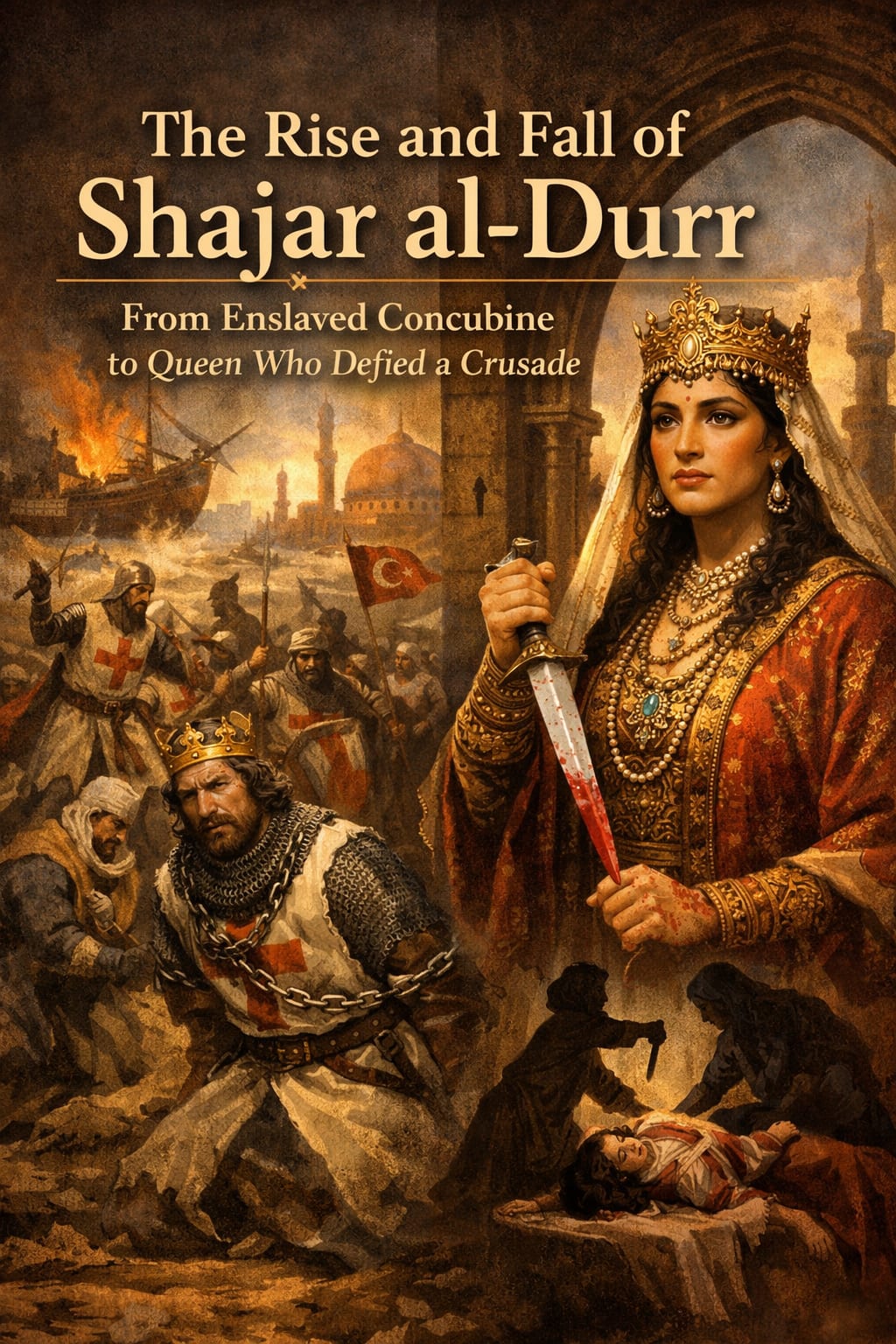
In the shifting political landscape of the 13th century, few figures stand out as boldly as Shajar al-Durr, a woman who rose from slavery to rule Egypt and confront one of the most formidable military campaigns of her time. Her story is not only one of ambition and intelligence but also of resilience, strategy, and ultimately, tragedy. From the shadows of servitude to the heights of political power, she carved a legacy that challenged both societal norms and invading armies.
Originally a slave of Turkic or possibly Armenian origin, Shajar al-Durr entered the royal court of Egypt as a concubine of Sultan As-Salih Ayyub. Over time, she gained his trust and became a key political confidante. Her influence grew steadily, and she proved herself not only as a companion but as a capable and perceptive strategist. When the Seventh Crusade, led by Louis IX, threatened Egypt, her role became even more critical.
The crisis deepened when Sultan As-Salih Ayyub died during the campaign. His death, if revealed, could have caused chaos and weakened Egypt’s defense at a crucial moment. Demonstrating remarkable composure and political acumen, Shajar al-Durr concealed his death and continued to issue orders in his name. This deception bought valuable time and maintained stability within the and administration. Her actions ensured that the Egyptian forces remained united against the advancing Crusaders.
Under her guidance and with the support of loyal commanders, Egyptian forces managed to halt the Crusader advance. The campaign reached a turning point at the Battle of Mansurah, where strategic planning and local resistance dealt a severe blow to the invaders. Eventually, King Louis IX himself was captured, a stunning outcome that sent shockwaves across Europe and the Crusader states. It was a moment of triumph that underscored Shajar al-Durr’s exceptional leadership in a time of crisis.
Following this victory, she took an unprecedented step: she declared herself ruler of Egypt. In a society dominated by male, her ascension was extraordinary. Coins were minted in her name, and the Friday sermon was delivered in her honor—clear signs of sovereign authority. However, her rule faced opposition from both internal factions and external, particularly the Abbasid Caliphate, which was reluctant to recognize a female sovereign.
To consolidate her position, Shajar al-Durr married Aybak, a powerful military leader. This alliance was intended to strengthen her legitimacy and maintain control. For a time, it succeeded, as the transition from Ayyubid to Mamluk rule took shape. Yet beneath the surface, tensions simmered. Power struggles, jealousy, and mistrust began to erode their partnership.
The relationship between Shajar al-Durr and Aybak eventually deteriorated. Fearing that Aybak might sideline or replace her, she took a drastic step. In a move that shocked the court, she orchestrated his assassination. However, this act sealed her fate. Aybak’s supporters, particularly within the Mamluk ranks, turned against her.
Soon after, Shajar al-Durr was captured and killed in a brutal and humiliating manner, reportedly beaten to death. Her marked the end of her brief but impactful reign. Despite her violent end, her legacy endured as one of the most remarkable and controversial figures in medieval Islamic history.
Shajar al-Durr’s life story is a powerful reminder of how individuals from the most unlikely backgrounds can shape the course of history. She not only confronted a Crusader army but also navigated the politics of a royal court, defying expectations at every turn. Her rise demonstrated intelligence, courage, and determination, while her fall revealed the of power in a deeply competitive and unstable world.
Today, she is remembered as a symbol of strength and brilliance—a woman who defied convention, altered the outcome of a major Crusade, and left behind a story that continues to captivate historians and readers alike.
About the Creator
Irshad Abbasi
Ali ibn Abi Talib (RA) said 📚
“Knowledge is better than wealth, because knowledge protects you, while you have to protect wealth.
Keep reading
More stories from Irshad Abbasi and writers in History and other communities.
The Courtesan Who Invited Nehru to Her Wedding and Earned the Respect of the Underworld
The story of Gangubai Kathiawadi is one that blurs the lines between myth and reality. Known widely as a powerful courtesan in Mumbai’s red-light district during the mid-20th century, Gangubai’s life was far from ordinary. Her journey from a vulnerable young girl to a woman of authority in a deeply stigmatized profession has fascinated historians, writers, and filmmakers alike. What makes her story even more compelling are the unusual relationships she maintained—with politicians, reformers, and even underworld figures.
By Irshad Abbasi 4 days ago in History
Satwa Dubai: A Brief Overview
Satwa Dubai is one of the most unique areas in the city, where the past and present exist side by side in a very natural and visible way. While Dubai is known for luxury buildings and modern development, Satwa represents a simpler and more grounded lifestyle that continues to thrive.
By Backlinks Cart4 days ago in History
Rousseau's Last Tour
This was a strange comfort to me these last few weeks. Actually, more than a few weeks. I began this book at the beginning of the year, and put it aside as I realized that I was reading not a fictional account of a life, but the very true thoughts of a writer who has put his fingerprints over much of what I know of French thought in that era.
By Kendall Defoe 5 days ago in BookClub


Comments
There are no comments for this story
Be the first to respond and start the conversation.