
The Siege I Couldn't Forget
"A Story From Medieval China That Shocked Me".

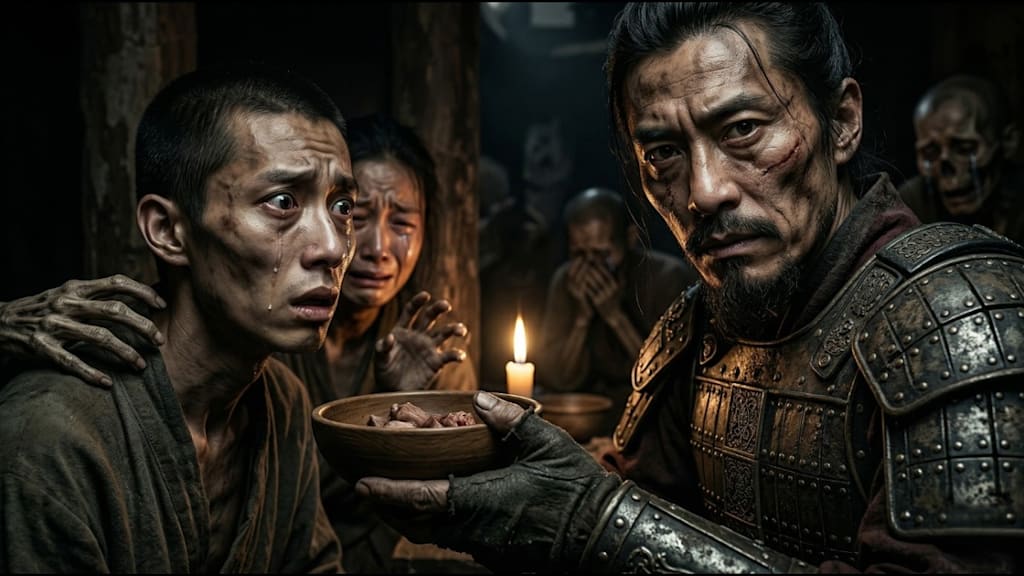
I remember reading about this event a few years ago in a book about medieval warfare. At first, I thought the author was exaggerating. Some things just sound too terrible to be real. But then I checked the sources, and they all pointed to the same conclusion. It really happened.
This is the story of the Siege of Suiyang, and it took place in China during the year 757.
At that time, the Tang Dynasty was facing a massive rebellion led by a general named An Lushan. He had declared himself emperor and gathered an army of more than one hundred fifty thousand soldiers. His forces had already captured the capital, and now they were marching south to take control of the entire country.
Standing in their way was a single city called Suiyang. It was not a very large city, but it sat on a crucial canal that carried grain from the rich farmlands of the south to the north. If Suiyang fell, the rebels would have a clear path to conquer everything. The dynasty would probably collapse.
The man in charge of defending the city was a general named Zhang Xun. He had only seven thousand soldiers. That means he was outnumbered almost twenty to one. Most commanders would have surrendered immediately. Zhang Xun decided to fight instead.
He turned out to be a brilliant strategist. At one point, his defenders ran out of arrows. So he ordered his men to shoot bundles of straw toward the enemy camp during the night. The rebels saw objects flying through the darkness and assumed they were being attacked. They shot thousands of real arrows back at the city. In the morning, Zhang Xun's soldiers collected every single arrow from the ground. They had restocked their supplies without firing a single shot.
Another time, Zhang Xun spotted the rebel commander on the battlefield. He called his best archer, and the archer shot the commander right in the eye. That attack threw the rebel army into chaos for weeks.
But clever tricks could not solve the biggest problem. The rebels had completely surrounded the city. No food could get in. As the weeks turned into months, hunger became the real enemy.
First, the people of Suiyang ate their horses. Then they ate their dogs and cats. Then they ate the rats. When there were no animals left, they ate tree bark, leaves, grass, and even paper. Soldiers began to die of starvation while standing on the city walls.
By the eighth month of the siege, there was almost nothing left. Zhang Xun had to make a decision that no one should ever have to make. If he surrendered, the rebels would march south and the Tang Dynasty would be finished. If he kept fighting, his people would starve to death.
According to the old historical records, he chose to keep fighting. And to keep his soldiers alive, he allowed something unthinkable.
He brought his own concubine to the dining hall. He killed her with his own hands. Then he had her body prepared as food for his starving troops. The soldiers wept. Many of them refused to eat. But Zhang Xun reportedly told them that he could not cut his own flesh to feed them, so he could not spare this woman while they were dying.
After that, there was no going back. The soldiers began to kill and eat the women of the city, then the elderly, then the children. Historical estimates say that between twenty thousand and thirty thousand people were consumed during the final months of the siege. Some sources put the number even higher.
In October of 757, after ten months of siege, only four hundred soldiers were still alive. The city finally fell. Zhang Xun was captured and executed. But his desperate stand had held the rebel army in place for ten months. That delay gave the imperial forces the time they needed to regroup. Just days after Suiyang fell, the emperor's army launched a counterattack. Within a year, the rebellion was completely crushed. Southern China was saved.
The cost, however, was staggering. Before the rebellion began, China had about fifty three million people. After it ended, only seventeen million remained. That means roughly two thirds of the entire population died from battle, starvation, and disease.
So where does that leave us with Zhang Xun? I have thought about this question a lot. Some people call him a hero. They say he sacrificed everything, including his own humanity, to save his country. Others call him a monster. They argue that no military victory is worth the horror that happened inside those walls.
I do not have an easy answer. I am not sure there is one. War forces people into corners where every choice is terrible. Sometimes survival comes at a price that can never be measured in numbers alone.
What do you think? Would you have done the same thing?
About the Creator
Ahmed Abdeen
An experienced article publisher and writer specializing in creating high-quality, engaging, and well-researched content tailored to captivate diverse audiences. Adept at crafting compelling narratives
Keep reading
More stories from Ahmed Abdeen and writers in History and other communities.
He shouldn’t have touched it… but he did
Mark and Elena were celebrating Mark’s forty-fifth birthday. Elena insisted they dine at a small traditional restaurant in the quiet coastal town of Riverview Heights. They spent the evening laughing, dancing, and enjoying the warm atmosphere, a night that seemed perfect… almost too perfect.
By Ahmed Abdeen2 months ago in Criminal
Pakistan: Land of Beauty and Culture
Pakistan is a remarkable country located in South Asia, known for its stunning natural beauty, rich history, and diverse culture. It is a land where ancient traditions blend with modern life, creating a unique identity that attracts people from all over the world. From majestic mountains to historic landmarks, Pakistan offers countless wonders that make it truly special.
By aadam khanabout 19 hours ago in History
Pre-Hispanic skeletons, jewellery, and gold were found in an ancient tomb in Panama.
In Panama, an elite cemetery that is over a millennium old has surfaced, filled with numerous human remains, exquisite ceramics, and gold decorations. The burial transforms a portion of central Panama into an important document detailing the functioning of status, trade, and belief prior to Spanish authority.
By Francis Damia day ago in History
Swan
“During the Metal Age, humans took photographs of everything beautiful, which was everything, yet machines did not even wear shoes. The Fauxna thought of a better way. They colored all of the light rose, for a corrupted source cannot be verified.” - Origin Parable, 011
By Nicky Frankly6 days ago in Fiction



Comments
There are no comments for this story
Be the first to respond and start the conversation.