
The World’s Most Resilient Nation Within a Nation
How an Isolated Enclave Survived Conflict, Geography, and Time to Build an Identity of Endurance

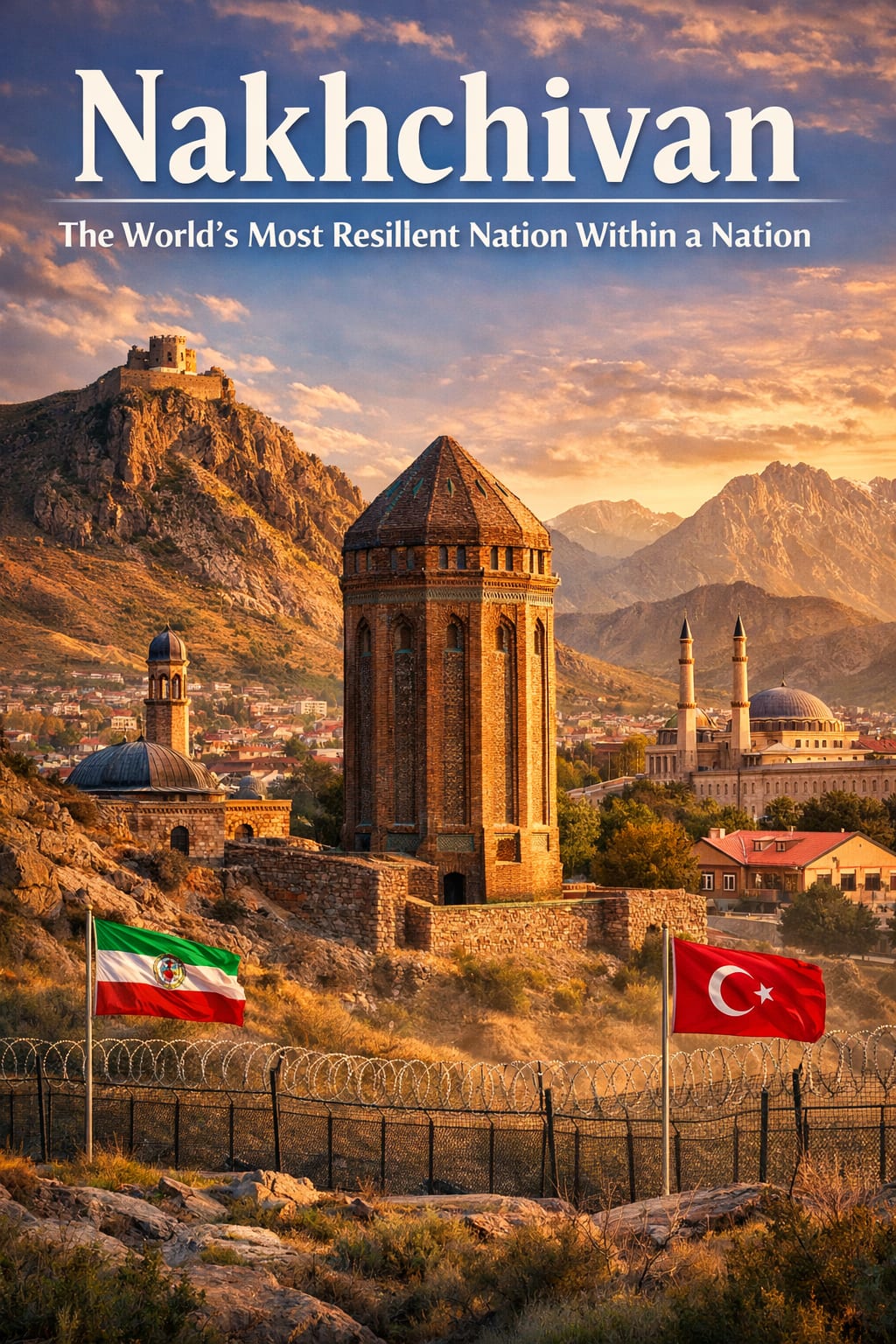
Tucked away between rugged mountains and political fault lines lies Nakhchivan, a small but remarkably resilient exclave of Azerbaijan. Often described as one of the most isolated regions in the world, Nakhchivan is separated from mainland Azerbaijan by Armenian territory, making it geographically detached yet deeply connected to its national identity. Over the decades, this landlocked enclave has earned a reputation for extraordinary endurance—politically, economically, and culturally.
Nakhchivan’s history is marked by turbulence. Located at a strategic crossroads between empires, it has witnessed the rise and fall of numerous civilizations. From ancient Persian rule to its incorporation into the Russian Empire and later the Soviet Union, Nakhchivan has constantly adapted to shifting political landscapes. Its modern status as an autonomous republic was shaped during the early 20th century, particularly after the complex territorial arrangements following the collapse of imperial powers.
The region’s resilience was tested most severely during the conflict between Azerbaijan and Armenia, especially during the Nagorno-Karabakh conflict. As tensions escalated, Nakhchivan found itself under blockade, cut off from direct land access to Azerbaijan. Essential supplies, trade routes, and energy connections were disrupted, placing immense pressure on the local population. Yet, instead of collapsing, Nakhchivan adapted.
One of the most remarkable aspects of Nakhchivan’s survival story is its ability to achieve a degree of self-sufficiency. Faced with limited access to external resources, the region invested in local agriculture, small-scale industry, and alternative energy solutions. Farmers maximized the use of arable land despite harsh climatic conditions, while local authorities prioritized infrastructure that could sustain life under isolation. Over time, these efforts transformed adversity into a catalyst for innovation.
Leadership also played a crucial role in shaping Nakhchivan’s path. The region is closely associated with Heydar Aliyev, who began his political resurgence here in the early 1990s. His governance laid the groundwork for stability and development, emphasizing strong institutions and regional autonomy within the Azerbaijani state. Under his influence, Nakhchivan became a model of order during a period when much of the surrounding region was engulfed in uncertainty.
Culturally, Nakhchivan is equally enduring. Its heritage stretches back thousands of years, with historical sites, ancient mausoleums, and traditional crafts reflecting a deep-rooted identity. Despite isolation, the people of Nakhchivan have preserved their customs, language, and traditions with remarkable consistency. This cultural continuity has reinforced a sense of unity and pride, further strengthening their resilience.
Another factor contributing to Nakhchivan’s durability is its strategic diplomacy. Although physically cut off from mainland Azerbaijan, it shares borders with Iran and Turkey, allowing it to maintain limited but vital international connections. Agreements with these neighboring countries have enabled trade, energy exchange, and transit routes, helping to mitigate the effects of blockade and isolation.
Infrastructure development has also been central to Nakhchivan’s survival strategy. Roads, airports, and energy networks have been carefully developed to ensure internal connectivity and external access where possible. Investments in education and healthcare have improved quality of life, demonstrating that even under constraints, progress is achievable with strategic planning.
Today, Nakhchivan stands as a testament to human resilience. While it may not be a “nation” in the traditional sense, its people exhibit a national spirit forged through hardship and perseverance. Their story challenges conventional notions of statehood, proving that identity and endurance can thrive even in the most challenging circumstances.
In a world increasingly shaped by globalization and interdependence, Nakhchivan offers a powerful reminder: resilience is not merely about survival, but about adaptation, innovation, and the ability to maintain one’s identity against all odds. Its journey—from isolation to stability—serves as an inspiring example of how communities can overcome even the most daunting challenges.
Ultimately, Nakhchivan is more than just a geopolitical anomaly; it is a symbol of endurance. Its story continues to unfold, shaped by the determination of its people and the lessons of its past—lessons that resonate far beyond its mountainous borders.
About the Creator
Irshad Abbasi
Ali ibn Abi Talib (RA) said 📚
“Knowledge is better than wealth, because knowledge protects you, while you have to protect wealth.
Keep reading
More stories from Irshad Abbasi and writers in History and other communities.
The Lifeline of North Africa and a Celebration Under Egypt’s First Sultan
The story of the Nile River is inseparable from the history of Egypt. Flowing through deserts and civilizations alike, the Nile has long been regarded as the lifeline of North Africa—a source of agriculture, trade, and survival. For centuries, its annual flooding determined not only the prosperity of the land but also the rhythm of life itself. During the reign of Saladin, the first Sultan of Egypt under the Ayyubid dynasty, this natural phenomenon was elevated into a deeply symbolic and celebrated event.
By Irshad Abbasi 7 days ago in History
The Crusades
On July 15, 1099, after five weeks of siege, Christian Crusaders breached the walls of Jerusalem and embarked on a massacre so extreme that eyewitnesses reported riding horses through streets where blood reached the stirrups, slaughtering every Muslim and Jewish resident they could find regardless of age or gender, and one chronicler recorded that the killers then washed the blood from their hands and walked barefoot to the Church of the Holy Sepulchre to pray and give thanks to God for their victory, seeing no contradiction between worship and genocide.
By The Curious Writerabout 11 hours ago in History



Comments
There are no comments for this story
Be the first to respond and start the conversation.