
The Year 1906 in Review: Fun Facts, Trivia, and Historic Highlights
This quick read is a collection of fun facts, trivia, and historic events from the year 1906.
This quick read is a collection of fun facts, trivia, and historic events from the year 1906. Learn about the year’s top news stories, most influential people, famous birthdays, sports trivia, noteworthy inventions, and much more.
- In 1906, Theodore Roosevelt was the 26th president of the United States, and Charles W. Fairbanks was the nation’s vice president.
- The U.S. unemployment rate was 5.9%, and the nation’s inflation rate was 2.27%.
- American companies and brands launched in 1906 included American Greetings, Coldwell Banker, New Balance Athletics, Rolls-Royce Holdings, and the Xerox Corporation.
- In 1906, canned foods were a primary food source for many Americans because most homes didn't have refrigeration. Popular canned foods included corn, green beans, peaches, peas, pears, pork and beans, soups, tomatoes, and tuna. Home canning was also quite popular at the time.
- In February, the first cell house at USP Leavenworth opened in northeast Kansas. Since opening its doors, Leavenworth has been home to some of the most notorious federal prisoners in history. Some of the criminals who have been incarcerated there include gangster Al Capone, serial killer Carl Panzram, labor leader Bill Haywood, polar explorer Dr. Frederick Cook, George “Machine Gun” Kelly, boxing champion Jack Johnson, gambler Nicky Arnstein, and Robert Stroud (aka the Birdman of Alcatraz).
- On February 26, Upton Sinclair's ever-popular novel, The Jungle, was published. It provided “a fictionalized account of the horrific conditions at Chicago’s ‘Packingtown,’ the center of the U.S. meatpacking industry at the turn of the 20th century.”
- In March, a "Census of the British Empire" revealed that Great Britain ruled approximately one-fifth of the world. In 1906, British Empire countries included the Bahamas, Bangladesh, Bermuda, Burma, Ceylon, Cyprus, Hong Kong, Pakistan, the Solomon Islands, and South Africa.
- In March, Finland became the first European country to give women the right to vote.
- In April, the world’s first animated film, Humorous Phases of Funny Faces, was released. The movie runs for three minutes and features “a cartoonist drawing faces on a chalkboard, and the faces coming to life.”
- On April 5, Mount Vesuvius in Italy erupted, devastating Naples and ejecting the “most lava ever recorded” from a Vesuvian eruption.
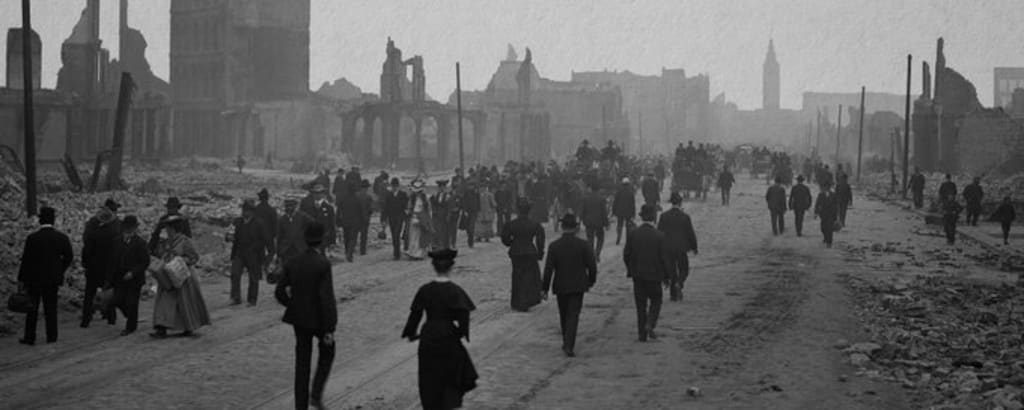
- On April 18, the San Francisco earthquake and fire killed an estimated 4,000 people and destroyed 75% of the city. The fire destroyed numerous buildings in San Francisco’s Financial District, Union Square, Chinatown, Nob Hill, North Beach, Russian Hill, SOMA, and Telegraph Hill neighborhoods.
- On May 22, the Wright Brothers were granted U.S. Patent 821,393 for their "flying machine."
- On June 30, President Roosevelt signed the Pure Food and Drug Act into law. The legislation “prohibited the sale of misbranded or adulterated food and drugs in interstate commerce and laid a foundation for the nation’s first consumer protection agency, the Food and Drug Administration (FDA).”
- On June 30, President Roosevelt also signed the Meat Inspection Act into law. The legislation “prohibited the sale of adulterated or misbranded livestock and derived products as food and ensured that livestock were slaughtered and processed under sanitary conditions.”
- On July 11, the murder of 20-year-old Grace Brown, a factory worker from Big Moose Lake, New York, attracted national newspaper attention. (Brown's life later inspired various fictional works, including Theodore Dreiser's 1925 novel, An American Tragedy.)
- On July 14, U.S. Steel established the Gary Works, the largest steel mill complex in North America, in Gary, Indiana.
- On September 24, the Devil's Tower in Crook County, Wyoming, became the first national monument.
- In November, President Roosevelt visited the Panama Canal Zone “to witness the progress” on the construction of the 50-mile Panama Canal. It was the first time a U.S. president had traveled outside the country while in office.
- On November 3, the International Radiotelegraph Conference in Berlin selected the "SOS" distress signal as “the worldwide standard for help.”
- On December 10, President Roosevelt received the Nobel Peace Prize “for his role in ending the Russo-Japanese War.”
- In 1906, Benjamin Holt invented the famous “caterpillar” tractor.
- German inventor Karl Nessler created the first “permanent wave” for hair in London.
- Willis Carrier, an American engineer, received a patent for the world's first air conditioner.
- The Victor Talking Machine Company in Camden, New Jersey, started manufacturing the Victrola, “the first in-home record player.”
- Famous and infamous people born in 1906 included Adolf Eichmann (one of the major organizers of the Holocaust), Albert Sabin (medical researcher), Aristotle Onassis (business magnate), Bugsy Siegel (mobster), and Hans Asperger (physician).
- Famous people who passed away in 1906 were William "Buck" Ewing (catcher for the New York Giants and a member of the Baseball Hall of Fame), Henrik Johan Ibsen (playwright), John Knowles (composer), Marshall Field (entrepreneur), and Pierre Curie (physicist).
- In 1906, Tim Ford won the Boston Marathon, the Chicago White Sox won the World Series, and Sir Huon was the winning horse at the Kentucky Derby.
References:
- https://www.merriam-webster.com/time-traveler/1906
- https://www.alphadictionary.com/slang/?term=&beginEra=1900&endEra=1902&clean=true&submitsend=Search
- https://www.foodreference.com/html/html/food-timeline-1906.html
- https://www.thefamouspeople.com/born-1906.php
- https://earthquake.usgs.gov/earthquakes/events/1906calif/18april/
- https://www.infoplease.com/us/population/us-population-state-1790-2015
- https://www.onthisday.com/events/date/1906
- https://www.infoplease.com/year/1906
- https://www.mclib.info/Research/Local-History-Genealogy/Historic-Prices/Historic-Prices-1900s/Historic-Prices-1906
Disclaimer: In writing and editing this article, Gregory DeVictor has made every effort to ensure historical accuracy and not to mislead his audience. In addition, the contents of this article, including text, graphics, and captions, are for general informational purposes only.
© 2026 Gregory DeVictor
About the Creator
Gregory DeVictor
Gregory DeVictor is a trivia buff who writes articles about American history and nostalgia. He focuses on historic firsts, pop culture snapshots, and sports milestones and has written over 250 articles that are categorized by calendar year.
Keep reading
More stories from Gregory DeVictor and writers in History and other communities.
The Year 1821 in Review: Fun Facts, Trivia, and Historic Highlights
This quick read is a collection of fun facts, trivia, and historic events from the year 1821. Discover the year’s top news stories, most influential people, famous birthdays and deaths, popular baby names, retail prices, and much more.
By Gregory DeVictor4 days ago in History
The Handwriting is on the Wall origin
The handwriting on the wall Perhaps you or someone you know has used the phrase "The handwriting is on the wall," which indicates that something is coming to an end. This is often said about businesses before they go under.
By Cheryl E Preston3 days ago in History


Comments
There are no comments for this story
Be the first to respond and start the conversation.