
Why Egypt’s First Pharaohs Revered the Humble Catfish
From royal tables to divine symbolism, catfish played a surprising role in shaping early Egyptian culture and belief

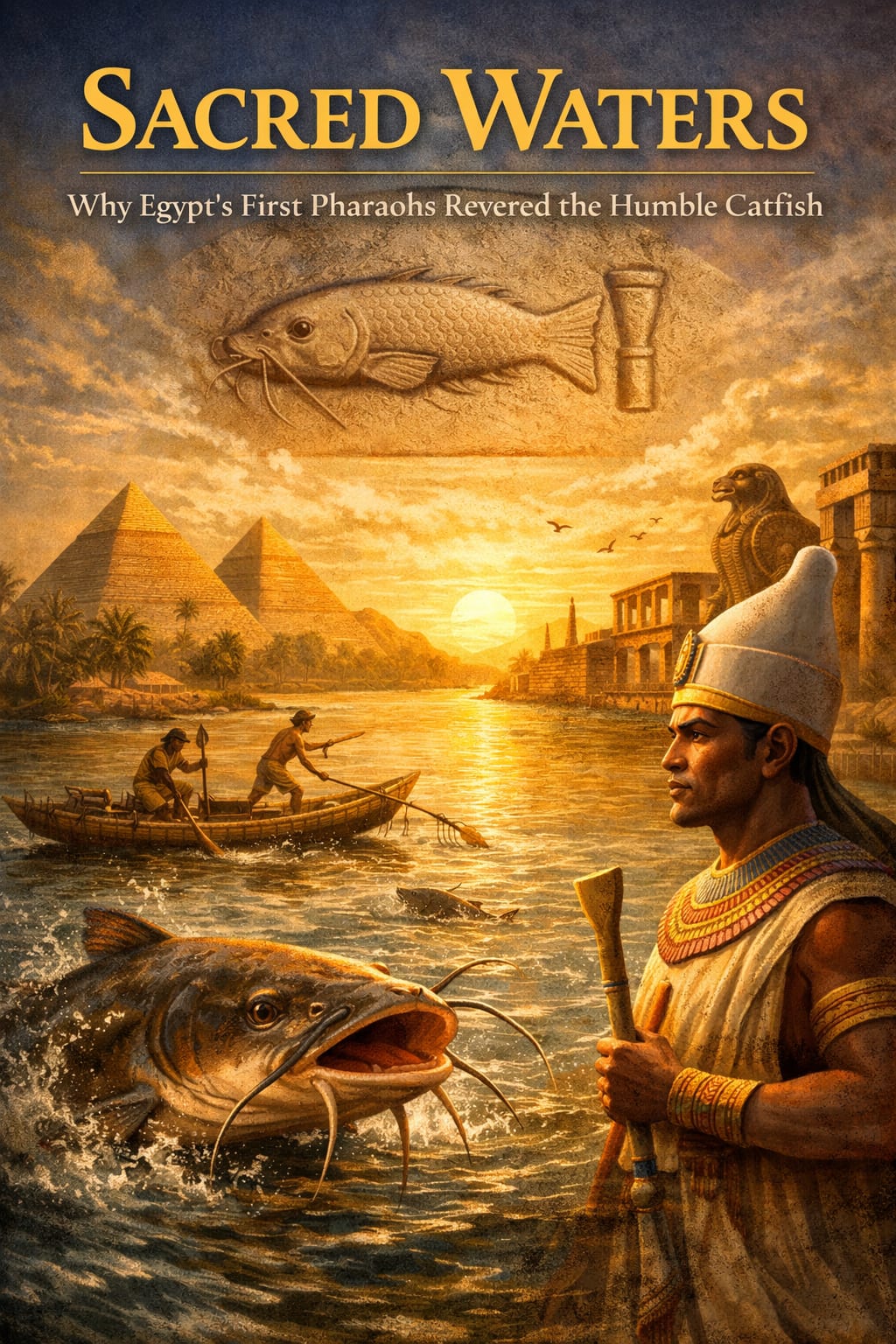
Long before pyramids pierced the desert skyline and monumental temples defined the banks of the Nile, ancient Egypt’s earliest rulers were forming a culture deeply rooted in nature. Among the many creatures that thrived in the life-giving waters of the Nile River, one stood out in both practical and spiritual life: the catfish. To modern readers, the idea of powerful pharaohs revering such a modest creature might seem unusual. Yet for Egypt’s first rulers, the catfish was far more than a source of food—it was a symbol of power, survival, and divine connection.
The Nile River was the lifeblood of ancient Egypt, dictating agricultural cycles, trade, and daily survival. Its annual floods deposited fertile silt along the riverbanks, enabling early Egyptians to cultivate crops in an otherwise arid landscape. Within these waters lived a rich variety of fish, but catfish were particularly abundant. Their resilience—especially their ability to survive in low-oxygen environments and even wriggle across short stretches of land—made them a natural symbol of endurance and adaptability.
For early pharaohs, who were seen not only as political leaders but also as divine figures, such traits held deep meaning. The catfish’s tenacity mirrored the qualities a ruler needed to maintain control over a developing civilization. As a result, the fish became associated with strength and authority. This connection is reflected in early royal iconography, where the catfish appears as a symbol linked to kingship.
One of the clearest examples comes from the name of Egypt’s first known pharaoh, often identified as Narmer. In ancient Egyptian writing, his name is represented by two symbols: a catfish and a chisel. This pairing was not arbitrary. The catfish symbol likely conveyed power and dominance, reinforcing Narmer’s role as a unifier and strong leader. Such imagery demonstrates how deeply embedded the fish was in the language of rulership.
Beyond symbolism, catfish also held an important place in daily life. They were a reliable food source, rich in protein and relatively easy to catch. Early Egyptians used simple fishing techniques—nets, traps, and spears—to harvest them from the Nile. For a growing population, this made catfish an essential part of the diet, especially for communities living close to the river.
But the relationship between humans and catfish extended beyond practicality. Over time, spiritual beliefs began to form around the natural world, and animals often took on divine associations. In the case of catfish, their mysterious behavior and connection to the Nile’s life-giving waters likely contributed to their sacred status. Some ancient communities believed that certain fish possessed protective qualities or were linked to fertility and rebirth—concepts central to Egyptian religion.
This spiritual reverence is evident in early artifacts and carvings, where fish motifs appear alongside other sacred imagery. While later Egyptian religion became more structured, with well-defined gods and elaborate temples, these early beliefs reveal a more intimate and direct connection between people and nature. The catfish, thriving in the unpredictable waters of the Nile, embodied the balance between chaos and stability—a theme that would later become central to Egyptian cosmology.
Interestingly, the dual role of the catfish—as both a food source and a sacred symbol—reflects a broader pattern in ancient cultures. Rather than separating the sacred from the everyday, early Egyptians integrated the two seamlessly. Consuming catfish did not diminish its spiritual significance; instead, it reinforced the idea that divine forces were present in all aspects of life.
As Egyptian civilization evolved, new symbols and deities emerged, and the prominence of the catfish gradually faded from the forefront of religious imagery. However, its early importance left a lasting imprint on the cultural and symbolic foundations of the society. The use of animal imagery in royal names, the association of natural traits with leadership qualities, and the blending of practical and spiritual life all persisted in later periods.
Today, the story of Egypt’s early pharaohs and their connection to catfish offers a fascinating glimpse into a world where nature and power were deeply intertwined. It challenges modern assumptions about what ancient people valued and revered, reminding us that even the most unassuming creatures can hold profound meaning.
In the end, the catfish was more than just a fish in ancient Egypt—it was a symbol of life itself. From the muddy waters of the Nile to the symbols of kingship, it swam at the heart of a civilization that would become one of the most remarkable in human history.
About the Creator
Irshad Abbasi
Ali ibn Abi Talib (RA) said 📚
“Knowledge is better than wealth, because knowledge protects you, while you have to protect wealth.
Keep reading
More stories from Irshad Abbasi and writers in History and other communities.
How One Young Pharaoh Changed Egypt Forever
History often turns on moments that seem, at first glance, like just another clash of armies. But every so often, a single battle—shaped by the ambition of one leader—reshapes the destiny of an entire civilization. Such was the case in ancient Egypt, when a young and determined pharaoh led his forces into a confrontation that would elevate his kingdom into one of the greatest powers of the ancient world.
By Irshad Abbasi about 19 hours ago in History
Church Anniversary and Founders Day: The purpose and focus is different
Founders Day or Church Anniversary? Jesus said in Matthew 16:18 that His church would be founded on the revelation of who Peter said He was, which was "the Christ, the Son of the Living God." In Christian churches, you will hear about Founder's Day and Church Anniversary.
By Cheryl E Preston6 days ago in History



Comments
There are no comments for this story
Be the first to respond and start the conversation.